
 Apple Podcasts

 Spotify

 Amazon Music
 RSS Feed
Music and Memory Care: How Your “Time of Life” Songs Support Cognitive and Emotional Health with Shannon Wallace, CDP, CDC
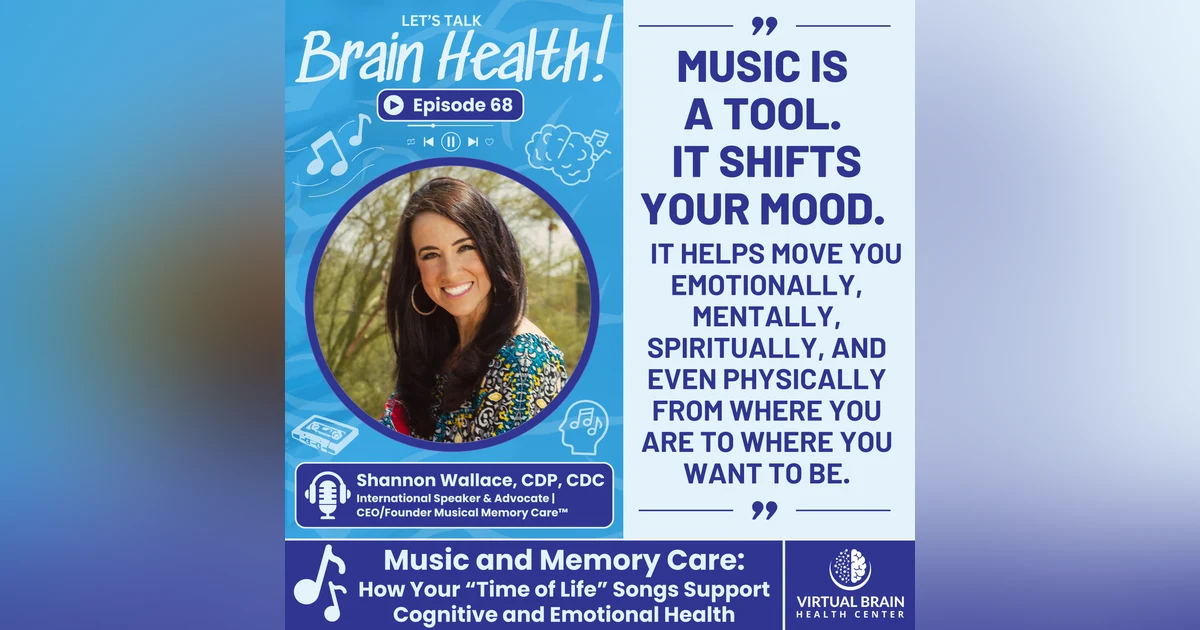
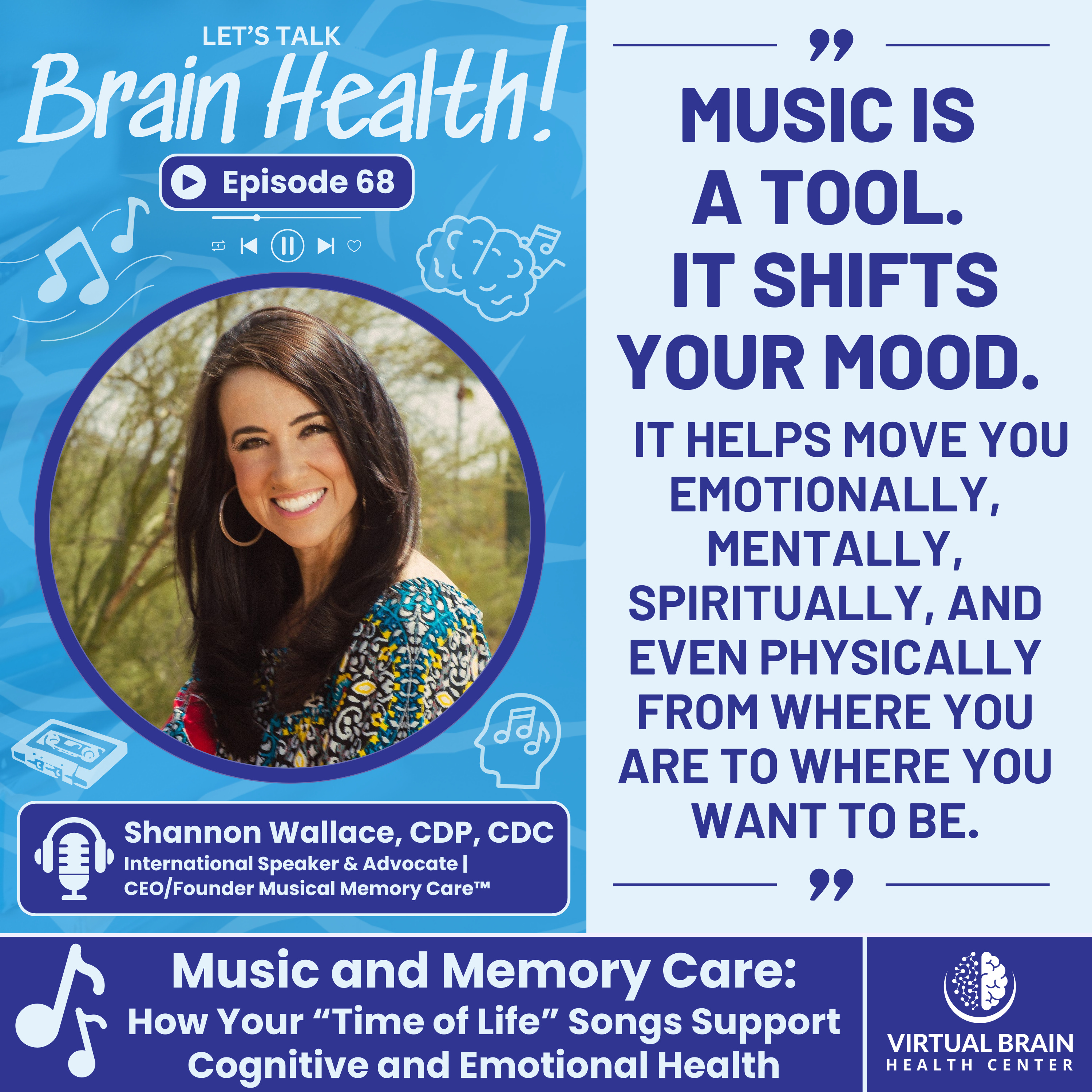
Music reaches your brain fast! It activates memory, movement, emotion, and connection in seconds.
In this episode, host Dr. Krystal L. Culler, DBH, MA, sat down with Shannon Wallace, CDP, CDC, creator of Musical Memory Care to explore how music functions as a whole-brain and body workout. We focus on one powerful idea—the “time of your life” effect.
Research shows the music you loved between roughly ages 13 and 27 leaves a lasting imprint. Those songs shape identity. They anchor memory. They often remain accessible even during cognitive change.
Shannon shares how she moved from professional jazz vocalist to serving older adults in memory care communities. What began as singing for residents evolved into an intentional, research-informed program that integrates rhythm, movement, emotional expression, and identity support.
We explore:
- Why time-of-life music remains accessible in dementia
- How music activates the limbic system and supports emotional regulation
- The role of rhythm in movement, including Parkinson’s support
- Why intentional facilitation matters in memory care settings
- How music supports dignity, identity, and human connection
- Practical ways you can use music today for brain health
You will hear real-world stories from Shannon’s work in memory care. Stories of individuals who had not spoken in years yet responded to music. Stories of rhythm supporting walking and daily tasks. Stories that reinforce this truth. Music is not entertainment alone. It is a neurological tool.
If you are a caregiver, clinician, or family member supporting someone with cognitive change, this conversation gives you some practical suggestions. Play their music, not yours. Use rhythm to support movement. Build playlists rooted in their adolescence and young adulthood. Intention matters.
If you are focused on your own brain health, start here:
- Create a “time of your life” playlist
- Use music to regulate mood and stress
- Pair rhythm with movement for exercise
- Share meaningful songs to deepen social connection
Music does not require perfection. It asks for presence.
About Shannon Wallace, CDP, CDC
Shannon Wallace is a professional international jazz vocalist and the creator of Musical Memory Care, an interactive program serving active older adults and individuals living with all stages of dementia. Her work has reached participants across North America and in more than 40 countries. She is a Certified Dementia Practitioner and Dementia Care Certified professional who integrates music, movement, and compassion into structured memory care experiences.
Brain health lives in daily moments. Music is one of the most accessible tools you already have.
00:00 Why Music Hits Fast: A Whole Brain + Body Workout
00:49 Meet Shannon Wallace & the Musical Memory Care Mission
02:23 The Grant Question That Changed Everything (Volunteering in Memory Care)
05:48 Music Like Fitness: Intentionality, Regulation, and Engagement
08:09 Your “Time of Life” Music Bump: Why Certain Songs Stick Forever
11:41 Music for Mood & Nervous System Regulation (Limbic System, Empathy, Shifting State)
15:10 Why Music Still Connects in Dementia—and the Need for Intentional Care
20:45 Inside the Musical Memory Care Program: Reading the Room + Multi-Sensory Design
23:32 Proof in Practice: Vivian Speaks Again & Building Trust Through Personal Connection
29:28 Try This at Home: Playlists, Movement, Sharing Songs + Parkinson’s Rhythm Hack
36:24 Closing Wisdom: Work-Life Balance, Where to Find Shannon, and Final Takeaways
Resources
-
Download the free infographic on how music is a whole brain-body workout!
-
Learn more about Shannon and her Musical Memory Care™ program on her website.
-
Connect with Shannon on LinkedIn or her professional website for her vocal talent or speaking.
-
Listen to our previous podcast conversation with Eyleen Braaten, Executive Director of the Giving Voice Chorus and Neuroscientist, Dr. Patricia Izbicki, Ph.D., to learn how singing can impact your brain.
0:02 Welcome to the Let's Talk Brain Health podcast, a public health educational initiative of the virtual Brain Health Center. I'm your host, Doctor Crystal Color, and I'm so glad you're here. On this podcast, I sit down with incredible guests to explore all things brain health and Wellness. Together, we'll talk about how to care for your total brain health, mind, body, and spirit while sharing the latest brain Health Science practical tips and strategies you can use every day. By prioritizing your brain health, you're taking an important step towards living a happier, healthier life. So let's dive in and welcome today's guest. Music reaches the brain fast. It crosses memory, movement, emotion, and connection in a single moment.
0:49 You feel it in your body. You notice it in your mood. You see it and how people relate to one another. Today's conversation focuses on music as a whole brain and body workout. We explore how rhythm, voice, and shared musical experience support physical regulation, cognitive engagement, emotional expression, and spiritual connection. We also look at why music remains meaningful across the lifespan, including during cognitive changes, and how it supports dignity, identity, and human connection. This episode center on music as a practical brain health. 1 you already have access to. 1 you use everyday, whether you realize it or not.
1:30 I'm joined by a collaborative partner and friend of the Virtual Brain Health Center, Shannon Wallace, the creator of the first ever interactive in person, live online and on demand musical memory care workshop that serves active adults and those of all ages living with all stages of dementia or cognitive impairment along with their care partners. Today, the program has reached participants live online and all of North America and 40 countries across the world. Program supporters include Borough Neurological Institute, ARP, the Alzheimer's Association, the Live Inside Foundation and our Virtual Brain Health Center, where she offers this program for free once a month.
2:11 Wallace's career spans 30 years in international music, television, marketing and public policy advocacy. Shannon is a certified dementia practitioner through the National Council of Certified Dementia Practitioners and is a dementia care certified through Dementia Care Education. She's an advocate for the humans adventurous and creative spirit through interactive expression and communication. Professional and international vocal jazz musician. Shannon, I'm so glad today, after all of the years we've been in touch with one another, that now you get to join me on the podcast. So welcome. Thank you so much. To kick off the conversation and asking what drew you to explore music and brain health as a memory care tool beyond your experience as a vocalist and performer? In 2015, I think it was, I'm a jazz vocalist, and so I hadn't yet cut my debut jazz album, and it was going to be pretty pricey to be able to do it.
3:15 So I was looking for funding and the Arizona Commission on the Arts was offering a grant for $5000 for individual artists. And I fit the bill with all of the parameters that they set. And as I was going through the process for the Arizona Commission on the Arts for this grant, one of the provocative questions was how does your project benefit your community? And I thought, uh oh, I hope that the people in Arizona are wanting to buy my albums or download my album and they would pay for it and enjoy it for their listening pleasure. Honestly, I thought, I need to stop applying for this grant because I didn't have the appropriate and honest answer.
3:56 But what that did, it was very provocative in that it literally asked me in my heart, what are you doing, Shannon, with your community, with your music? And I thought, I'm really doing nothing to benefit my community. And it was the time in my life where that meant something to me. This was really the pivotal moment for me to grow up a little bit more and see that my gifts and talents maybe could be of benefit to the community. So I decided to work with seniors because seniors have always been my jam, always ever since I was a kid and my grandma was the piece to my carrots. So she's now deceased. But at the time she was still very much with us, and I decided I wanted to start working with seniors now. What did that mean?
4:38 I thought at the time I'll sing for seniors. A colleague of mine who was playing piano for me at the time stumbled upon a memory care community in the Scottsdale, AZ area and we met with the executive director and told her that we wanted to offer some music to her memory care residence and I didn't know anything about memory care. I didn't even understand what memory care was at the time. I ended up volunteering 3 * a week for two years, volunteering to sing to them, and it started off singing to them and then I brought in instruments for them to play along while I still sang to them. And there's nothing wrong with that. That's music therapy one O 1 and it's a really important aspect of bringing joy to the human soul. But what I didn't know about memory care and dementia was a lot.
5:30 And what they did is taught me about what dementia is and what it isn't, and the various stages of dementia. There are 7 stages and learning how to serve each stage according that three days a week for two years volunteering set the foundation for what it is where I am now. And I wouldn't have it any other way. I'm very grateful for, I call them now my dementia darlings who taught me a whole heck of a lot, and as a result I feel like I'm a better servant to them, as well as even just active seniors or the developmentally disabled. I serve them all. Thank you so much for sharing. What brought you into that space. I feel so many of us that find our way to the broader brain health and memory care areas as a whole have some type of shift that brings us into this area of work. And he alluded to talking about music as this whole brain experience.
6:28 When we start to think about music as a whole brain body workout, what does that mean in ractical terms? I've been involved in fitness and fitness competitions and had various trainers helping me in the gym. I learned also a mind and muscle connection, a mind and body connection. So if you're at the gym and you're working out and maybe you're working out your back that day, it's back day or it's leg day or whatever. If your mind is not on those muscles, then the muscles and the body won't respond and benefit nearly as much as if you put the intentionality behind putting your mind into that muscle. Music is the same thing with what it is Ioffer for the body because the experience that Ioffer now, thanks to my experiences being immersed into this field called maybe dementia or just mindfulness.
7:19 Brain health is that intentionality, even in music, is imperative and paramount for positive outcomes in attitude and emotion, in psychology and in maybe even hand eye coordination, body responses, with the music being a facilitator for that. And what do you think sets music apart from other cognitive and creative activities? What makes music unique for how people get engaged? My belief is that music is the elixir of the soul. It's the common thread that runs through all of us beyond our humanity. Music has a great impact on the soul. Certainly there's a therapeutic value to music, but also depends on the person themselves.
8:04 For example, if I am working with a painter, this person's been a painter all of her life. Music is going to be impactful, but she may not therapeutically benefit from my music as much as she might if I were a painter and I came to her community and I started with brushes, paints and a palette. She might benefit differently. As much as music is, I believe, the common thread that runs through us, it's also what touches the human spirit and the human soul is what resonates most. And that's very subjective. And there was something we've talked about before that comes up about this idea that music hits this time of our life for people. That gets us to this personal level of the idea of music that will resonate with me will be different from music that resonates with you, Shannon, that will be different from anyone else that's tuning in on this podcast. Would you like to tell us a bit about that idea of the time of our life or that music bump, of why that is unique to all of us? And what is about that time period that is so meaningful? I think the time period is roughly between the ages of say 131415, somewhere on the bottom in there all the way up to maybe late 20s, early 30s, but 27 ish.
9:21 There's some science on that. So if any of your listeners are interested in digging in that different white papers say different time frames, but that's basically the era of our lives that is the most impactful on who we become. Relative to the music, Whatever music you were exposed to during that time of your life, that stays with you for the rest of your life. And depending on where you're from in the world or the country will determine what that music is. If you were raised in the South part of the United States versus the Midwest versus the Upper East Coast, or if you were raised in Mexico or Uganda, you're going to have different influences and you're also influenced by your parents music of the time of their life.
10:02 So whatever music they played and loved during their time of their life ends up being in the household of the child growing up with their parents. I was born in the 70s, but my parents were born in the 40s and their time of their life was the 50s. So Motown was a big thing in my house and Elvis Presley and the Dave Clark 5 and a lot of the British music and even into the 60's The Beatles played in my house. That's not my time of my life music, but it becomes part of the time of my life because it's what's played, it's what's immersed. It's my culture that surrounded me at the time. And the culture can be of the house, just the household itself is part of the culture that you're growing up in. And then when you get to school in high school and then maybe possibly post high school education or just your peers, it's what's played on the radio during that time of your life or what your peers love. Or oh, did you hear that new song that just came out by someone?
10:52 And then you hear that and because your best friend loves it, you might too. You might not. Peers have a lot of influence on each other. So that's another culture that we are exposed to in our lives. When you become later stages in your life senior, even if we're so lucky to live to be 7580859095, maybe even 100, that music never leaves us. And then it becomes therapeutic for us. It takes us back to the time when we had physical abilities and when we had we remember hot rodding down the Main Street, running around with your girlfriends on the playground or whatever it was. It takes you there, and that's where a lot of people find their joy. It seems to be that time period where we naturally seem to gravitate back to our musical preferences. And I suspect for many of us listening in, you probably already had songs come to mind or artist come to mind. I know as soon as I heard you listening, I went straight to The Beach Boys and the Eagles with common CDs that we had listening growing up.
11:54 Grew up on the oldies and that was a very salient period for myself versus my own punk rock with my own preference, but very different ones of what we will gravitate to. But the other area we seem to talk about music and you and I collaborated on an infographic which people can grab from the show notes about how music's this whole brain body experience was these physical and emotional components, which we've already started to hit on a little bit. But music can somewhat be this tool to help us with nervous system regulation or stress regulation. How does fake music can also be a tool for us in that physical or emotional domain that you might want to highlight for people?
12:39 Because we clearly got how music can take us to this time of our lives and be a period where we all probably instantly had memories or a beat. Then we know, OK, we can use this to get us to an emotional state. What are some other things you might want to highlight for us to know about for music and our emotions? This little sciency portion of that answers that music affects the brain's limbic system, which is where the emotion, behavior, learning, long term memories, spatial navigation lives in the limbic system of the brain, music and even a cadence of someone's voice in a delivery of speech, for example, rhythm in the voice and it can alert and arouse.
13:22 So music can alert and arouse. That's what like a real upbeat song can do and it makes you maybe want to dance in your seat, but it also can calm and create a resting state too. Chances are all of us have heard us a beautiful ballad that was from the time of our life that took us straight back to when our boyfriend or girlfriend broke up with us when we were in high school and we didn't know what we're going to do. So we listen to the Best Song that can make us feel the worst and it can empathize with us. So music can be an empathy tool as well. You can set your current mood. You can play a song that keeps you in that mood if you choose to stay in that place, or it can take you out of that mood and take you somewhere else. So we can use music as a tool for arousing and changing a bad mood into a good mood, like turning the frown upside down kind of concept.
14:13 But it's a tool that can help us take us where we might want to go, emotionally, psychologically, mentally, spiritually, even. I'm not going to say physically because that ends up happening too. I was thinking about earlier when you said for your background and fitness of how music is so important for a lot of us to keep moving and that could be a mismatch. I was thinking about this the last time we happened to be out at park and I could hear the music before you saw the people that were coming through exercising because it's almost like where are they and you know they're coming because it's this upbeat tempo music. And you're like, of course, because you need something like that almost to keep the move and the pace if you're wanting to exercise because we were at the top of the hill, of course that's what I would need to get me to a top of the hill. But you think about it in that way would not be the slow ballad of how you use music to match what a goal maybe for yourself or an emotional state as well.
15:15 Our infographic does highlight some of these things around how music will be a benefit to your physical, cognitive, emotional, or spiritual health, and people can snag that from the show notes below. But I want to make sure that we can tap into your expertise in today's conversation about music and memory care. And how does music ability often remain accessible even as people's cognitive abilities may change or shift? Music is accessible. But then I said to myself, before I open my mouth, it all depends, I guess, on where we are cognitively, but where we are actually even maybe physically too. Because I think about a lot of the patients that I work with who live in these communities, memory care communities, assisted living, independent living.
16:00 Music is totally accessible. Because even if you don't sing, a lot of people think, oh, I don't sing, I can't carry a tune. Doesn't matter if you can carry a tune or not, because music's in your heart, music's in your mind. You can play a song in your brain and maybe it's the Eagles Hotel California that you can hear them sing it in your brain. So music is highly accessible on demand that way. So I'm answering your question maybe at least initially that way. But then we have to think about if we are care partners or the people who live in some of these communities may not have the cognition to have the accessibility right away just to play Hotel California in their head.
16:41 It's imperative then and incumbent upon our care partners and our carers to help us access this. And that's where maybe I come along with musical memory care, musical memorycare.com, because I do it live online, but I'm also in person going to a lot of these buildings. I bring my program and I sing and we do the wonderful things that we do in the chair. We move our bodies and we do hand eye coordination games and those are all wonderful and it goes over really quite well. But when I'm not there, what's going on? Are CN as being trained to know that music is actually therapy and can be played for the benefit of the collective who live in that particular building? To be honest with you, I've seen a lot of not that. I'm taking your question a little in a different direction because that's how it's hitting my heart right now as you asked it.
17:27 So forgive me if I'm not exactly on point. With what your intention was, but I think right now, because where we are in the world, where we are in the American Society since Crystal, you and I are in America having this conversation, but I would imagine it's same all over the world right now. It's a challenging time and what's missing, I think, for humanity is love, compassion, kindness and intention. I'm in the business of all that, and I just happened to be able to sing, too. What I'd love for the world to be able to do for our elders particularly is to understand that music and especially the time of the life of the person who's the elder, music is paramount in the lives of these people to add quality of life.
18:14 Now, it can be used as a physical benefit because we can dance in our seats and we can move our bodies and that's what I offer and that's great. But in the end, as much as the physical aspect of what it is Ioffer and what music can offer in terms of dancing or cardiovascular components and movements is the heart of all of this. Our elders are not respected in the way they used to be. Now, I may be talking out of school when it comes to other countries and how they treat their elders, but I know in our American culture, we used to treat them better and we used to Revere them more. And seniors are my jam and I'm going to serve them until I can't serve them anymore and honor who they are and what they bring.
18:56 Music and the time of their life. Music brings them alive, whether they're high functioning seniors or whether they're deep in the disease of dementia. Music is a game changer for the soul and right now in our world, people are worth our time to implement the game changer that honors their soul. I think it's one of those ones from anyone that's observed, people that have an opportunity to engage in music across ages, how different those types of interactions look for people when an opportunity is present.
19:38 We also forget the intentionality that has to be put into place to create those experiences, to have the environments that hold those spaces, as well as the gifts of practitioners that have to have a skill set in order to properly facilitate programs in a meaningful way. I think so many times I've seen places where it's up here's a box or here's a crate and here's just instruments put in a room and you expect things to almost happen. You have seen that if you happens when you do music class with young children and you get chaos and it's just loud noises and it's not necessarily what we're aiming to do, right?
20:21 We forget of what can happen when things aren't necessarily facilitated in a right way or where there's a skill. And when you're trying to do that with intentionality of what can happen to what you're saying of holding a space and creating and environment and creating experiences for people and what music really can do. And because it is at the essence, it opens up doors. It still allows communication. And I would love more if you could tell us about your musical memory care program because I feel like there's so many components to it beyond the music and the movement. And I think from so many people with, if you were to reflect of what happens when people are involved in music, how many different levels of expression can happen even if you aren't vocally singing, the ways that there are still opportunities to communicate and engage and socially connect with one another. So I would love if you could tell us more about the multifaceted musical memory care program that you have created. What are some of the outcomes from working with individuals? The program is based on so many different dynamics and levels of maybe even science and research done by others and then of course practically applied by me. I'll be clear that I'm not a certified music therapist. I am certified in dementia.
21:45 But I am a professional singer for 30 years and have toured around the world singing. What I've done is combine everything as an entertainer, have learned how to read A room. As an entertainer, you walk on stage and you feel the energy in the room. You take a temperature of the collective, their consciousness as well as just their energy. As the entertainer, you are obligated to raise the consciousness of the room. That is part of your job as an entertainer. And I've taken all of that. My ability to sing helps for sure. That I can carry a tune is helpful, very helpful.
22:25 But then my compassion for seniors and my love for seniors and my service heart. I'm sounding a little egocentric, but that's not what I mean at all. Because if there's anyone listening to this and they've got these, thanks. Go do go, do go serve. We all have different gifts and talents. I'm just naming a few that I have collected over the years. I think the only thing I was really born with is being able to sing and maybe energy read. I think that's something I was born with, but the fitness aspect of my life and being involved in fitness also helps because I understand fitness. I understand cardiovascular exercises that are not harmful to the seniors. I know how to move a body mindfully without popping out a shoulder or something like that.
23:07 So those are also helpful. And then of course, being trained in dementia and being able to identify the various stages of dementia and how to work with that, how to respond to that is also helpful. So there's all those layers and what I have seen anecdotally are some incredible things I've been Privy to quite a bit quickly. When I first started doing this, when I was volunteering my time, there was a woman named Vivian. She's no longer with us, and her son was her primary care partner. She lived in a memory care community. She hadn't spoken for five years. She was deep in the disease and her body was starting to curl up on her hands. She could not extend her hands out anymore. They were collapsing on themselves, the fingers up into a ball, into a fist. But she had her eyes and she had her smile. I would be singing with Vivian and her son Kevin. I'll never forget them.
23:58 And I was done with my class. And then I went up to Vivian. I had a little soft spark in my heart for her. So I went up to her and I sang a little extra song in her eyes to stance. She had the most crooked, rotten teeth you could ever see. But she had the most beautiful smile that I had ever seen. And all of a sudden, after I was done singing straight to her and she had her arms were moving a little bit to the rhythm, not much, but she looked at me and she said, beautiful, just like that beautiful. And I looked up at her son and his jaw dropped. And I said, she's from the East Coast of the United States. Where is she from? He said Long Island, New York.
24:39 And I didn't know that. But when she said beautiful, then I knew she was from the East Coast. And he started to cry because he says, I have not heard my mother's voice in five years. What an anecdote to tell. That was my very first experience with what it is that I was doing and still learning what I was doing at the time. Today, I had three sessions and there's a woman in memory care. I call her Miss Samara. She has another name, too. And I call her by her real name because I make sure I know everyone's name. That's paramount too, that I know everybody's name because people need to hear their name. They need to feel heard and seen. We need to learn people's names. And if you say, oh, I'm bad at names, then get good at names, then get good at names because people are worth your time to remember them.
25:24 I make sure to remember names. But I also call this woman Miss America. She had a very bad stroke, as I understand, and she doesn't have any of her right side legs, the arm, none of the right side does she have. I'm still trying to surmise if she still has it, if she has any cognitive issues, because the only thing that she can say is I want to. I want to is the sky blue today Miss America? I want to. Does 2 and 2 equal for Miss America? I want to. That's all I can get from her. But I'm learning her and her expression in her face tells me the answer, not her words. I found out she's a horse woman, that she used to ride and raise horses.
26:05 I need to find a little more about that. But I went up to her today and I said, I understand that you love horses. And her eyes got so big and her eyebrows lifted up. I want to. That's how she said it. I want to. Which meant, yes, you're right, Shannon. Yes, you're right. Is that an example of the music aspect of what Ioffer? No, But here's what this is an example of. The foundation on which I base my service is a compassionate heart and authenticity. And when you have that, there's nothing you can't do, regardless of what it is you do it. With that you can never fail.
26:47 As a result, I come into this particular memory care community where Miss America lives, and I'm doing music and I'm doing movement. She's moving the left part of her body because she can't move the right. And she's doing her best. And as a result, and I know her name and I'm calling her Miss America because she's beautiful. Even though she may think she's not, she is because everyone's beautiful. In my opinion, I've ingratiated myself into not only that building, but I've also ingratiated myself into her heart intentionally. It's not that I wanted to take over her heart, but I wanted to prove myself to her that she can trust me and as a result, I can have a conversation with her outside of the music and have her be vulnerable. And together we can be vulnerable and move mountains because we're both being authentic and true to ourselves as a result, true to each other.
27:42 And that's why my program works, is because people are worth my time to learn that they like horses or they're from Walla, Washington or Puerto Rico or whatever. And I give them a mirror. I show them a mirror, not literally, but figuratively of who they are, who they once were, and who they can be. Because who they once were is who they still are. And it's never too late to still become. And they're worth my time and they're worth the world's time. That's why music and movement and my program works. I encourage any of the listeners out there. You don't have to do music.
28:22 Whatever you do best, go do that and go give it. Go give it because that's why you do it best. It's because it's not meant for you. It's meant to be given. Go give it. Thank you so much for sharing more about your program and how the different elements come together to support people in music and memory. And it sounds like such a shared musical engagement environment that also supports connection in so many different ways while providing dignity and identity for those who do engage. And what was the question as we're starting to line down our time? I have no idea how time goes so fast with our guests, but for listeners that might want to begin to use music intentionally as holistic brain care, what would you recommend for them as a step of how can they use music intentionally to support their brain kit in day-to-day life? Start remembering what songs you like and put them in a playlist or get out that CD that you still have. If you still have the CD player, depending on your age, or even a cassette.
29:32 I still have cassettes and I still play those too. But whatever modality you have to be able to play music. Play what you love and then that way you can love what you play and as a result, start dancing, start moving. And if you don't have the ability physically, maybe you're in a wheelchair, I don't know. That doesn't mean you still can't do this if you're in a wheelchair or your abilities are limited. Still play the music and move as you're able. If you have a bad shoulder, then work around that. If you have arthritis, work around it. There's all these workarounds you can do. Find your joy in the music and express it the way you want to express it. If that means privately because you don't want anybody to see, that's all right too, because this is about you anyway.
30:14 It's about how you want to do this. So find the music of the time of your life that you love so much and then play that and keep playing that. And if you're in a bad mood when you wake up, maybe play it to get you out of the bad mood to start your day on a good foot, if you will. If you're into fitness or you're not into fitness, even better. If you're not into fitness, use it as a modality for exercise because frankly, that's what gets people through My class is that we do the music. So it's a nice distractor from doing arm movements, leg movements, getting the heart rate up, getting the blood moving. The music is a beautiful distraction from the arduous exercising that our doctors tell us is good for us. That's another way to do it.
30:56 Or share time with someone else, whether it's family, husband, wife, boyfriend, girlfriend, best friend, neighbor. Whatever it is, get people together in a living room and sit around in a circle and do it together. Or go to the Senior Center. Or if you're not a senior, create a class outside in your park or whatever. As long as you've got music, even if you Can't Sing, play it. I think you gave us lots of practical ways that we can add music into our daily brain care. And I almost remember the suggestion of years ago, I think so many people used to just send someone a song because it was on their mind. And I feel like because of the way social media and so many other things have taken over more recently, we've almost gotten away from that. But I think we could totally get back to that being a more prominent way of doing that of, hey, I heard this song and thought of you.
31:48 Because there's probably a lot of songs that if we hear it, someone immediately will come to our mind or a group of friends, there's a memory with a friend or a significant life event that could easily be a way to start a social connection as well. And there's many ways that we can use music to enhance our brain health. And I love your way of saying it to just create the playlist for yourself. I think so many times we think we have to make the list and share with others but make it for just yourself and enjoy it and play it at home and move in whatever way feels good for you. No judgement. Luckily, no one has to watch you. I love singing in the shower.
32:29 My dog will walk out because I think I'm too loud, but the shower is a great place. The acoustics are always so good in there, especially with the water running. That is my stage. I love the shower, but I'll also sing at the kitchen sink while I'm washing dishes. It's a great place to do a little dance while my hands are in the water. I have no shame when it comes to that. I just do whatever. And my husband rolls his eyes and sometimes he'll sing with me, too. And music can be such a fellowship, if you will, a community engagement type of thing. But I want to say really quickly, too, Crystal, you had mentioned sending a song to someone. Music can be a gift for someone else, too. It's such a subjective thing. Beauty is in the eye of the beholder, they say.
33:10 So if we were to go to the museum and art and you and I are looking at the same painting, I would think it's gorgeous and you might think it's hideous. Music is in the ear of the beholder as well, and it's so subjective. So if you are a caregiver to someone right now, please play the music that they love and not you. Not your music, because you can play that later for yourself, but please play the music for them that is about them because it is about them. Such a great thing to always remember of the ways to prioritize others and music preferences when you can. Last thing I want to say really quick if there's anybody out there who's caring for or has Parkinson's themselves, music is a great therapy to get you or the loved one from point A to point B.
33:55 So you could sing a song as simple as You Are My Sunshine, even at the cadence at which that person or yourself walks. Take a step and take a step and take a step. There's the rhythm. Maybe you're walking and walking, but if you have Parkinson's, going from point A to point B is highly challenging if you're in advanced stages of Parkinson's. So if it's you yourself, or you're the caregiver of someone who has Parkinson's, sing a song. Sing a song. You are are my sunshine. You feel that rhythm, my only sunshine. You start to sing that for yourself. If you have Parkinson's or for the one you're caring for, that person will immediately start on a more clear trajectory to get to their destination with more confidence because it's the music and the rhythm that's helping to facilitate their cadence.
34:52 With Parkinson's particularly and even Parkinson's dementia, try to use music for the modality of brushing the teeth and walking to the bathroom and folding a towel. Do you feel that rhythm? You can even talk like this. They can talk back to you and you can do things together successfully. So food for thought on that. I want to make sure to mention that Crystal. Thank you so much for sharing one simple music based practice that listeners could start using this week. That's a great applied example for all of us to try as we're winding down. I want to make sure I get to pick your brain on a few last minute things before we close out the conversation. As a musician as well as someone that prioritizes musical memory care and brain based practices, what's your one non negotiable for your own personal brain care? Work life balance, I think that's becoming more acceptable these days than it used to be too, because it used to be that we would just work in order to live, and I now live to work. So I want to make sure that as much as I give back to myself, and it doesn't have to be in the form of music, it just has to be in the form of other things.
36:08 I think that's important for anybody who's still working or just branching out into their career is making sure that there is a balance in that fine time for you. Thank you so much for sharing that. And if there are other things that has piqued people's interest and they want to learn more about you or your musical memory care program, where can they find you and your work? Musicalmemorycare.com is the work I do with music and brain health if you want to find out more about kind of like the jazz side of my life. So I have two websites musicalmemorycare.com and Shannon wallacesings.com and they cross pollinate there too. So you can find my musical memory care hyperlink on my Shannon Wallace Sings website.
36:52 Perfect. And what do you most hope listeners carry away with them after hearing today's conversation? Do what you love and love what you do, because why would you do anything else? Why do you do what you do? Why are you doing what you're doing in any given moment? If you don't know why you're doing that, then why are you doing it? Be mindful with your own time and your own mind and start doing what you love and love what you do because you're going to benefit first and foremost. And then the world as a result will benefit. Because when you start to love what you do and do what you love, it no longer becomes work. It becomes a passion. It becomes something that's meaningful to yourself and as a result, to the world.
37:36 That's the way we move the needle in this world towards a bright future, a more compassionate earth. And if you do that for yourself, if you make things about you in a benevolent, compassionate, respectful way, then everyone benefits and our world starts to shift pretty quickly. Music does not require perfection. It asks for presents. When you engage with music, you activate multiple brain systems at once and support regulation, connection, and meaning. As you leave this conversation, think about how music shows up in your daily life, not as background noise, but as an intentional practice for brain health, for movement, for memory, for emotion, for connection with others. Brain health lives in daily moments. Music gives you one more way to care for your brain and for the people around you.
38:29 Shannon Wallace, thank you so much for letting me pick your brilliant brain on the Let's Talk Brain Health podcast. Thank you for investing your time and energy into your personal brain care by listening to today's episode of the Let's Talk Brain Health Podcast. I hope our conversation gave you fresh insights, a bit of inspiration, or practical steps that you can take on your own personal brain care journey. If you enjoyed today's conversation, I'd like to ask you to please share this episode with someone who could benefit from it or consider leaving us a review. If you have questions or a topic in brain health you'd like me to explore, please e-mail me anytime at podcast at virtualbrainhealthcenter.com. I'd love to hear from you.
39:14 We have so many more exciting topics ahead, and I can't wait to continue this lifelong journey of better brain health together with you and our growing virtual community. Until next time, remember to give your brain the care it deserves and make your brain health a priority.

Founder/CEO
As an advocate for the human’s adventurous and creative spirit through interactive expression and communication, professional and international vocal jazz musician Shannon Wallace, CDP, CDC has created the first-ever, interactive, in-person, live online and on-demand Musical Memory Care™ workshop program that serves active adults and those of all ages living with all stages of dementia or cognitive impairment, along with their care partners.
To date, the program has reached participants (live online) in all of North America and 40 countries around the world. Program supporters include Barrow Neurological Institute, AARP, the Alzheimer’s Association, the Alive Inside Foundation and the Virtual Brain Health Center, among others.
Wallace’s career spans 30-years in international music, television, marketing and public policy/advocacy. Shannon is a Certified Dementia Practitioner (CDP) through the National Council of Certified Dementia Practitioners (NCCDP) and is Dementia Care Certified (CDC) through Dementia Care Education.