
 Apple Podcasts

 Spotify

 Amazon Music
 RSS Feed
Brain Health In Action: How Youth Are Leading Change in Their Communities with Shawn, Manasvi, and Nandita

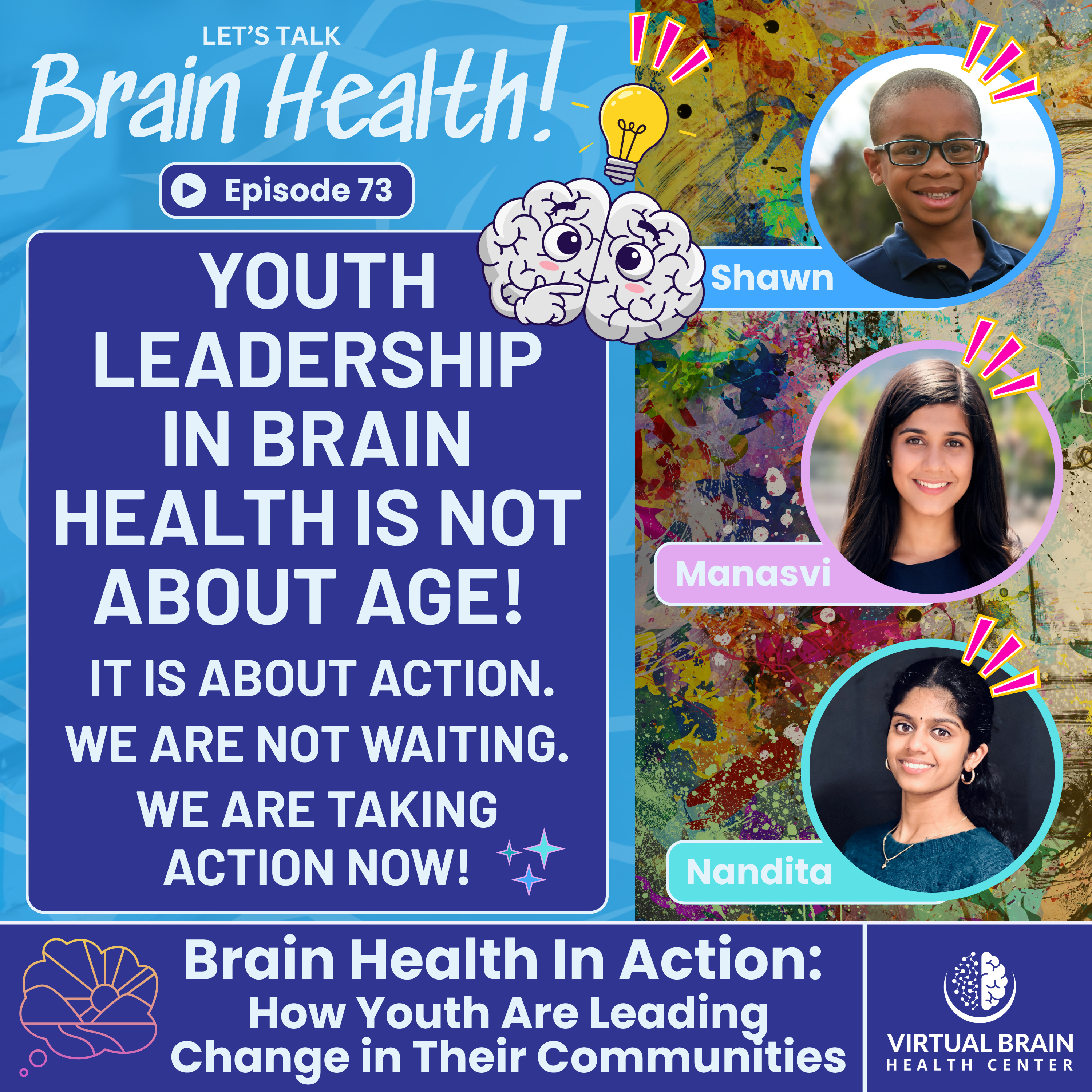
What happens when young people move beyond awareness and start taking action on brain health in their schools and communities?
In this special episode of the Let’s Talk Brain Health Podcast, Dr. Krystal Culler sits down with youth leaders–Shawn, Mansavi, and Nandita– who are not waiting for change. They are creating it. Through advocacy, education, and peer engagement, these young changemakers are putting brain health into action and showing what prevention can look like in real life.
This conversation highlights how youth are using their voices to reduce stigma, promote mental wellness, and build healthier environments where they live and learn. Their stories remind us that brain health is not only a future issue. It is something that can be supported starting today.
This episode offers a powerful look at youth leadership, prevention, and the role young people play in shaping the future of brain health.
What You Will Learn in This Episode
Why youth voices matter in brain health conversations
How students are raising awareness about mental and brain health
Ways young leaders are supporting their peers
The importance of curiosity and education in brain health advocacy
How youth are building supportive school and community environments
What motivates young people to become brain health advocates
Key Takeaways
Brain health starts early, and youth are an essential part of prevention efforts.
Young people are not only learning about brain health. They are teaching others and creating change.
Peer leadership plays a powerful role in reducing stigma and encouraging help-seeking.
Small actions such as starting conversations, sharing resources, and supporting peers can create a meaningful impact.
Investing in youth leadership is investing in the future of brain health.
Why This Conversation Matters
Youth are often talked about in brain health conversations. This episode highlights what happens when youth are part of the conversation and part of the solution.
Their leadership shows how education, advocacy, and community engagement can work together to strengthen brain health literacy and prevention.
Who Should Listen
Educators and school leaders
Parents and caregivers
Youth development professionals
Public health professionals
Students interested in advocacy
Anyone interested in prevention and community brain health
Key Message From This Episode
Brain health is not only something we learn about. It is something we practice. These youth leaders show what it looks like to turn knowledge into action.
Resources
Learn more about Shawn’s work at Brainolicious Adventures™ and check out his books on Amazon!
Explore Manasvi’s work at The Mind Initiative
Visit Nandita’s S.T.R.A.P. the Stroke App and learn more about her work at Cognitive Connections
Download the Virtual Brain Health Center’s resources for kids and teens on their website
Listen to our previous podcast conversation on brain health across the lifespan featuring Nandita!
Earn FREE CEs
The podcast qualifies for the following credit types: AMA PRA CATEGORY 1, ANCC, AAPA, APA, ASWB, and IPCE. Join the Learn at Pinnacle app to earn FREE CE Credit for listening to this episode!
Support the Podcast
If this episode inspired you:
- Share it with an educator or youth leader
- Subscribe for more brain health conversations
- Leave a review to help others find the show
Thank you for investing in your time in brain health today, and for the next generation.
**This conversation was part of the Virtual Brain Health Center's Brain Week 2026 events and is being released on the podcast to reach a broader audience.
0:00 Welcome to the Let's Talk Brain Health podcast, a public health educational initiative of the virtual Brain Health Center. I'm your host, Doctor Crystal Keller, and I'm so glad you're here. On this podcast, I sit down with incredible guests to explore all things brain health and Wellness. Together, we'll talk about how to care for your total brain health, mind, body and spirit while sharing the latest brain Health Science practical tips and strategies you can use every day. By prioritizing your brain health, you're taking an important step towards living a happier, healthier life. So let's dive in and welcome today's guest. I wanted to frame this evening around one word that comes to mind when we hear youth brain health.
0:46 That word to me was curiosity. Brains run on curiosity. Children and teens bring curiosity and large supplies. Statistics say children will ask over 100 questions an hour. How that can change as we start to age and hit adulthood. When young people step into science, advocacy, and creative work around the brain, progress can accelerate and it can happen quickly. Fresh questions appear, old assumptions can get tested, and new solutions can move forward fast. The spirit's going to sit today at the center of the conversation tonight.
1:27 Welcome to BRAIN Week 2026 here at the Virtual Brain Health Center. Tonight's panel highlights a powerful truth. The future of brain health is not decades away. The young people are already leading that change through curiosity, research, creativity and advocacy. And tonight we are joined by three of those young youth leaders. I'd like to introduce first, we're going to go in order of age from youngest to eldest on our panel for all of our questions tonight. So first I'd like to introduce Sean, the creative kid. He published his first creativity book at just three years old and is now on a global mission to help the world think more creativity.
2:09 Every day he delights his parents with fresh examples of inventive thinking and imaginative connection. He still enjoys sprinklers, has developed a passion for Sonic the Hedgehog, and is determined to solve the Rubik's Cube faster than his dad. He's an eager observer and strengthened his mind through piano playing and creative expression. Sean speaks internationally, including the United Nations Brain Day events and shared insights on creativity in the brain. He's also an honorary brain health actionist with the Center for Brain Health in Dallas, TX. And his favorite musical tune is Sonic Superstars. Sean's our youngest panelist tonight and he's here to tell us about brain health.
2:53 Hi, Sean, So glad you're here. Is there anything else you'd like us to know about you before we start our conversation this evening? I also run track too. So you do everything for mind and body. That's fantastic. Thank you for joining us. Our next panelist is Manasi Sharma, and she's a high school student who loves exploring how the brain works and why it matters in everyday life. She enjoys research and translating complex neuroscience and mental health topics into ideas that feel relatable and meaningful. Outside of research and advocacy, she's also involved in creating youth focused content where she blends science, storytelling, and creativity to spark curiosity and conversation. Welcome to tonight's conversation with us. What else would you like us to know about you before we dive in this evening?
3:52 Hi. I just wanted to say thank you so much for having me here and I'm really excited to be part of this conversation and learn from everybody. Thank you for joining us from the West Coast and bringing your passion and curiosity to this conversation. And welcome back to our third panelist. But it's her second year with us at the Virtual Brain Health Center. To Nandita, the founder of Cognitive Connections. And now her latest project, Strap the Stroke. She's a senior at Solon High School and a certified brain health and stroke tier educator. She's a passionate advocate about brain health. Her interest in this field began with her research for the past three years on Alzheimer's disease at Case Western Reserve and her research on heart and brain health at Yale University.
4:38 She's also the founder of an internationally recognized brain Health Organization, Cognitive Connections, which has already impacted over 10,000 people to date. You can think about that as 10,000 brains she has helped support to date. Through her work, she's currently been selected as a Youth Ambassador to spread stroke health awareness and has empowered hundreds of students with stroke health education. Most recently, she filled an app called Strap for Stroke, which was recognized nationally by the US Congressional Health. Mandita looks to forward her education journey as a passionate brain health advocate and researcher. Welcome back to Brain Week at the virtual Brain Health Center. Mandita, what else would you like us to know about you and your work, and what have you been up to since last year? Yeah, I just wanted to say thank you so much for having me again, Miss Crystal.
5:28 It's truly an honor to be back on this panel and I'm excited to share all the different activities and advocacy that I've done over the past 2 1/2 years. Initially started focusing just on dementia, but over this past year, I've extended it into stroke health as well. So I'm excited to share all that work. And a welcome to every youth leader on this panel. I think tonight, each of these young leaders bring a unique pro voice and perspective to brain health. And we're going to learn now how each of you found your interests, what are the issues that matter most to you and how you're already creating change in your community. So, Sean, I'd love to get the conversation started with why do You care about the Brain as the youngest youth advocate here on the channel. I started running and running helps your brain by exercising and I was curious on how the brain works. Thank you for sharing that.
6:26 I have to say, I think when I was your age, I probably didn't think much about my brain. And you have done a lot of work to let other people know why they should care about their brains and the things that they can do. So thank you so much for sharing that to be what brought you into wanting to educate others about the brain and your own personal interest in this house. Yeah, so my interest in the brain began with simple but also persistent curiosity. And it started way before I hope it knew what neuroscience was. Ever since I was a child, I always wanted to understand how system works and the why behind things so why people think, why do they feel and just like why we behave the way we do.
7:14 I just found myself asking questions about things like resilience, emotion, and the fact that two people can experience the same situation but also just walk away with completely different inferences of the situation. And I feel like as I got older, my curiosity also expanded into something bigger as I started noticing how people's lives can be shaped by the structures around them. And these can include like education, the healthcare access that they have, the environmental stress around them, and most of all, the access to the resources that they have. I realized that the brain sits at the center of all of it, Your personality, how you impact the world, and just like the footprints that you leave.
8:06 And I've realized that the brain is an organ that interprets the world and just helps us respond to pressure. It encodes our experiences. And it's just that the more I learn about it, the more fascinated I am from this organ. And apart from this, I also learned that the more I learn about the brain, I also see how invisible our brain health is in most systems, even though our mental health is just as important as our physical health. No, we talk about academic performance, but we do that without talking about the cognitive load that we have, which also connects to another theme that I'm passionate about, which is just like burnout and advocacy for teens.
8:52 And this realization changed a lot of things to me because I wanted to then know more about the brain, more than just the fact that it's a biological organ as the interface between people and systems that the brain shapes. And why certain communities face higher risks of maybe neurological and mental health challenges, early signs going unnoticed, and what we can do to design environments that can help people before. You guys are tackling big issues with just that initial spark of curiosity that tackles how complex the brain can be and how it impacts so many issues in society as well as your peers as well as yourself.
9:40 So Mandia, what brought you into brain health research for the last three years, as well as what you're going to study when you go off to college? What was that initial interest point for you? I can definitely say that I've always been a kid that was interested in science and STEM, but what really got me into neuroscience and brain health specifically was actually a club at my school. So that year the international topic was neuroscience, and this club is all about solving problems. And I had to do a lot of research for this competition. So during this research process, I came across neurodegenerative diseases and this was one problem that I couldn't solve with all of the solutions that we have to create for this competition. And it really got me to thinking, why is there the specific field of brain health that still seems to be unsolvable despite the fact that we have decades and decades of research conducted on it?
10:33 So that's what took me into the dementia and neurodegenerative space and modesty too. I've certainly been very fascinated about the brain because it really shapes everything about who we are, whether that be the memories we create, the personality, and even the decisions that we make. As I learned more about neuroscience and the complexities of the brain, I certainly became drawn to these diseases like dementia that slowly, chip by chip, take things away from us. And I think one of the most interesting aspects of these neurodegenerative disorders is how they start very early on. And that's really what my advocacy is really focused on is starting this brain health education from a very young age, because the younger that we start this education at, the more likelihood that we have that we're able to potentially prevent these neurodegenerative diseases in the long run. And that's really what took me into this dementia and neurodegenerative space.
11:30 And I eventually started conducting research on Alzheimer's disease in the hospital that I volunteered at. I even witnessed these patients going through these dementia and related neurodegenerative disorders. And that eventually led me to found cognitive connections. But apart from dementia and the neurodegenerative space, another aspect that I really got interested into over the past year is looking at strokes. Strokes is something that impacts millions and millions of individuals across the nation, and it's something that individuals are left with the lasting impacts of for years and years to come. So I really wanted to look into how can we empower kids to make a difference because this panel, today's meeting is all about it.
12:13 Looking at how the youth are shaping the next generation and shaping the world and creating an impact. So I really wanted to spread that awareness to the rising generation, telling them that even though you are kids, you can make just as big as an impact as any adult can. So I think my focus over the past few years has been on dementia and stroke related. Advocates, thank you all for sharing what has brought you into this space. I think we can see why we have, even within the youth, different age groups talking about this. And Sean, I'm going to ask you now, what brain health issue matters to you the most right now? And why is it so important that you're out telling people about it?
12:54 Why is it important to kids your age? People are eating too much sugar and instead of giving sugar, we want to give toys to kids. I like that healthy swap idea. I think we've seen a lot of information around that, especially for kids in the ways that we can. That's always the nice idea. We don't necessarily we're going to take something away. What's the good swap? And who doesn't love a toy? There's practical things we can do to decrease that sugar intake. So thank you so much for sharing that. What is the issue for you that's top of mind that matters most to you right now? And why is that the one you're really advocating for in your work?
13:37 Yeah. So the issue that matters most to me right now is the invisibility of mental and neurological health. And especially this is seen in rural or low resource communities because I feel like in a lot of places, mental health is still treated as something secondary, less urgent than physical illness. But as I said before, and even then these I emphasized it, the brain shapes everything. These are things like how we cope, how we learn and our connection and how we survive as a community. I'm especially focused on how we can use maybe AI and data science to detect early signs of neurological and psychological risk long before someone reaches a crisis point. And my work is mostly focused on early interventions and trying to spread brain health awareness to rural communities and the young generation and just making people familiar with the idea of mental health.
14:42 Because I feel like it's still something new to a lot of people, and a lot of people don't know what mental health is. So just getting people more familiar with the thing, reducing any stigmas they are around this issue and just spreading awareness, yes. Thank you for sharing the issues that are important to you. I think one of the most important things we have around all of these conversations is the call in to talk about the ways we take care of our brain, whether that's the conversation under brain health or mental health or this broader umbrella. It's that how do we prioritize our brain care and that this is a conversation for all of us. So Nandita, what is the issue that's mattering most to you right now and why are you advocating for it in your work today?
15:27 Yes, one of the main issues that matters to me right now is certainly the lack of awareness around preventative brain health and especially focusing on the younger generation. Currently a lot of individuals only begin to think about brain health when something goes wrong. So whether that be a stroke, a concussion or even memory decline. But by then, the opportunities for early prevention, that endo for early prevention can sometimes already have been missed. And that's where passion for changing that mindset so people can actually begin viewing brain health as something that should be done more actively to protect their lives throughout the years rather than only focusing it at the end.
16:08 So really focusing on this idea of prevention and being proactive rather than being reactive. At the end of the day, my work through cognitive connections, I've certainly seen how lifestyle factors, whether that be sleep, nutrition, exercise, stress management, your emotional well-being can certainly influence your long term neurological outcomes. And over the course of the past few years, I've conducted almost 15 plus workshops, whether that be locally or even online workshops and we've impacted nearly 10,000 individuals. And similarly with the Stroke Health Awareness initiative that I started, Strap the Stroke. It's all about empowering the next generation to identify by the signs of a stroke and someone that is experiencing a stroke, medical emergencies so that these kids are empowered to call 911. And I think it's really important to spread awareness like this to the young generation because they can certainly make an impact and make a difference in the long term.
17:07 So really improving this brain health and stroke health awareness is really important because it helps to shift the focus from reacting to these diseases and it shifts it to the idea of prevention. And if we can help these people understand that their brain is so important and it is crucial to continue to protect it from a younger age, we can truly improve the quality of life for these individuals, but also the entire communities in the long. Run. It's so wonderful to hear all the work that you are all advocating for because it fits so well into the global conversation on brain health where brain health for all ages and stages of life. Because for so long the field did focus on later age, adulthood.
17:51 And now we're saying it is all ages and there's so much work to be done to equally serve all population around the conversation of brain health. So now I want to pose a slightly different question because in doing your work, because the way we have changed the field and the areas we're trying to serve, is there a myth or misunderstanding around brain health that you want people to know about? Something different that you want to correct for them? So, Sean, what is it that you might find in your work that people might get wrong, that you want them to know better about the brain? Some people think their brain stops growing at childhood, but it keeps growing through the whole life. Your whole life and some things you can do to keep it growing are exercising, eating healthy foods, playing music and stuff like that.
18:47 You highlighted so many important things that is never too late to try something new for your brain. There's always things that all of us can do. And I think that's such an important message is we think I'm a certain age, there's nothing I can do for my brain. And the research shows it doesn't matter your age, you can always do something new and different. So now, Mandy, what's something that you want to correct? And I know with the issues you're tackling is there's probably a lot of mis and misunderstanding and there's broader brain health conversation. So what's what do you want to set the record straight on for us this evening? Yes, and I actually love this question because it's something I'm so passionate about.
19:30 A lot of students, and I've seen my peers, they describe feeling overwhelmed, mentally drained and unable to focus. And sometimes these experiences get dismissed as a lack of motivation or discipline. But in reality, mental exhaustion is a very real thing that a lot of people go through. And it's not necessarily laziness how a lot of people describe it, but it's it actually reflects what's happening inside the brain when it has been sustained under cognitive or emotional pressure and. As we already know that our brain is constantly processing information, regulating emotions, making decisions and just constantly adapting to our environments.
20:17 Once stress becomes something chronic and recovery time is limited, the systems that support attention and emotional regulations can become very overloaded. That's when people start experiencing things like brain fog or difficulty concentrating, even irritability or feeling even when they want to perform well. And these experiences aren't necessarily characters boss as they signal something very important, which is that the brain has been working extremely hard for a long time with no clear breaks or rest time. And I think that this understanding is very important to address because when mental health exhaustion gets labeled as laziness, it can also lead a lot of people to blame themselves instead of recognizing what their brains are trying to tell.
21:10 And it makes it hard for people to have honest conversations about how stressed they are and what their well-being is. For me, one of the most meaningful shifts we can have is just learning to listen to those signals from the brain instead of ignoring them. And when we understand how the brain responds to stress or cognitive overload, we can start building more healthier habits, environments, and start having really those conversations that support healthier focus and mutual understanding between people. Thank you so much. And I already see yours building off of Sean because with his work earlier in life as if we have some of those healthy habits as more of those foundational pillars. There are tools that serve us well when we get into some of these environments where we could easily negate those. Those are the first things that fall off our plate when we're in this stressful situation.
22:07 So it's these are lifelong habits to have as a foundational tool. So now, Mindita, what is the one myth or understanding that you want us to correct throughout your work? We're just going to keep this line going and see how we build off of one another. Yeah, I guess I have two actually. So the first one is more on dementia. SO1 common myth that I've seen across a lot of the workshops that I've done for cognitive connections is that serious memory loss is just a normal part of aging. And I've seen this coming from a lot of the senior centers that I've done workshops at. And it's certainly true that small changes in memory, so maybe like occasionally forgetting something or misplacing your keys at home can certainly happen as we grow older.
22:52 But significant memory loss that interferes with your daily life, It's important to note that is not a part of normal aging. So conditions like Alzheimer's disease and other forms of dementia are neurological disorders and diseases that affect these brain cells, and they affect the functionality of these cells within our brain. When individuals tend to assume that memory decline is just a normal part of aging, it can certainly delay diagnosis and also prevent individuals from getting this medical care support and early interventions that could actually help maintain that quality of life. And I guess tying back to what both Sean and Manasi said, this really ties back into why it's so important to start that brain health journey from a younger age and really focusing on the the idea of prevention and protecting our brain from a younger age so that we can strengthen it as we continue to grow older. And another misconception that I've seen through my strap the Stroke initiative is the idea that strokes only affect older adults.
23:53 It's really important to note that stroke is a brain disorder that can actually occur at any age, including young adults and even children. And some of the risk factors tied back into the brain health idea of stress, such as high blood pressure, the lifestyle habits such as the food you eat, the amount of exercise you do, or even it could be underlying medical conditions. But because many people don't expect stroke symptoms in younger individuals, warning signs can sometimes be overlooked or dismissed sometimes. So it's really important to note that a stroke can really happens at any age, at any time. And that is why it's so important to know the signs of a stroke and always be on the lookout for them in the event that someone is having a medical emergency.
24:37 And I think raising awareness about myths like this is just so critical because early recognition can truly make a large difference in the long run. There are a lot of issues under this broader brain health conversation, and I'm so grateful for the work that all three of you are doing in your local communities as well as at the national level. And as you're all having influence, national and international level through your work and the way you are serving others. So thank you for championing the brain health conversation, conversations for all. So now I want to get to the most important and exciting part is what are the current projects that you are doing to have an impact? So Sean, what are you working on right now to improve the brain health of others? Tell us about it.
25:24 We haven't. We're writing a new book. It's called My Brain Soon and it talks about the seven pillars of brain capital, which is brain food, brain sleep, brain mental stimulation, bring social connections, bring exercise and brain arts. That's very exciting and this will be what number book for you now. How many have you written already? It's going to be your 4th book. Congratulations. You will have to let us know when that's available and you're going to share your 7 pillars of brain health. So what an exciting for you to do and to champion for you and kids your age. Thank you for sharing the projects that you are currently working on.
26:07 Fantasy. What are you up to now to improve the brain health of others? Right now I'm working across several projects actually, but they all connect back to my 1 mission, which is just making brain health more accessible through research, advocacy and policy level change. One of the main projects I'm developing right now, as you already know about is the Brain Health for Youth magazine and it basically translate neuroscience and public health research into practical tools that young people can use everyday and uses modules on how stress, environmental and digital health shape our brain.
26:49 It has interactive activities that help teen identify cognitive and emotional triggers. And it also focuses on a major topic of burnout and how teens can bring emotional resilience to help prevent this. And I'm refining it using organizations like Youth Movement Against Alzheimer's and of course the Virtual Brain Health Center. And I'm just trying to ensure that it's more scientifically accurate and accessible. Other than this, I'm continuing my data-driven brain health research. So recently I conducted a study and it was analyzing neurological and mental health patterns, especially in wildfire prone areas.
27:31 So basically just figuring out how our environment shapes our mental health and that project really helped me understand how our environmental stressors influence our cognition and long term neurological risks. So I presented this work to the American Chemical Society, and it helped reinforce how research can reveal early brain health worker release that are also often overlooked. Other than this, I've deeply involved in brain health advocacy and also education. As a certified Brain Health Leader and a member of Hillary for Charity Youth Council, I help facilitate workshops on things like cognitive Wellness, Alzheimer's prevention, and healthy aging overall for both huge and older adults.
28:22 I also create huge focused content, including the brain health magazine I'm releasing later this year and just making neuroscience more engaging and practicals for teens and young adults. And another idea I'm actively advocating for is telehealth equity for older adults, which is also a brain health issue because I've learned that telehealth has become a default mode of healthcare, and it has made healthcare so much accessible for a lot of people. But for many older adults who are at a higher risk of cognitive decline, dementia, and also chronic neurological conditions, they are excluded by inaccessible digital systems or people from rural areas too that are not as familiar with these digital devices. And I've been writing and speaking about how digital exclusion can increase loneliness, anxiety, and just reduce access to mental health and neurological care overall. And across these projects for both research and education, my focus is the same, which is just to bridge neuroscience and public health.
29:34 So the brain health becomes something that people can understand and protect before it becomes a crisis, like Nandia said. And overall, I just want to build something where it really promotes brain health education as a foundation for everyone and of all ages, of all regions, across different abilities. Thank you so much for sharing all the different hats you seem to have on in this brain health space in the projects you are working on, from research to science communication to advocacy and influencing even policy and change. So thank you for highlighting that. Mandita, what is the project you're working on now to improve the brain health of others?
30:17 Yeah. So like I was mentioning earlier, I have kind of two projects running at the same time. So the first one is cognitive connections, which is essentially a brain health that we're earnest initiative for all ages. So in this one, I've been conducting workshops for kids, teens, adults and seniors. And I've been running this initiative for about the past 2 1/2 years now. The most recent one that I started, it's been about a year, close to a year now I strap the stroke. So this is more focused on stroke health education and encouraging younger kids especially to learn the symptoms and respond quickly to a stroke medical emergency. So I've centered the curriculum of this strap the stroke around the acronym called B fast. So B fast stands for balance, eyes, face, arm, speech, and then T stands for time to call 911. The acronym itself encourages the kids to literally be fast while they are identifying if an individual has a stroke and calling 911.
31:19 But it also serves as a easy to remember acronym that these kids can use to remember the signs of a stroke. And especially for strokes, when And every single minute matters because every single minute that we lose, the brain continues to lose the neuronal cells. So spreading awareness about these warning signs can really make a large difference in the long run. And my goal, similar to Modesties, is also to help translate neuroscience knowledge into real world impact. I've been conducting Alzheimer's disease research at Case Western Reserve University for about the past three years now. And a lot of that information I have translated through the podcast that I've conducted with other brain health experts, the workshops that I've conducted through Cognitive Connections, and also the online videos that I've created, whether that be through the John Hopkins program that I did and other online YouTube videos to really encourage our generation to learn about brain health in a very easy and understandable manner.
32:18 And similarly, with my Stroke Health initiative as well, it's really taking the information that I learned through my research at Yale about what are some of the biggest barriers that individuals are facing when it comes to receiving the stroke health information. And one thing that I found through this research was the fact that a lot of the medical content available currently is not very easy to understand. Rather, it often requires a high level of medical knowledge to actually be able to digest that information. And this is especially a large barrier for younger kids who certainly have the curiosity to learn but are inhibited from this learning growth because the information might be too complex to understand. So really the goal of both of the organizations that I'm doing is to take this complex medical information and break it down in very easy and digestible concepts so that the youth can really benefit and learn from it and continue to protect their brain health.
33:15 Thank you so much for giving us an update on your two projects. People can grab links to the websites and updates in the show notes below as well as in the chat. So I want to make sure that we get some things that will simulate our brain. We know, love brains, love things that are new, novel and challenging that stick to our memory. And you all have some creative ways of sharing brain health. So I'm curious now if we can share those messages out with everyone tuning in. Sean, if you're comfortable, you have a song that helps people know the importance of sleep. Would you like to share that with us this evening? Yeah.
33:59 Sweep up, sweep up the toxins, sweep up the toxins and it clears the brain out. You can have a new fresh brain for the next day when you're sleeping. Thank you so much for sharing that. I think that's one that I need to remember when I'm laying there talking and turning. That song sounds much better than counting sleep sheep. Thank you for sharing that with all of us. A little while back you wrote a poem about dementia awareness. Would you be open to sharing and reading that with us all the feeds? Yes, I can certainly share that. I guess I can give a little bit of background before I get started with the actual speech itself. So I gave the speech at the Stop the Hate contest about a year ago.
34:45 I think it's exactly been a year now. So I gave it last time around March or April, And this is inspired by the individual that I witnessed during my volunteer medical shift at the hospital. And this is actually what led me to eventually starting cognitive connection. I am very happy to share it, so here it is. Help me please, I need someone to help me. These were the shrill repeated cries of a dementia patient that I witnessed at my local Medical Center during my volunteer shift. The police never stopped despite the patient receiving constant attention. However, those endless repetitive requests had worn the nurse down, leading to frustration.
35:26 I witnessed the nurse's face, which was once bright and warm, wash over with annoyance and even unintentional hatred. As the nurse slowly began to ignore the patient. Second by second, minute by minute, I could see the dementia patient being more and more excluded. At that moment, I felt a wave of emotions crash through me. Empathy for the caregivers, sympathy for the patient, and a sense of resonance for the 7 million dementia patients and their caregivers in the United States. I knew something had to be done. Could I find a solution to aid both the patient and the caregiver? I began to research the costly toll that impacts both the patient and the caregiver. I realized that while caregivers make every effort to help their loved ones, the simple yet profound fact that dementia has no cure leads to caregivers feeling more and more hopeless. This ongoing cycle leads to unintentional hatred by the caregivers, causing social isolation of the patient. Realizing the gravity of this issue and the fact that the best cure to prevent dementia is preserving 1's brain health, I knew I had to go one step further. While I couldn't hit the reverse button for the patient's life, I could pave a journey for the next generation. A journey against dementia, a journey against unintentional hatred, and a journey for brain health inclusivity. Thus, I founded Cognitive
36:59 Connections, a foundation dedicated to increasing brain health awareness for all ages. Through in person and virtual workshops. I've already impacted over 10,000 individuals, and I plan to pave the journey for more. Through collaboration with the Virtual Brain Health Center and the youth movement against Alzheimer's, I aim to expand my impact exponentially. Furthermore, I've connected with Ohio's District Senator Jerry Serino to expand my initiative and contacted former Senator Sherrod Brown to urge him to pass policies that increase funding for dementia research. I believe that cognitive connections can remind caregivers and seniors to take care of their brain health while empowering the next generation to incorporate brain healthy practices to garner community support.
37:50 I led the team for the Walk to End Alzheimer's, encouraging my community to walk to increase advocacy and care for dementia. Through this, I not only raised funds but also increased awareness within my community. Those cries, screams and desperate calls for help still ring in my ears today. It was that unforgettable moment that started my journey of working towards a society with brain health awareness for all. And it's that moment that will drive me forever. Through step by step, action by action, we can work together to stop the hate towards dementia. Thank you for sharing your poem and for all of you for sharing your work and advocacy.
38:33 Nancy, I want to ask you, what is it that you think that adults often misunderstand about young people in brain health to highlight for us this evening? Something that adults really misunderstand about brain health is that it can impact people from to being older adults. There's no specific age to start taking care of your mental health. You can start today. You can start from the day you realize what mental health is and it's a really long journey, like a marathon instead of 1 specific day that you're supposed to commit to your mental health. And it's just as important as our physical health is strongly tied to our physical health. And it can really impact how we perceive our life and the digital footprint that we leave for other people. And yeah.
39:27 Thank you all for being here with us as the change makers and the youth leaders of tomorrow. I want to make sure though, that I understand what is the hope you want to see in the future, Sean? What is the change that you want to see in the future of brain health? I want to make sure people take care of their brains and make sure their brains stay healthy by exercising, eating healthy foods, and staying creative. And what important messages that we could all get behind and support you in your advocacy work, in your journey. Manas B. What is it that you hope to see? In the future.
40:11 Yes, this actually ties back for what I said in the previous question, and the change I hope to see is a world where brain health is treated as a universal foundation for human well-being instead of just a luxury or something people only think about when they're struggling. And for young people, that could mean creating environments with emotional regulation, digital Wellness, and cognitive resilience all at the same time. For older adults, I want a world where aging is met with support and accessible care. Because right now, we're watching a silent crisis unfold with telehealth systems that were meant to expand access, but unintentionally excluding the very people who need neurological and mental health support the most. And for communities, I hope to see brain health being recognized as a public health priority, and that means addressing the environment, social and economic conditions that support brain health and shape our emotional well-being. For healthcare, I hope to see prevention become the norm, as Nandita said.
41:21 And right now, we often wait until symptoms are very severe before offering support. But we need to understand that brain health doesn't work that way. And the earlier that we intervene with things like education, screenings and accessible tools, the better the outcomes are going to be. And just really focusing on the prevention because they're the thing that prevention is better than cure. And for young people specifically, I hope to see our voices being taken seriously. We are the first generation to grow up fully digital and have access to all these different tools and mental awareness and being the first ones to navigate this level of academic and emotional pressure. I hope we understand the urgency of brain health as we are living in it.
42:15 And ultimately, the change I hope to see in the world is where every person, regardless of their age, background, ability, region has just the knowledge, the tools and the support to understand and protect the most important organ that they have, which is the. Brain and the data. What is it that you hope to see for the? Future as we move into the future in such a very fast-paced world, I hope to see a future where brain health disorders and diseases are detected and addressed much earlier. So again, going back to that idea of prevention and whether that be with the research, technology or awareness, I'm really looking forward to the ways that we can prevent or even help to delay conditions like dementia and even help to respond faster to events like stroke, for example.
43:04 I've started this already with the technology, like combining a medical medicine with technology, especially through the app that I've created, Strap the stroke. In the future, I'm hoping that especially with AI that is continuing to grow, how can we really combine, find technology into medicine to really go into this idea of preventative care? And I really believe that even the smallest improvements in early intervention and detection could really help to impact millions and millions of life. So ultimately, it all boils down to protecting our brain health. Again, really has to be a global priority. And hearing what you all envision for the future, I know it is a world that I would like to be a part of and to remind that we're all Co creating this together and you all are not waiting.
43:53 You are taking the steps for change now and today. And I want to ensure that in our final time today that you all get a chance for your final message of what it is you want to share with our listeners today as part of Brain Week. So, Sean, what is the final message you want us all to know about Great House today? We're doing a fundraiser and it's about brain health and make sure you don't forget that your brain is very important and beautiful. Thank you for sharing that with us. We can put the link below for your fundraiser in our show notes. And I love the sentiment that we all can remember that our brains are beautiful and unique, and that we all to do what we can to take care of them.
44:42 Thank you for sharing your work and advocacy with us this evening. Minus B. What is it that you want us to know as the final word to see? Yeah, my final message is that your brain is your power, which I have sold from my magazine, and you need to take care of it with curiosity and patience, and it's something that anybody can do. You don't have to be a doctor, you don't have to be a scientist to take care of your brain. It's yours and just yours. And your brain deserves care and compassion from you and from the world around you. And I hope every single person listening to this right now walks away remembering that everyone's brain is doing the best it can with the tools it has.
45:28 And a little understanding of your own mind and the minds around you can change so much. Just be gentle with yourself, be patient with your growth, and be kind to the people who struggles. You may not be able to see and most of the fall. Stay curious because the more you understand your brain, the more empowered you become to shape your life, your relationships, and your future. And then Dida, what is the final message you would like to share with us this evening? Tying back to what I had essentially started off with, our brain is once again this very powerful organ that holds our memories, relationships, and sense of self. And that is why it really boils down to why protecting our brain health is just so important.
46:11 Conditions like stroke and Alzheimer's disease really remind us how profound these neurological disorders can affect individuals, families, and entire communities. But encourage the idea of awareness, education, and early action can truly help to change that outcome. And to any young adult that is listening into today's conversation, I think it's really important to emphasize the idea that the youth can certainly make a change and make a difference. So I think that is 1 message that everyone here can take away from this panelist conversation is the idea that the next generation can and should be empowered with stroke health awareness and brain health education so that not only can they protect their own brains, but they can also teach their friends, family, teachers, and their neighbors how to protect their brains as well.
47:02 So it's really important for all of us to stay informed, support the scientific progress, and truly just look out for one another so that we can help protect our brain health and our communities for the next generation. I feel as though this is the mic drop moment that you all have so well deserved and earned for sharing all of the fantastic work and impact that you all are having this evening. And I truly hope that tonight's conversation reminds us all of something very important, that young people are not only the future of brain health, they are part of the current leadership today shaping the current brain health landscape.
47:43 We heard curiosity, creativity and action from the three young advocates on our panel this evening who are already actively educating others, raising awareness, and building new ideas to support healthier brain. Their work shows what happens when young voices are encouraged to ask questions and share knowledge. Thanks to Mylan, to Sean, Modesty, and Nandita for sharing their brilliant brain with us for Brain Week events at the Virtual Brain Health Center. Thank you for investing your time and energy into your personal brain care by listening to today's episode of the Let's Talk Brain Health podcast.
48:23 I hope our conversation gave you fresh insights, a bit of inspiration, or practical steps that you can take on your own personal brain care journey. If you enjoyed today's conversation, I'd like to ask you to please share this episode with someone who could benefit from it or consider leaving us a review. If you have questions or a topic in brain health you'd like me to explore, please e-mail me anytime at podcast at virtualbrainhealthcenter.com. I'd love to hear from you. We have so many more exciting topics ahead, and I can't wait to continue this lifelong journey of better brain health together with you and our growing virtual community. Until next time, remember to give your brain the care it deserves and make your brain health a priority.