
 Apple Podcasts

 Spotify

 Amazon Music
 RSS Feed
Exposing Gaslighting: What it Does to the Brain And How to Heal with Dr. Jennifer Fraser,
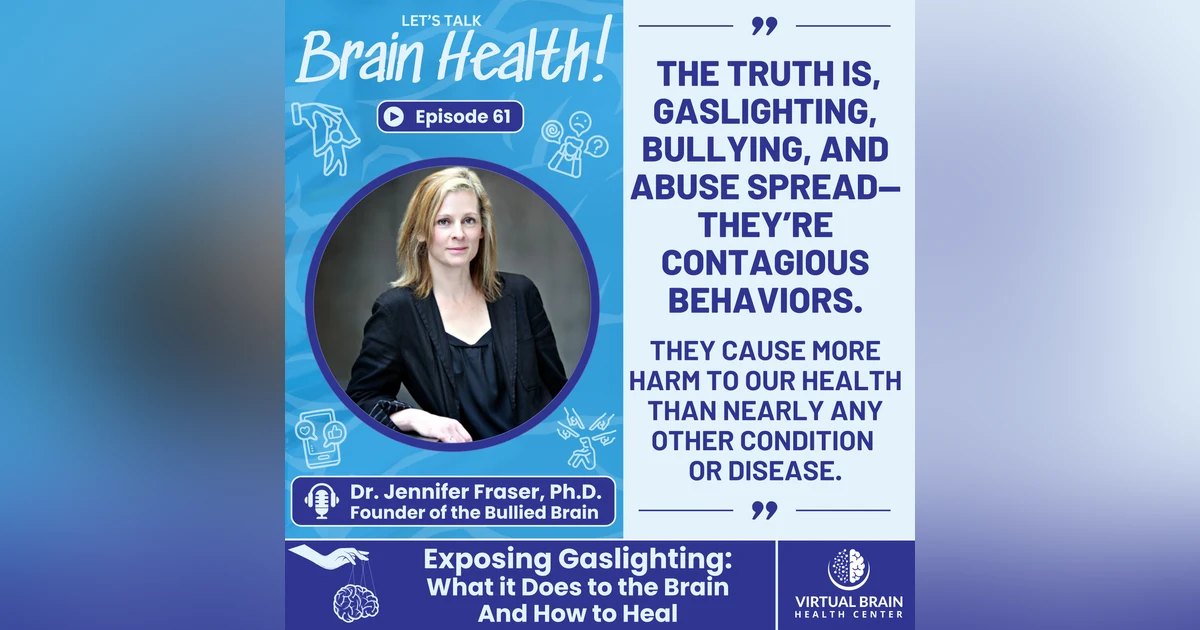

In this episode of the Let's Talk Brain Health! podcast, returning guest Dr. Jennifer Fraser, Ph.D. delves into the concept of gaslighting and its severe impact on brain health.
A renowned educator and author, Dr. Fraser explains how gaslighting can manipulate individuals, causing them to question reality and suffer significant emotional harm.
She references her latest book, 'The Gaslit Brain,' and provides practical insights on identifying gaslighting behaviors, advocating for legal changes, and fostering environments that combat this toxic behavior.
Dr. Fraser also shares actionable steps to protect oneself from gaslighting and stresses the importance of recognizing its manipulative nature.
Join us for an enlightening conversation designed to help you understand and counteract gaslighting's pervasive influence.
00:00 Introduction and Guest Reintroduction
01:12 Understanding Gaslighting
02:48 Personal Experience with Gaslighting
04:33 Gaslighting in Society and Media
07:22 Impact of Gaslighting on the Brain
09:25 Gaslighting in the Workplace
14:33 Protecting Children and Youth from Gaslighting
18:36 Gaslighting and Social Media
27:00 Spotting and Stopping Gaslighting
31:31 Future Work and Final Thoughts
Resources:
-
Listen to our previous podcast conversation on “Understanding the Neuroscience of Bullying & Its Impact on the Brain: A Conversation with Dr. Jennifer Fraser, Ph.D.”
-
https://drkrystalculler.substack.com/p/understanding-the-neuroscience-of-8e3
-
Learn more about Jennifer and her work on her website or LinkedIn.
-
Read more about gaslighting and bullying in recent media in Dr. Fraser’s Substack.
-
Explore Dr. Fraser’s latest blog post on Psychology Today.
-
- Follow Jennifer’s updates on social media @bulliedbrain on Instagram and Facebook.
- Purchase “The Gaslit Brain” on Amazon, Barnes & Noble, Books-a-Million, and Bookshop.
0:02 Welcome to the Let's Talk Brain Health podcast, a public health educational initiative of the virtual Brain Health Center. I'm your host, Doctor Crystal Color, and I'm so glad you're here. On this podcast, I sit down with incredible guests to explore all things brain health and Wellness. Together, we'll talk about how to care for your total brain health, mind, body, and spirit while sharing the latest brain Health Science practical tips and strategies you can use every day. By prioritizing your brain health, you're taking an important step towards living a happier, healthier life. So let's dive in and welcome today's guest. Today's podcast guest is a return popular episode where we are going to dive into a topic that is related to what she spoke to us before about bullying.
0:52 Today she is back to talk to us about gaslighting. Doctor Jennifer Frazier has been studying and writing about cultures for over a decade. Her PhD trained her to take different discourses out of their silos and put them into an arena to see if the conversation changed. When she put bullying into the arena with neuroscience, she was shocked by how the conversation shifted. We live in a culture that all too often normalizes abuse and yet the research is clear all forms of bullying abuse can do physical damage to brain architecture. It's time for change new ways of thinking and behaving. Jennifer is an award-winning educator and author of five books. Her latest book, The Gaslit Brain, tackles the way abusive individuals in the workplace and in leadership positions can manipulate others to believe in falsehoods and illusions. The book's goal is to prevent trauma from gaslighting and to teach readers how to resist its manipulative force. Jen, welcome back to the podcast. Is there anything else about your background you'd like to share with our audience before we dive into today's topic? Just for people who have very busy lives. If you want to read more about this, I write a regular series for Psychology Today called The Bullied Brain. And I also am writing a regular sub stack very specifically laser focused on gaslighting.
2:19 So if you want quick reads and you're interested in the science, the science mostly the neuroscience is in Psychology Today, whereas the sub stack is more about contemporary affairs. And we'll include links to those in our show notes so our listeners can grab those right away. I have to admit, I'm a fan of both. That's how I found your work. And I appreciate what you share on sub staff because we get these, I think, opportunities in mainstream media, from stories to new coverage, where it's like, hey, here's what's happening here is how this applies to bullying and gaslighting in today and what we're seeing. And here's also a way to think about this critically or some action steps that you can take.
3:01 I'm so glad you are back on the podcast as well as you always provide us expert insights and a plethora of resources. So I think today before we even get started, you spoke with us before about bullying in the bully brain and how that impacts our brain health and Wellness, How that research help lead you into this conversation of gas lighting in the gas lit brain, which we're going to dive into today. I had never even heard the word gaslighting. It wasn't really part of my vocabulary or how I thought about things or things I did or relationships with other people. And I was in a workplace as crystal where I reported psychological and physical abuse being done to children.
3:47 And I had heard from multiple children and from multiple parents about psychological and physical abuse, emotional abuse kind of thing. And it was being done by teachers. There were 4 teachers involved that had been reported on. So it's my legal duty to go and inform the administration, which is exactly what I did. And I also have to report to the government, which I also did. So I went to my the leader of the organization and I said, oh, here's what's happening. Here's what they're doing. This is what they're saying. This is the abuse, just documented it. Here's physical abuse. Here's the psychological abuse. And the leader looked up at me and I'd worked with this man for eight years. He looked in my face and he went, oh, that's just old school coaching. Now that's gaslighting.
4:34 Let me explain. What is happening in that moment is that seemingly innocent speech act is actually conveyed to my brain that I can't trust myself. What he's saying is, oh, you don't understand. You're not perceiving reality correctly. You're seeing something that's not even there. You're seeing abuse, but there is no abuse. You're getting all confused. You might even be a bit hysterical. You might be insane actually, because really what's happening is simply coaching sports. Like what's your problem? And I think even for other people that are tuning in, gasoline probably not a term we've heard recently until the last few years.
5:17 And I think there are these big bucket areas we're going to talk about because not only in your book, but likely in society that we've heard about this. You've mentioned sports, I believe schools is another popular place. Workplace is another one. It can come down to sometimes relationships or those certain didactics is where it comes out more prominently, usually when someone has more of an authoritative position over somebody else. Are there other areas where you'd like to highlight or emphasize where people may have these areas of gas lighting, just as an example? All of us are very keyed into a media now that's in our houses. It's with us day in, day out.
6:00 Because of the way media operates, we can now see people in very high level positions and they speak very directly and they answer media questions and they're in interviews and they make presentations. So all of us in a sense are in the position to study how they are conducting themselves and what they are doing with the words that they're using, the stories they tell, what they want us to focus. And it's really, if you are interested in gaslighting and how someone might be trying to make you doubt what you consider to be true or real or observable fact. It's a great exercise to look at immediate person being interviewed, a political figure or a lawyer or a press secretary, and watch what they're saying and how.
6:45 Often times a fast way to notice a gaslighting technique is they will be asked a question about one thing, but they'll answer about something else. Or they'll be asked to speak to an issue, but they'll accuse the person of being out of line. And the question that they're asking, that's gaslighting. So that instead of just having a real and authentic exchange, oh, you're asking me a question about this, let me answer. What you're doing is they're asking you a question. You're like, I don't want you to look at that and I don't want you to ask me questions about that. Let me deflect attention elsewhere and maybe even on you. I might deflect the attention back on you like a boomerang so that really everyone stops thinking about me and they start looking at you or a target group.
7:32 That's the other way that they do it. I suspect that's a challenge we can all accept now and see what we can notice a little bit differently and what we observe in media or exchanges and conversations we may have with others. You share a bit about your own gas lighting experience. How has that influenced your work and your writing into the gaslit brain now that you're sharing out with others? I had a sort of a series of layers that I was interested in. A lot of times when people look at gaslighting, they focus on the perpetrator and the target, but I wasn't interested in that. I wasn't interested in personal relationships. I was interested in the organizational psychology of it all.
8:15 I was looking big picture. I could understand that a perpetrator, the person that gaslights, the person that abuses, I could understand that their brains were damaged. Just to sounds so harsh and I almost hesitate to say it, but it is just factual. Their brains are damaged. It can be seen on a brain scan. I talk about it in the bullied brain. I talk about the different ways in which a psychopath's brain, a narcissist brain, a Machiavellian's brain, looks so the dark triad. But what I was looking at in the gaslit brain was how does that person manipulate the administrators and the colleagues to fall in line with their manipulation of reality?
8:57 In other words, it can be very obvious that someone is lying. We see people lie all the time, and we see that our society doesn't know what to do about it. It's not like lying has a consequence. So we see people in positions of great power and they're just lying repeatedly. And our whole society is, we don't know what to do about that. We're just going to document it and business as usual. So that just gives you an indication really about how little we understand about manipulation, about how it impacts the brain, about how dangerous it is. We're not even dealing with it in a legal manner or regulation manner that controls it in a sense. Crystal, what you could say is we all understand and the laws are very clear. You cannot hurt someone's body, but you can hurt their brains over and over again with impunity. And I find that really confusing. My big question was I could understand the perpetrator. I could understand how they scramble the brain of the victim.
9:54 What I couldn't understand is why does the institution enable it and cover it up and protect the abuser? Those were my biggest questions in the Gaslight. Brain and I always find that to be fascinating part of where neuroscience intersects with society and we hear even this field of neuro law coming online is like how do we start to protect people and their brains in real time and with what we're knowing in the science as that's changing, what do we do? And then yet we still have this lag between by the time we have policy and protections in place. And we always like to hope our podcast plays this little bit of this public health education awareness piece of where we let people know, here's what we know about the science, but what are some of the things you can at least do for yourself if you become more of an informed citizen? What are some of the steps you can do if it's to stop and think and pause and then put some barriers or protections just in place for yourself today?
10:57 And I think the topics that you highlight on and do your advocacy work mostly around in this bullying and gaslighting is this huge awareness piece where it's almost mind blowing to think that these forms of bullying and gaslighting impact the brain just as much as physical abuse, this emotional social realm leave. And those changes on brain scans. That has always stuck with me from our conversations where it's like it's there and it lingers. And we know that carries over into other aspects of people's health and also the interactions they have with others through society. So it's like you can see how these ripples continue beyond just the individual. Exactly.
11:41 I became very interested when COVID struck because I work in this world and then COVID struck and people are always telling me in my advocacy that the laws can't change, it takes forever. It's really difficult. It has to be studied. And my husband works in emergency preparedness for the government. And when COVID struck, he was changing laws every day left and center. And the reason being is because they had to stop the contagion. They had to stop the virus. They had to ensure that it was not infecting large, larger and larger swaths of the population. Really, the truth of it is gaslighting, bullying, abuse. They are contagious. They infect whole organizations.
12:21 They infect society. They're very dangerous. They cause much more negative health impact than anything else in our world, any other disease. And yet we never seem able to create laws. I don't want to see anybody get into criminal justice system, or that's not my goal. What I do believe is if you had laws, just like we saw with smoking, when you put in laws that said you can't smoke at work, nobody's smoking at work, and everybody started to get educated about cancer and the relationship to smoking. If we did the same thing with bullying and abuse and lying and gaslighting and manipulating people and thereby harming their brains and their inner workings of their bodies, we would see a huge deterrence and we would get educated.
13:05 Leaders would know everything about psychological safety because it's going to impact them. I think we're long overdue for that change. And I suspect a lot of people that have had these experiences in the most common places in schools and arenas, in sports workplaces or multiple different workplaces. And it would push kind of those bad characters out of those arenas and into the areas where they get the help and the support and let those that are in there doing the work rise to the level where they were able to thrive and be contributing people rather than they are the ones being pushed out of those spaces. They're the ones pushed out of sports. They're the ones pushed out of schools or out of workplace environments where they really could have thrived. Unfortunately, we see that being the reverse, but there's lots of room for change here if a lot of us are rallying behind it. I completely agree.
14:01 It's one of the things that most amazed me in writing The Gaslit Brain was that I finally realized that the only truly protected class in the workplace is the abuser and the whistleblower. The truth tellers and the victims will all be driven out and they will be maltreated. It's unbelievable, but it's unfortunately true and I do think we can change. When I was working on the book, really what I finally got to you and I think Crystal, this is where we really connect. I'm a big believer in if society is not going to make the change, if they are going to go down a particular path, that doesn't mean you need to. I love the idea that knowledge is power and you can read all these neuroscience strategies that will help you stay far safer from gaslighting and emotional abuse and psychological manipulation. And I believe in your book, one of the places you talk about how can we start to support people is it starts in the home. And so if we want to lean into a little bit about how can parents consciously build an environment where children feel that they can speak out and protect themselves from potentially being gas lit in the school environment. If this may be one of those first arenas where young children are introduced to this as well as parents may now have to navigate this with a child and this begins in the home where they are having these conversations in private, what are your recommendations for us?
15:29 The first one would be, I think many parents have done this and it's just a default that it has to do with our own panic and our own stress and our own desire for our child to be safe. And we end up gaslighting our own kids. Imagine you've got a six year old, they fall off their bike and they cut open their knee and they start crying and they're hurt. They're getting the pain signal from their brain and body. And the parent says, oh, you're fine. You're just fine. You just get back up on your bike, you're fine. That's a form of gaslighting because what you're doing in that moment, although you don't mean to, of course, but what you're doing in that moment is you're stopping the child from trusting their own perception, trusting their own feelings, trusting the communication they're getting from brain and body. You don't want to do that, of course. So all of us need to learn to just try to catch ourselves when we slip into those types of behaviors. And then the other critical thing is the more parents get educated on perpetrators and how they behave, how they manipulate and the profile that is attached to them, they're going to be much better able to accept very difficult information. Because what happens, and this has been documented since Roland Summit's work in the 1980s, what happens is he refers to it as the child sexual abuse accommodation syndrome. And what happens is the child reports sexual abuse almost always by a person that the parent knows. And the parent's response is there's no way that's not possible.
17:01 He couldn't have done that. She never would have done that in that moment. Again, they're gaslighting their own child and it's because their own brain is self destructing on a whole series of levels because you can't believe something to be true. Now, what's really important is for us to remember this in the workplace. You're in the workplace and next thing your leader is announcing that so and so is going to leave because they've had a bit of a breakdown and they're suffering from mental illness of this kind or the next. And you have to believe that because it's your leader, that person has authority, position of power, position of trust, credibility and social standing. Who are you to question that? At the same time as going back to something you said earlier, Crystal, all of us have to continually, especially in this atmosphere right now, keep our critical thinking, keep our judgement at Bay, keep very clear on the different ways in which information is being presented to us and by whom. So the thing I would say to parents is the most important thing to know is perpetrators are often highly charismatic, highly intelligent.
18:05 They have advanced cognitive empathy, which means they can read you like a book. They're not just going to manipulate your child. They've manipulated the higher ups and they're going to manipulate you. And psychiatric experts succumb to this kind of personality, the dark triad. It takes something like 20 minutes for them to confuse a psychopathic. An expert in psychopathology who's across the table from them within about 20 minutes will start doubting their own perception. The people that are highly skilled are at times the ones that unfortunately are ones to be weary of. I'm a little hesitant to ask you this question of what does gaslighting look like though in the advent of social media now because I can only imagine the prevalence and also how this may take a different form with the rise of social media and the amount of teens and youth having more exposure to social media platforms.
19:02 There's two statistics that I think answer the question very painfully and very powerfully, and to my mind, it makes the lack of legal protections absolutely inexcusable. When Facebook was disseminated and available to all college students, all of a sudden everybody could access it. The beta was over, the pilot studies everything. All college students were able to access Facebook. They found that in a very short period of time, depression in college students went up by over 80%. Again, how is it possible that you are allowed to have some sort of a mechanism unregulated that creates that sort of damaging impact on the brain? The other statistic that I think everybody needs to know is from early 2000s until 2018, they have seen, so that's social media.
19:56 The advent of it's just everybody has it, all kids have it, it's everywhere. They've seen an increase of 57% in youth suicide. That's 10 year olds to 24 year olds. I just don't understand why social media is allowed to do what it does. Be unregulated, be in the hands of all kinds of children and youth when we know that this is what I mean. If it was beating their bodies up and killing them through physical damage, we would have all kinds of laws in place that would protect them. But because it's damaging their brains, we have no laws that protect them. Well, and I think even in the flip side of contact, sports have become even more regulated in the rules in the game of play as neuroscience has evolved to what we know of what impact can do to developing brains. And that has influenced and swayed at least how sports are regulated or when certain ages can tackle and certain things depending on the sports you're looking at. So it's just like you're saying, if we're looking at comparing to some of our arenas where it's like we have neuroscience that has made influence and we have changed roles in the way that children play or interact.
21:10 And then you have this Wild West of social media. And I know as someone that kind of reads and follows along and different arenas from the behavioral health side and how people interact, it's always mind blowing to me on social media where I just like to remind people is you have entire teams of people dedicated to figure out how to hack your brains to keep you engaged on their platforms. And then you have people that have now engaged bots to just keep you on. And then when you hear the statistics of the high percentage of users being bought, to have the divide of whether it's politics or an opinion about something, and then that is used to exploit people's focus and attention, it is really scary as you start to dig into just hearing these different elements of it.
22:03 And never in my wildest dream did you ever think that there would just be rooms of people that take what we know about the neuroscience and actually exploit it to that level rather than just as you're saying, in the same sense, having those rooms of people thinking, what are the safety features that we put in so that it's not used to those extents for people? Because we do know of these types of consequences in terms of depression or anxiety or overuse. What are some of these backstops that we at least put in now that we have enough data to say this isn't necessarily a good thing in abundance or unregulated, but we haven't gotten there.
22:44 We just have those teams that are really just sitting there saying how do we use this to advantage? How do we use it to monetize and get ads and to keep you hooked in this loop that then unfortunately exploits your brain? It's amazing to me. I cannot wrap my mind around it. It's the tragic story of the boy who was counseled very lovingly by his chatbot to kill himself, which he did. And then what is the response to that? Oh, we're going to put in some protections that parents can use on what their children are doing as if it's a parenting issue. No, this isn't a parenting issue. This is absolutely highly destructive content that your platform is generating in a really manipulative, addictive way.
23:32 And you have no responsibility or accountability. The law doesn't do anything to you. The law won't let you go into a store and steal something. You can't walk into a store and steal anything without a criminal legal intervention. But you can rob a child's life no problem. And their confidence, their mental health, their health, their everything. I honestly find it it's one of the most serious issues facing society today. And it is one where I think you've seen a lot of people that speak out a lot more around ethics and accountability on this. And it is unfortunately these tragic stories that you hear.
24:12 And at least the parents are really taking a stand and advocating. And I've only heard parts of the transcript of the one child that with the interface of the GPT. And you are just like, wow of what was put back or reflected back to the child from an AI bot. It is truly heartbreaking in time that we have really to work forward to and I think a lot of advocacy and a lot of education. Are there any other insights that you want to share about gaslighting in terms of the younger generations that we need to be aware of? I think it's very important that if we are going to put people in front of children from an early age, so all through their development in terms of the brain development, those are the most critical years, the teenage years, 13 to 25. So we're looking at professors, we're looking at coaches, we're looking at teachers.
25:07 Those people have such remarkable influence and control and power over these young people. I think that there should be really strong safeguards put in place, just like they should be on social media. I'm not a big controlling person, but I do think the kids are very vulnerable. And young people, especially up to 25, when they have mature brains, are very vulnerable. The science tells us that. And they are particularly vulnerable in ways that social media can exploit and teachers and coaches and professors can exploit. So we need to have mechanisms like an anonymous survey. No kid should be in a class where there isn't every six months an anonymous survey what's happening, what are you experiencing, what are your parents seeing, etcetera.
25:52 And then we need to have oversight because we know that administrators, all too often they get worried about the wrong things like their own reputation, the reputation of the school, the reputation of the Sports Club. They want to protect the perpetrator. They get scrambled. That's what I write about a lot in the Gaslight Brain. I do a lot of the what are the brain mechanisms that lead them to make these terrible mistakes where they cover up abuse. So you have to have a higher level of oversight on the administrators. And I think that would solve upstream a huge amount of issues that we as a society have to do damage control on downstream. We could stop a lot of that from happening by having anonymous surveys regularly in all areas where children and youth are up until 25. And as well, an oversight for all that data. That data shouldn't just go to conflict of interest administrators.
26:42 It should also go into a larger oversight body. And hearing all of your thoughts so far in our conversation up today, are there ways where we can spot a gaslighter or things that we should know about? Yes, The thing is, everybody listening to this needs to remember gaslighters are remarkably manipulative. If you get fooled by one, don't beat yourself up. The experts get fooled by them. But that said, here's some of the things to watch for. You want to watch for somebody who love bombs. Love bombing is used in romantic relationships, but it also can apply to organizational culture, to political leaders, et cetera.
27:23 And you can hear right in the word that there's something wrong. So it's not authentic love that's been offered to you. It's love that isn't going to create meaning and authenticity and care and all these things. It's going to bomb you. It's going to destroy you and blow up your life and cause all kinds of trauma to you. So you don't want it. But what the person will do is one of the things you can watch for with the Gaslighter is they put on, it's like the mask of the psychopath. They will put on different faces depending on who they're talking to. So they're talking to you in the house and they're being really oppressive and unkind and so on. Second, you go out the door, they're being charming right there. You're seeing that there's something off that's very off. And if you're a person of integrity and empathy, you often turn that on the inside and you go, what is it about me that makes so and so behave that way?
28:12 This is the problem. I saw this repeatedly in the gaslit brain in my case studies where these are very high level professionals. They would be completely gaslit right to their face and they would turn it on themselves and start to try and figure out what they've done wrong. What is it about me that has caused this to happen? Because I have a lot of integrity, so I want to make it better. And I also have a lot of empathy. So I really care about the group and I have feelings for them. And I know this person that's maltreating me is like me. No, they're not. They don't have affective empathy. It's extinguished in their brains. They're very dangerous. They have no feelings at all, but they're very good at mimicking when the person, whether it's a church leader or a political leader or the leader of your organization, if they're telling you how much they love you and how great you are and how they'll do anything for you and they're going to save you and they're going to protect you. Those kinds of things are red flags. They don't love you.
29:06 They don't even know you. So why are they saying that you should be? That is a big red flag that there's something off. If they're putting on the face of what you want to, let's say you're a Christian and they act like they're a Christian too, but their track record shows that they're not at all a Christian. Those discrepancies is where you need to pay attention. Always look at what the person's track record is, What is it that they have done and said, and then compare it to how they're speaking to you in the moment. Do not listen to the voice in the moment. Look at the track record to assess whether or not you can trust them or not. Thank you for giving us some of those applied examples. Are there any other effective ways that we can stop gaslighting from invading our lives?
29:49 I think that the more you understand the perpetrator's brain and the administrator's brain, why the administrator covers up, it's going to keep you a lot healthier and happier and high performing. Because at a certain point, you can't fix the administrator's brain. And if the administrator's brain or the leader's brain is not going to intervene and stop the gaslighting from happening and the bullying from happening, you have to develop an exoplan. You can't save yourself. You can't change that world. You do need to recognize that it's incredibly destructive and it will be so terrible for your health and well-being.
30:29 You don't want to just say that's it, I'm walking. You want to be very strategic. You want to stop trusting anybody in that environment and start drawing up with people you do trust a really good exit plan, Your next job, how it's going to impact your finances, your career, all those things. Be utterly relentless. I would start taping everything. I would turn my phone on for all conversations and record and I would try and get as much in text or e-mail. If you're have to have those kinds of private conversations, turn your phone on. Thank you so much for your examples. I'm curious now, what's next for you or what next are you working on? My next book is called The Liberated Brain, and I'm very interested in the criminal justice system for young people and how it fails them, and I'm really interested in changing it. I want to use a neuroscience intervention so that instead of incarcerating a kid for six months or something, you give them the option of doing the brain training program. And if they do the brain training program, you teach them how traumas affected their brain, how they can make really good decisions, how they can manage their adolescent brain, how they can use all kinds of techniques and tools to have health and happiness and high performance, etcetera. That's what I'm really interested in. But I'm interested in how all of us are trapped in various ways. We're beholden to various things. And this feeds into the fact that we imprison children, which is just unbelievable to me.
31:57 So yeah, that's what I'm really excited about, is the idea of liberation. Conversation time always goes so fast and we're winding down, but I want to make sure we can give our listeners some actionable takeaways from you today. I want to ask as you've been studying bullying, gaslighting and now you've shared the next thing for you on the liberated brain, What if you're 1 non negotiable for taking care of your own brilliant brain? Reading books. That does not surprise me. We run in our notebook club, so we love reading books over here too as well. How could listeners learn more about you or follow your work? My website isbulliedbrain.com, I use bullied brain just as the handle for everything. So my Psychology Today is bullied brain, the book is bullied brain, my sub sex bullied brain. But yeah, everything about what I'm doing is on that website and I'm very open to talking to people, doing anything I can to help.
32:55 Do write me. If it takes me a while to answer, it's just because I'm busy. But there is a contact form. I do tons of presentations and workshops and I love to get into organizations and get them to let go of a bullying abuse culture that has felt safe for a long time and replace it with something fabulous like a neuroscience informed culture. And all of our listeners can grab those links in the show notes below. What do you hope our listeners take away from our conversation today? It's a little bit of a sad thing, but I believe that knowledge is an empowering thing, and the more we know, even if it's about difficult material, the safer we can be in, the safer we can keep other people. I really want everyone to understand how dangerous gaslighting is.
33:42 It's really dangerous, although the law is not protecting us from it right now. I went back to what you were saying before, Crystal. It's moving in that direction. In the book, I write about a legal case in the United States and a legal case in the in the United Kingdom, and in both places, gaslighting has entered into the judge's decision. I hope people will take a chance to check out that book, and I really hope today's conversation helped shine a light on the connection between gaslighting, abuse cultures, and brain health. I thank our listeners for being a part of this important discussion. Gaslighting doesn't only cause emotional harm, it can also create real changes in the brain.
34:23 Recognizing it, naming it, and challenging it are key steps toward protecting yourself and others. Brain health is for everyone, and part of that care means safeguarding your brain from manipulation and abuse. Doctor Jennifer Frazier, thank you so much for letting me pick your brilliant brain on the Let's Talk Brain Health podcast. Thank you for investing your time and energy into your personal brain care by listening to today's episode of the Let's Talk Brain Health Podcast. I hope our conversation gave you fresh insights, a bit of inspiration, or practical steps that you can take on your own personal brain care journey. If you enjoyed today's conversation, I'd like to ask you to please share this episode with someone who could benefit from it or consider leaving us a review.
35:11 If you have questions or a topic in brain health you'd like me to explore, please e-mail me anytime at podcast at virtualbrainhealthcenter.com. I'd love to hear from you. We have so many more exciting topics ahead, and I can't wait to continue this lifelong journey of better brain health together with you and our growing virtual community. Until next time, remember to give your brain the care it deserves and make your brain health a priority.

Author, Founder & Consultant of The Bullied Brain
As an award-winning educator and innovative strategist, Jennifer’s evidence-based approach, grounded in brain science, informs and protects leadership. Her intervention and training prevent public crisis and proactively establish a healthy, happy, high-performing environment. An environment that replaces bullying with equity, diversity, and inclusion.
Having experienced the broken system first-hand, Jennifer has developed a new framework for bringing organizations into the 21st century with science-informed practices.
In the 1980s, we had the fitness revolution that transformed our understanding of the relationship between aerobic exercise and wellness. We are in a new revolutionary era due to scientists’ knowledge that we have neuroplasticity. We can change and strengthen our brains at any stage in our lives.
Grounded in the extensive research that fuels her new book The Bullied Brain: Heal Your Scars and Restore Your Health, Jennifer brings a brain-fitness revolution to her clients. They learn to exit the normalized bullying paradigm and enter into a new brain-informed “neuroparadigm.”
Research is clear that this change results in health and happiness, talent acquisition and retention, increased productivity and profits, higher performance and achievement.