
 Apple Podcasts

 Spotify

 Amazon Music
 RSS Feed
How Digital Cognitive Assessments Support Brain Health: Real World Insights with Professor Adrian Owen, Ph.D. of Creyos
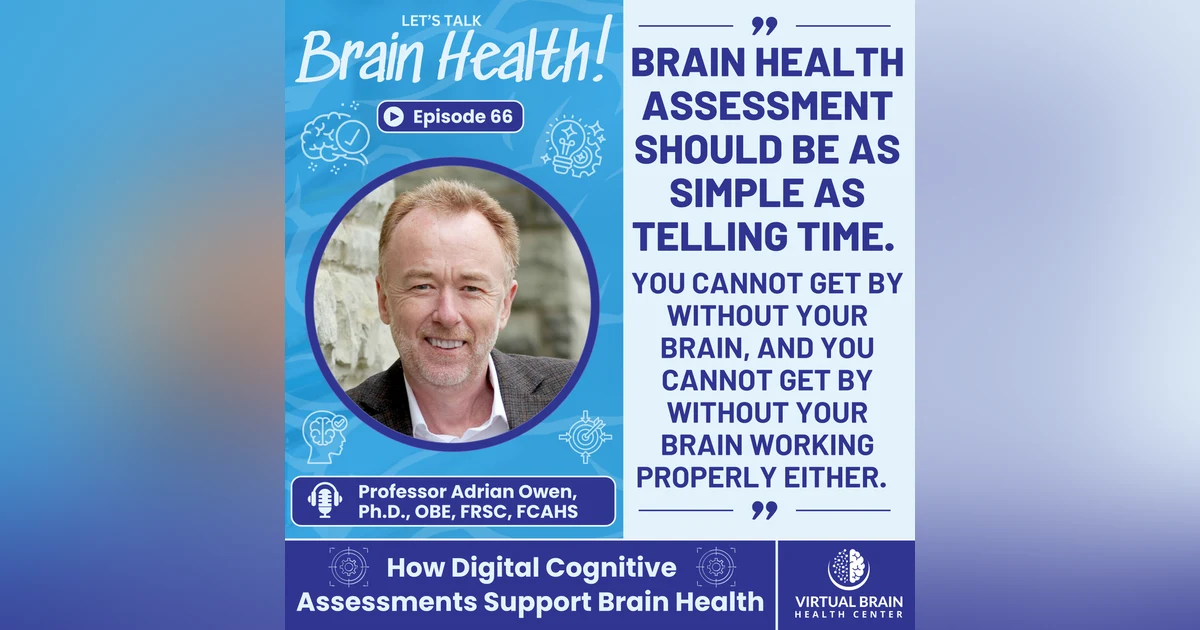

In this episode of the Let's Talk Brain Health! Podcast, we were joined by Professor Adrian Owen, a globally recognized neuroscientist, author, and Chief Scientific Officer of Creyos.
The conversation delves into Professor Owen's extensive career in cognitive neuroscience, his groundbreaking research on brain function and dementia, and the innovative digital tools his team has developed to make cognitive assessment more accessible to the public.
Key topics include the importance of brain health, the role of sleep in cognitive function, and practical strategies for monitoring and enhancing brain health using technology.
Listeners will gain valuable insights on how to take proactive steps to care for their brains and why it's crucial to measure cognitive health accurately and consistently.
The episode wraps up with actionable steps listeners can take to prioritize their brain health daily. Join this enlightening conversation to learn more about protecting and optimizing brain function at every stage of life.
00:00 Introduction to Let's Talk Brain Health! Podcast
00:41 Meet Professor Adrian Owen
03:11 Professor Owen's Journey into Neuroscience
06:37 Understanding Dementia and Cognitive Decline
12:24 The Importance of Brain Health and Cognitive Assessments
18:04 The Role of Technology in Brain Health
27:06 Future of Neuroscience and Brain Health
31:34 Actionable Steps for Better Brain Health
37:24 Conclusion and Final Thoughts
Resources:
- Learn more about Creyos' digital cognitive assessments on their website.
- Explore Creyos’ blog for additional resources and information.
- Stay in touch with Creyos on LinkedIn, Facebook, X, and YouTube.
- Questions? Email help@creyos.com for additional information.
- Read more about his book “Into the Gray Zone” and sign up for his next book’s release on August 4, 2026, “Think Before You Think: Understanding and Mastering Executive Function.”
0:02 Welcome to the Let's Talk Brain Health podcast, a public health educational initiative of the virtual Brain Health Center. I'm your host, Doctor Crystal Color, and I'm so glad you're here. On this podcast, I sit down with incredible guests to explore all things brain health and Wellness. Together, we'll talk. About how to care for your total brain health, mind, body, and spirit while sharing the latest brain Health Science practical tips and strategies you can use every day. By prioritizing your brain health, you're taking an important step towards living a happier, healthier life. So let's dive in and welcome today's guest. We'd like to welcome Professor Adrian Owen, PHDOBEFRSCFCA, HS, who's the Chief Scientific Officer and Co founder of Kraus, A cognitive assessment platform grounded in decades of neuroscience research. He also serves as a Professor of Cognitive Neuroscience and Imaging at the University of Western Ontario, where he leads one of the world's most prolific brain research labs. Professor Owen is a global recognized neuroscientist whose work has transferred how we understand brain function, consciousness and cognitive decline. He has authored over 4 100 peer reviewed papers and leading journals such as The Lancet, Nature Science and the New England Journal of Medicine.
1:27 With more than 70,000 citations. He's the scientific mind behind the creation of Creos Digital Cognitive Assessments, which are lab validity tools designed for real world impact. He pioneered digitized versions of neuropsychological tests that are scalable, scientifically rigorous, and trusted by health systems clinical researchers alike. His work brings cognitive science out of the lab and into everyday clinical practice, making assessment more routine, reliable, and accessible. Professor Owen is a widely respected voice on the science and ethics of brain health, known for making complex research accessible to broad audiences. His research on patients and vegetative states has been featured in the New York Times, CNN, and BBC and profiled on multiple international documentaries. He's the author of Into the Gray Zone, a best selling book on consciousness and the human brain translated into over a dozen languages.
2:27 His next book, Think Before You Think, will be published in 2026 and explores the neuroscience of attention, distraction, and executive function across the lifespan. Doctor Owen, you have a very long and established experience and background in neuroscience, and is there anything else you'd like to add about your experience or background for the audience? You did very well. Thanks so much and. Thanks for having me on. You can probably tell, although. I'm based in Canada. I've. Been here. I'm Canadian. I've been here since 2010. I'm not Canadian. By person, but probably tell me my voice. I was all in the UK. It's been the first half of my career working in Cambridge University. Professor Owen.
3:08 Thank you for joining us on the podcast today. I'm curious with hearing all of your experience, what brought you to initially study the brain and to focus your career on the aging brain and the applied work that you're doing today? It's a great question and it's a sort of a 35 year old story, but I'll try to compress it in a couple of minutes. But I think. Timing really is the main thing I did my it. Was at university. In the mid 1980s, I graduated. In 88 started my PhD. And that, I think, was a really important time As for understanding the brain. Function also that awareness of conditions like dementia. So around the time I think it was a. Turning.
3:51 Point where people stopped all. As stigmatized as it was, and people started to wake up and realized that this really was a big problem it was affecting. A lot of people, and that was very interesting to me, but it also coincided with. What some people refer to as the revolution in. Neuroscience, which was really main brain imaging tools and things like MRI, PET or positron emission. Technography. Really took off and these were sort of new, really exciting methods that I was actually looking into the living brain as it was doing. Its thing and. That was tremendously exciting to me. Because of course, the late 80s with all sorts of areas. And you just took off within about five years. From never having seen one of these things. And I think 1 like.
4:41 This and. An evil is to get into. Personal. Computing and then into brain imaging and then into brain ageing. And dementia research using. These tools. To do that so. It's just a very icing combination of things all happening. Around the same time being in like career. Your work has always. Blended this applied science and humanity together as you've explored even consciousness as well in your written book. How does that experience shape how? You view brain health today. Yeah, that's a great question. The real answer is when I come to realize this is actually a message that I've put throughout my book. He said we are our.
5:25 Brains There are many organs in our bodies and. Most of them we can replace and it doesn't change us as. People, if you have your kidneys replaced or your heart effects your lungs replaced. All of these things we live. In a world where we can do all of these amazing things, but we can't. Replace our brain. At least if we did. Replace our brains, we'd be an entirely different. Person and that's. Really got a message? For me it says. That is who we are and I think a lot. Of people, and this is really where it comes to. Learn, I think, a lot of our state about our. Brains is just being part of our bodies and something that helps us get through life. But it is it's. Everything. But absolutely you will be nothing. I thought this is really.
6:08 Something scored for me the importance of looking after your brain. I thought of many what's under emphasized and it is more than my opinion and looking after any other part of your body because without it you've been asked. You can go by without an arm in a. Leg or a kidney or. You can even have a. Number of heart. Base, but you can't. Get by without your brain and you can't get by without your brain working. Properly either look after your. Brain, I think that's what I've learned. I actually have a series of questions about what's starting to happen in the world about dementia, neurodegenerative dementia specifically, and given the increasing prevalence, incidence, I guess detection for this condition.
6:54 I'm an adult neurologist. I do see a lot of people who have neurocognitive disorders. But from your scientific perspective, why do you think it's been so difficult to detect dementia just generally? There's lots of tension at the moment. In the media about. Biomarkers, and it's a big password in science as well, Then biomarkers are basically the markers of the early sign of dementia. That's how it's changing. In that context, of course, everybody is looking for biomass. And I think the reason is that dementia is so. Difficult to 1 is. Of course it progresses. Received by definition so. Things move. Very slowly, you think of yourself. It's going into a pill that starts very. Very gently and then get steep and steep and steeper. We're going to be getting you doing your. Own health that you wouldn't be aware of being my health halfway up it starts to once you start to. Feel the animation.
7:51 You can think of dementia in a similar way that early on. You may not recognize the science because the changes are small and. Sub and even though you're on. That. Trajectory, you don't know. So that's one of the big problems. And The upshot of that is the very often by the time that people recognize there really is a problem, things are the thoughts. So. Far. Even if there was a cure. Even if. We could do something. About it, you know, certainly we will talk about later. They certainly our lifestyle are changing what we can do to help slow things down, but it's too late for that by the time people recognise it, sure. I think which is the most difficult 1 is that we all go through.
8:32 Brain wear and tear as we get. Older all of us cognitively decline. Very, very few of us maintain. Our sort of optimal cognitive health and well into old age and this is just part and parts and when you're bonding to jury. So function is your brain, that's your cognitive or making. Functions curate and telling the difference. Between those two things is quite. Difficult. Again, think of the Hill. On Am I on a hill that's going to get? Steeple and steeple steeper because I'm demented. Or am I just on the usual of hill that all the older people experience and telling the difference early on between what I refer to as typical ageing and something like health sizes, disease is extremely difficult because they're very similar in many ways. I'm just thinking about so many patients that say my brain's just aging, it's just accelerated aging. One of my thoughts is people don't understand that there's a difference between aging or rapid aging and disease of the brain.
9:37 It's a timeline. You're somewhere on your own line and you have to figure out where that line is. Other question is about barriers to addressing this evolving dementia crisis. So where do you see the different barriers, either scientifically, socially or culturally, or all three? Well, there are two of those areas for sure. Let's start with that. Positive I've been. Doing this for 35 years and things have got much better. In the mid 1980s. When I first started. Working with conditions. Like outside disease and people don't really talk about something. It was often a family secret that people really didn't profess to. And this of course may not as much worse because people would progress to really quite a late stay or they get to see or if I've national. I think that's changed.
10:27 I think we've really accepted. Dementia as. One of those things that happens to a lot of people in life. So it's a question society has to deal with. And the good news is that we think are much better than they will evolve. And of course. As ever. But there's still some way to go. We think we need to detect more sensitive tools. That's the main challenge. I think we need to get tests that are both. Sensitive to early changes. But also specific to the. Changes. That are. Indicative that you're on the. Road to the main shapes rather than just going through a typical ageing process. I think that's probably the main scientific challenge.
11:08 And that comes. Back to a remarkable ISM cognitive assessments and things like that. I think. That's an interesting challenge because I think we're at a time where computing. Power. Is giving us tools that make this possible. In ways that we're never good for. I think just our ability to take very large amounts of data look for. Patterns in that data. And try and work out what it all. Needs for the individual patient. Are better than they've ever been. That's exciting. On the sort of societal side, I would say a cultural. Same thing I was saying which is that. I think education we really need to understand.
11:50 And I think the more. We can. Explain to me pretty straightforward non jargon. And Laden in. Ways What are the signs of all incremental? When should you work? Just as importantly, when shouldn't we worry? When should you access? This is just me getting a bit older. I think a lot of that is not about science. It's about the way we convey information with people and we make information. Available in a way that. Allows people to understand what they mentioned what they mention are. And how they give us some. Typical aging. Hearing your response, I think people can see why we're grateful you were here on the podcast having this conversation as that was 1 John Guy's vision for the podcast was to do this public health awareness piece and having conversations with experts like yourself around brain health and different facets of what does that mean, to try to get people to take their brain health seriously and to think about it.
12:51 And goodness, have you given us so many clips that we can use to raise that flag? I know John's always saying cognitive health is one of our vital signs early on. You speak about how brain health should be measured early and often. What does that mean for the everyday person? There are two steps here. 1 is that there are many tools out there that I think people need to understand the difference between things that are based in really good solid science of things that are perhaps people taking. Opportunities. To commercialize or just market something that doesn't do what it suggests. With my I understand that's.
13:37 Extremely difficult for people to do. I would urge people to just with the credentials and. Who's by finding the? Test are these. Only 5A scientists or doctors that have actually. Worked in this area, published scientific papers in this area. I think this is tremendously. Challenging. There are hundreds and hundreds of possibilities beyond that, if you can talk through the noise. And really find the tools. That are scientifically validated. They are there and they are. Available. For people to use. And I think that this is, you have an opportunity now like never before is the fact that almost everybody has a smartphone in their pocket. Many people have a smart watch on their wrist.
14:19 These are tools that we can use to monitor cognitive health in much the same way that people use them to measure their blood pressure, atrial fibrillation or everyone else. It is that you're using your smart watch to measure the number of steps you make. Some so often, I think there are very sensible tools now becoming available. And they're generally. Right to people that can allow you to monitor your cognitive health and that's what people. Need to be doing. They need to be doing it. The same reason. In the same way that people will measure their steps. And I'm really very optimistic. About because of an. Age where I remember when they would. Have a smart watch and nobody had a smart. Phone and nobody thought about how many steps they were taking every day.
15:03 But that's now my friends. And family who report. How many steps they did? It's great to move into. This era where? People are thinking about that physical exercise, they're doing it. And I think we can also move the dial so that people do the same thing with cognitive function. Think about if my new new shark used to be. Am I still able? To concentrate the way I used to be. Are there signing several signs that things are changing? I can do that. I think it's a great opportunity. I share your sentiment and almost thinking that our smartphones to an extent, we have this brain health coach in our pocket if we leverage it. But we have to find this right balance of not hitting this digital overload. And how do we interact with, like you said, some ballot apps or information in a way that's meaningful to us that supports our behavior in a good way.
15:55 Because unfortunately, we could almost get caught in a trap and have a spiral where we become too fixated on what we're tracking or what we are doing. But I really do think, as I heard someone talk about it before, is like we're all walking around with a brain health coach in our pocket to an extent. If you wanted to focus on your nutrition or if you wanted to focus on a different way to engage your brain, that there is something for that could meet what your brain health goal is in a way. But how do we balance some of that? Do you have any suggestions for people on a way to avoid that idea of digital overload and you very? Kindly mentioned my. New book Things Before. You think, and I go into a lot of this in that.
16:38 Which is what I need to do. I mean, a lot of people feel with these like dimensions. But there's nothing that can be done that's going to do. What can I do? I go probably not in terms of. What can you do and. A lot, a lot of it simply about using these technologies to simplify how you measure things. So ultimate things as. Much as you can and think about range house as you've. Implied crystal. It's not just about. Measuring your memory. Or your intention. It's about. Eating well to maintain. Good brain health. It's about. It's about. Regular exercises. These things are easily and. Automatically.
17:19 Monitored with things like smart devices, phones, and. More trees and so forth. So. Set yourself at all set yourself. I'm going to follow this diet. Or I'm going to do. This amount of exercise it. Doesn't need to go to the gym of the day, just need to get out and do some. Walking again. Let me talk about this in a bit. We knew it's vital, important for brain. Health and cognitive health, obviously. Your sleep and. Use that. Information to try and develop. Good. Cheating habits. No reason why out. Yet it's about 8 hours. And that would be our. Recommendation. Yeah. So use the technology. To your advantage rather than simply made it overwhelming. Thank.
18:05 You so much for sharing. Some of your insights because now I'm excited to hear how you've taken all of your knowledge and your career to now tell us about the work you've been doing at Creos and how it makes brain tracking more accessible and meaningful outside of the lab or in the clinic. So can you tell us more about that, please? Sure. Yeah. So, Kraos I started. Developing when I was a PhD student. In 1988, it's been known. On a long time, and of course we've gone through many. Iterations over the 35. Years or so has it been. In developed, I think we're now at the stage where. One of the most important. Components are fit with respect to your question is that.
18:46 People can test themselves now one of the. Problems with cognitive assessment is we don't really know what to obsess and how to. Assess it's Most people understand not having a manually proper base, but do people? Understand how we've been testing a problem with attention or concentration. Or executive function is a term probably most people have heard. You know exactly what it is for most people, probably. And this means that people get in line to see a professional. And. That may take many months. Plus all the money. Chaos versus if it uses the best science we have. And that's been developed at the same 35 years to try and put this into the hands. Of the sort of end.
19:30 User to make it possible for people to test. Themselves. And I think that's the most important thing. We've had many successful. Trials now and we've shown that regardless of whether you go off and spend 3 hours with a professional. Or you test yourself. You get. Much the same information about. At the end and of. Course we've tried to serve. It up in a way that people will understand. That makes sense to me with. Everyday examples. These are the sorts of things. That. You might struggle with if. You have a problem with attention or these are the sorts of things that you might struggle with. You have a problem with executive function so. We're trying to turn what is essentially. In medical scientific area in order to make it more.
20:14 Accessible without losing any. Efforts or someone's behind it we're. Putting it back into the hands of the. User. That's the main thing. It's very. Efficient. It runs very. Quickly. This has been developed in my lab. Is to try and work. Out ways of very quickly. Finding out how good somebody is something problems with If anybody listening has been off to see a say, a neuropsychologist for. An evaluation they'll know that involves a lot of very long Orient tests. No. Disrespect to any neuropsychologist this name, but that's the nature. It was the nature. Of a cognitive assessment, we found ways of speeding. That up making it more interesting and babyfying things so it's actually fun matter the reason.
20:59 Why we? Collect our script is because some smart person has made it fun to monitor. How many steps you have? Given them, we're doing the same thing. For. Cognition we're making it wouldn't see any fun. For people to measure their memory, measure their attention, muscle function and I think. That's where chaos sits. And of course you have about. 20 million data sets now, so it gets better and better because the more people that. Get tested, the better we are able to model how. Typical AG presses for. Example and dementia person. This is much. Better with developing the precision with which we can make various predictions about the of health. Thank you so much for telling us more about. That do you have an example or a case study that might put it all together for us now that we've heard the science behind it? Absolutely.
21:51 Just two weeks ago her friend got in touch and say that she was borrowing her husband. They've been deteriorating, but they. Were only in their early 60s. I'm really they shouldn't, I don't feel they should be deteriorated. So I interviewed the person and actually. She's seen, surprisingly, nothing she can answer questions have more more. Conversation told me that she'd. Just been shopping and. What we did is we gave chaos evaluation. As I've said, it's a series of short. Test memory. Attention executive functionalists it was. Very. Immediately that she actually had a much more serious problem than I could even tell by just interacting with it in person.
22:37 So what we then did, listen, we need to answer your question. We thought, OK, what we need to. Do is to monitor. Our overtimes. Now if in three months she will receive them. The money saying it's time to beat the cryos. Des, he's taken again in chart you just mentioned we'll be. Updated in three months and we'll be able to see whether. She is. Deteriorating from the time we already know that she's not in the typical. Range for most of any of the tests we tried. But. What's really? For determining is the renting. And how she? Declines if she declines and that's all for the automated and in fact I didn't.
23:20 Need to do anything. Else perhaps the next 6. Or 9. Months when I look at this data. Every three months which we automatically collected. Draft and tabulated and. It'll tell me. Whether she's deteriorating or whether there's some other issue with her brain. A. Lot of our podcasts are focused on normal healthy people or keeping brains healthy in the Middle Ages as people get older. And I'm just curious, given that your technology can evaluate people who have diseases and presumably that people that are normally aging, do you have some good data sets about people intervening who generally seem to be otherwise normal in their Middle Ages with sleep, exercise, social engagement, and how your cognitive testing shows or delineates that they're actually maintaining or improving brain function?
24:18 Yeah. This is what? The bread and butchers what I do every day, so I'll. Run a lab. Even though so my son's very early. What we do is we. Use to conduct large scale. Studies in the general public. By large. Scale. I mean they typically involve 10 to 20,000. People, and we include them through. Media ads or through podcasts. Like. This and we look at specific issues like how does. Sleep affect cognitive function, so a. Couple of years ago. We did the study of. Almost three 2000 people. Of all ages, and that actually will become important a couple of minutes. What we did is we. Got them to talk how much sleep they had last night as well as how much.
25:01 Sleep they typically get. What their sleeping patterns are? Lots of information about sleep. And then perform our cognitive tasks and within a couple of weeks we had 20,000 data sets of people who. Were doing their. Sleeping habits. Some really interesting things. And I'll give you 2 habits that we found amazing. That, of course. 3 Little sleeping is not good. Right, the absolute. In the end of sleep, it should be getting between. 7 and 8 hours. So that's probably not going to surprise. Anybody that number has been banned in around. Decades. It's true those people are sleeping from 7 or 8 hours. Were doing their best to call them.
25:41 What was really surprised, I mean, is that too much? He says. It's bad. It's too little sleep. If you. Are only getting five hours in fact, you want me behaving cognitively like somebody who's almost 10 years older than. Yourself so if you're a 50 year old. You're only getting between. Four and five hours of sleep a night, your cognitive performance is more like a 60 year old, but also at the other. End Literature. Those people who are always sleeping for 12. Hours a night weren't doing very well. Cognitive. That's interesting and. For me it's. A bit of a surprise. It's not true that you should get as much as you. Can you should get. Just the right amount. The other thing living, which I think will be very interesting for this audience is. That.
26:24 It's generally full. As we get older, we need less sleep. What we showed through this study. That's not true at all as you get older and. Get less actually. If you get more sleep, you are positively in much better shape. So it's not what older? People need it's. For I know psychological or physiological reason, don't really know exactly, but old endlessly less. And that is bad. So it's Uphold. To the marriage. That well you needlessly as you get old. It's just not true. You need just. The same amount of sleep, it's just that you're not getting it most of the time. And that was a surprise for me, too.
27:07 And in the next decade, what's the future of your work? What do you see the future of neuroscience? Digital health. I think of it as a feedback loop. We're walking around with brain health. We can look at our phone, my watch, and say, oh, my attention's not good today. Maybe it's time for a little exercise, a little cognitive training program or whatever for 5 minutes. That's how I see it. But I just curious how you see it. I had the same vision as you. But a sort of scientific version of it rather than a sort of cycle version. In the sense that. Like you means feedback. These new sort of digital tools empower. Us to collect much more information about ourselves. But we. Didn't have at all. And that information will become essential for us developing. Better tools.
27:55 I spend a lot of my time that, as I just said, conducting these very large scale studies. And once you start using 10s of thousands, even on millions of data sets, you start to. Be able to testing. That you really weren't. Able to test before you really seen an example. We did another study where only. Had about 20,000. People we asked them simply 2 questions, one when you had a had a compassion in my life. But the question was, how many confessions have you? Had and it turns out. I mean this is. Completely out of. It was a very scientific way of I think. Most scientists have referred to this as a. Fishing Epic addition We have a strong idea about what happened, but it turned out that among the.
28:35 Prayers, tests. We had one. That would detect people had. Concussions, we weren't able to do that. Because we had 20. 1000 brains to go 20,000 people donated their time and their cognition to tell us and. We found this one desk that really had no idea was specifically sensitive. Question. And the more concussions. We had. Where she were at the desk. We then did something very scientific, which is we went. To. In my case I went to the. Group of Arson football team here at West West. And we made a prediction. These. Players not as supposedly, even. Thought it had a good fashion. Would be bad. At this task because. There's no question that they spend a lot of time tying their heads. Together and that.
29:19 Is going to be indicative. Of some passive injury, and sure enough, they were just one. So that's a very strong. Scientific conviction to me, which was shown to be truthfully studies. That's the cycle that. I see here which is that once we start collecting from the data when we want to providing it for scientists to always and look at it. I think we're going to. Learn a lot more about. Devise better ways of testing. I want to add one more thing and Crystal's going to go forward. Very interesting. I'm thinking now preventive neurology, predictive analytics, for example, somebody who's getting ready to drive, take on a truck, a plane, and you can do a Chris analysis before you go on to one of these risky adventures. Maybe, you know, a car ride and you say, oh, my attention's not good today, maybe I shouldn't be driving or something like that. We're.
30:15 Going to be going back. We do quite a lot of work. On workplace safety, which is a. Version of what you've just described. We've developed a tool. A very quick and easy set of cognitive tests. We could do in two or three minutes, particularly. They are in fashions, put themselves or others at risk. So imagine your pilot. Or even a bus truck, somebody who's other people's. Lives are dependent on you. Yes, you would want to know in the morning you're in tip top condition, you're able to concentrate, you're able to make. Decisions you're able to solve problems. We don't. Care. Why somebody may not be on tip condition, we're not in the business of saying.
30:56 Hang on a minute. You had a bit too much to drink. Last night, or you need a bit more coffee, or you need more sleep. It's not really about. That. It's just. About only when you're not at your. Best and you that person. Step. Away. I'm not actually today. I'm not equipped to. I'm not at my best do this job again, it's not. About choosing people of bad behaviour, I mean it's. About identifying risk and you have a tool for that, I think it's really interesting areas for further develop. We've covered so many fascinating topics with you today, and I regret our conversation is winding down, but one of the things we like to do is to make sure we can give our listeners some actionable steps from you today. So I'm going to do our rapid fire questions with you. As an expert in brain health, what is your one non negotiable for taking care of your own?
31:51 Brain, I don't do any activity that could possibly impact. My brain without wearing how I sneezed a helmet I cycled. I annoyingly for my family and. That's the room for a family cycling medication without my helmet all the way home because I was determined I ordinary. Disciple the other. As I've said earlier in this podcast. We are our. Minds and we should do our absolute best to protect. Our brains and one way to do. That is to make sure you don't. Hit your head. At least if you do, you're wearing I'm. Glad you shared that. We wrote a kids book about brain health and that was one of the edits we made sure we went back and stressed and to make sure that if they hit their head hard enough to say Ouch that they told a grown up truthful.
32:37 Adults as well. I think many of us think that's the thing for kids hitting Drew. In adulthood, can be as. Bad as an adult, actually injury. In childhood, it's an easy thing to do. It really isn't hard. It's not a bother, and people should think of it the way people think about seatbelts. You just took it. Yes, and our part of the way of being tricky was we thought if we educated the young kids, ages 5 to 9 is they were reading with a grown up, meaning an adult or grandparent. And so that was the back door way of having these brain health conversations early. And it makes adults think differently when they're engaging in that with the child and reflecting on their own behavior a little bit. We thought we could impact change just a little bit differently.
33:22 So we were trying to be a little sneaky there. So glad to have you highlight that one. I want to ask you, if every listener took one small action step today to protect their brain, what would you recommend I? Would say get better sleep. I think really. Prioritize your sleep. That's about the making sure you get enough sleep. And as I said, 7 to 8 hours is the right amount. 1 interesting thing in that sample of. 20,000 people. Was that? More than half. Those people were reporting getting under 6 1/2 hour sleeper night, so that's half the population aren't getting any sleep. And I think if people. Just worked a little bit harder. Went to bed a little.
34:04 Bit earlier, and I certainly did for myself. Trying to really. Prioritize sleep? I think not. Only will. Their. Lines be better on a day-to-day. Basis because we know from the size that they will be sharper. You're also protecting your brain for the future. I'm so glad you've highlighted that, and I'm going to make sure that we can snag the link to your research study as well to include in the show notes below for our listeners. How can they learn more about you and? Follow your work. Quite a comprehensive website. It's an owing lab. Dot org that sort of, that's a lot of information about things like trios and you get access to trios, but also the research earlier in the lab.
34:47 All about scientific. Papers including sleep study that I've just described from being quiet. On that website. So it's quite a resource. You also mentioned. The book came out in 2. 1018 into the Gray zone. It's quite. A lot of information about the work I've done on. Brain injury involved consciousness. And then how we measured? Brain injury and then the. New book coming out in published by Norton in 2026. Think before we think that's really. Much more focused on. What we've spoken about today, what's the influence of sleep and nutrition, exercise and how does it? Affect life. How does it affect still the lifespan? Is there anything we can do about these things?
35:29 As well as. Breaking down obligated size of the terms label executive function, does that really mean you're in the? Place. Everybody's got a problem with the executive function these days. And so I'm trying to break that down. And make that truly accessible to the general public. And all. Those links will be below. In our show notes or our listeners can find that in your guest profile. With this episode, I want to ensure you have the final word today. What message do you want people to take away from our conversation today about caring for their brains? You sound like an old broken record. It's. McCarthy Brain, because you are your. Brain, really. It's absolutely everything I see. So many questions, not only.
36:14 Patients and dementia struggling with COVID function, but also patients that have. Been involved in a road traffic accident. Or. Even hang their head on kitchen cover a bit too hard and these things all affect your. Copy of function and they all effects who you are. As I say, we are output. Please, if you do nothing. Else. Whoever you can to. Come to your brain because it is what you want from home. And I think all of us share your sentiment that you have. And I want to reiterate this for our audience that I think this is the vision and hope that we have ideally for the field of brain health, that understanding brain health should be as simple as telling time.
37:03 And you have dedicated your 35 year long career and your work to show that measurement and objectivity are the compass in guiding both science and everyday care. The tools that you have created to make brain health both measurable, reliable and actual give us all ways to protect and support our minds. Professor Adrian Owen, thank you so much for letting us pick your brilliant brain on the Let's Talk Brain Health podcast. Thank you for investing your time and energy into your personal brain care by listening to today's episode of the Let's Talk Brain Health podcast. I hope our conversation gave you fresh insights, a bit of infiration or. Practical.
37:46 Steps that you can take on your own personal brain care journey. If you enjoyed today's conversation, I'd like to ask you to please share this episode with someone who could benefit from it. Or. Consider leaving us a review if you have questions or a topic in brain health you'd like me to explore. Please e-mail me anytime at podcast at virtualbrainhealthcenter.com. I'd love to hear from you. We have so many more exciting topics ahead, and I can't wait to continue this lifelong journey of better brain health together with you and our growing virtual community. Until next time, remember to give your brain the care it deserves and make your brain health a priority.