
 Apple Podcasts

 Spotify

 Amazon Music
 RSS Feed
Integrative Brain Health for Neurodivergent Kids: Insights from a Pediatrician with Dr. Hokehe Eko, MD MPH FAAP
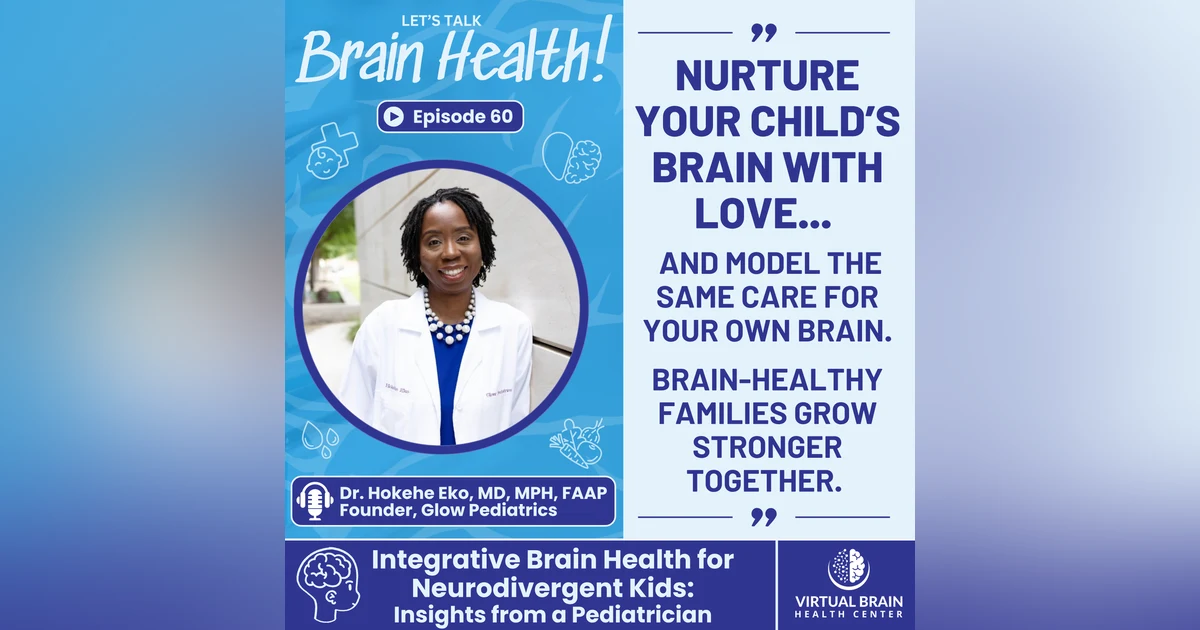

In this episode of the Let's Talk Brain Health podcast, Dr. Hokehe Eko explores the crucial role of nutrition in supporting children with ADHD and autism.
A board-certified pediatrician and specialist in integrative medicine, Dr. Eko discusses the gut-brain connection, blood sugar regulation, essential nutrients for cognitive support, and practical dietary changes.
Sharing insights from her personal journey and professional expertise, Dr. Eko emphasizes the importance of addressing food sensitivities and adopting healthier eating habits to improve behaviors, focus, and overall brain health in neurodivergent children.
She provides actionable strategies to help families make small but impactful changes, underscoring the interconnectedness of diet, hydration, and brain health.
00:00 Introduction to Nutrition and Integrative Medicine
00:24 Meet Dr. Hokehe Eko, MD MPH FAAP
01:45 A Personal Journey to Integrative Medicine
07:24 The Gut-Brain Connection
11:25 Practical Dietary Strategies for Neurodivergent Children
15:56 Identifying Food Sensitivities
20:43 The Importance of Hydration
24:16 Debunking Myths and Final Advice
28:24 Conclusion and Key Takeaways
Resources
0:02 Welcome to the Let's Talk Brain Health podcast, a public health educational initiative of the virtual Brain Health Center. I'm your host, Doctor Crystal Color, and I'm so glad you're here. On this podcast, I sit down with incredible guests to explore all things brain health and Wellness. Together, we'll talk about how to care. For your total brain health, mind, body and spirit while sharing the latest brain Health Science practical. Tips. And strategies you can use everyday. By prioritizing your brain health, you're taking an important step towards living a happier, healthier life. So let's dive in and welcome today's guest. In this episode, we'll explore the critical role of nutrition in supporting children with ADHD and autism, and how integrative medicine can improve behavior, focus, and overall brain health.
0:54 Today, we will explore the gut brain connection, the impact of blood sugar regulation, key nutrients for cognitive support, and practical dietary changes that can make a difference for neurodivergent children. With Doctor Hokey Echo, who is a board certified pediatrician specializing in integrative medicine for children with ADHD and autism. She is on a mission to empower families with neurodivergent children through her practice, Glow Pediatrics, an innovative virtual practice that conducts autism and ADHD valuations nationwide and also provides ongoing holistic care to significantly improve behaviors and boost the gut brain health of their patients. Doctor Echo is a Fellow of the American Academy of Pediatrics, a TEDx speaker, and has been featured on various platforms including Black Enterprise, Business Insider, BuzzFeed, Thrive Global, and the UN Youth Forum. She hosts the Brain Power with Doctor Echo podcast and speaks regularly at conferences on topics related to brain health strategies and improving outcomes for children with autism and ADHD.
2:03 When Doctor Echo is not seeing patients, she can be found chasing her three children and serving foster kids as the founder of Kits of Hope, Inc, A5O13C nonprofit organization that shares love, hope, and dignity with children in foster care. Doctor. Echo, thank you so much for. Joining us today, what inspired you to focus on integrative medicine for children and their parents? Great question. I've been a pediatrician for over 12 years now and everything was fine. And then my daughter's lips turn jet black, like my hair color and I said what in the world? So it wasn't just her lips that turn black.
2:43 Her whole face broke out and then her behavior started changing and then her grades started sleeping and I was like what is going on with this kid? So of course I took her to see the dermatologist and they're like they have no idea what this is. I went to see the allergist and they said we don't know. All her tests are negative. So they did the whole skin prick test, test everything. That's when I got upset because then I let them know I was also a physician. And listen people, there has to be something going on here. You can't tell me this kid has is negative for everything, not even dust. Like seriously, I was desperate and I started looking around and I was on Facebook and I came across this group called functional MD's and I was like functional MD's.
3:25 What's that? I went in there and I discovered there was this whole nother world I had no clue about called functional medicine. That's when I started asking questions in the group about what to do with my kid and then somebody suggested do a food sensitivity test. So I did it and I found out my child was very highly sensitive to gluten, eggs, dairy, pineapple, cashews. So all the things I thought I was just amazing mommy, the whole wheat Mama. And then I was like, wait, hold on. OK, so that's not going to work anymore. So I cleared our fridge that day and cleared out all the culprits. And in six weeks, her lips turned back to pink.
4:07 And that's when I was like, oh, nutrition plays such a big role in behaviour in all of that. And so I went back and I started searching and asking more questions. And then that's how I discovered my fellowship. And I retrained as an integrated pediatrician. But before I did that, I had this one patient that had autism and ADHD, and she had never let me touch her before. Every time I'll see her in the clinic, I would have to be on this side while she and her parents are on that side. She was nine years old. She was so aggressive, also constipated, also wasn't sleeping well. So I told the parents I just learned this stuff about my kid.
4:48 Maybe try your kid off gluten and dairy. Maybe you make a difference because I've been doing some reading about what those two food groups can do to kids brains. And so they tried it in four months, this child that was non verbal and very aggressive and not sleeping and constipated, she was now sleeping better, was no longer constipated and less aggressive. By 6 months she said her first word, Mama. And that's when I was like, oh wait, this stuff actually is critical. Like I can't even Unsee this anymore. Like how can I keep treating kids the same way? Fast forward, I was at a different job and by this point I've started just doing those two things with my patients. Well before I got retrained, I had this job and I was being harassed at my job.
5:37 So I left and I was like OK, so now what am I going to do? So I call it my God moment because it's not like I didn't know there was an issue with autism and ADHD evaluations in my state. But he dropped in my heart and so I decided to go find a specialist like a developmental pediatrician and shadow him. So I learned how to do the medical diagnosis because there's a two year wait list and counting in our state. That's how I started my practice doing medical diagnosis for autism and ADHD. And at this point I had retreat. Then I was like, wait, how can I just give them the diagnosis and say bye when I know I can help them with all the things that they have going on?
6:17 Because when I do the evaluations, I'm doing it from a holistic standpoint like sleep picking, eating behaviour. So it's not just hey, you have autism, but hey, you're not sleeping well, you're not. We can address this picky eating because it's affecting the way you behave. That's how my practice evolved to now becoming a practice where we do we practice integrative holistic medicine for children with ADHD and autism. Thank you so much for sharing your story. I think for most people, if they're following around brain health, whether it's themselves or their loved ones, this idea that we reframe the experiences that happened to us, we can either see it as a challenge to overcome or something that redirects us.
6:59 And it's wonderful to hear how it was a point that pivoted your journey and now a way that you are continuing to help people in new and different ways. And I like to recognize in the brain health space, functional medicine comes online a lot or lifestyle medicine. There's lots of other disciplines now, preventative neurology, all with an idea that we need to pay more attention to these lifestyle factors for everyone. Because unfortunately, it takes kind of the worst case scenario for a lot of people, for themselves or their loved one define these fields. Because if not the mainstream ones like pediatric primary care or primary care, like they're overwhelmed with what they're able to do. And just like you said, they don't have enough time to dig as deep as some of the specialties can. And so appreciate you sharing that for today's conversation, I wanted to jump in a little bit deeper on the gut brain connection for our listeners because I think that highlights your area of expertise.
7:55 What should people know about the gut brain connection and how that influences behavior and learning for neurodivergent children? Excellent question. When we talk about neurodivergence, the word neuros in there, which simply means the brain, if we're going to make any difference in the behaviours that our children have, we have to address the health of the physical organ in the brain. And there's so much research to show and even the stories I shared that shows that the gut and the brain are connected to each other. The gut is often referred to as the second brain. For example, melatonin is something that's produced in the brain to help with sleep, to help regulate our sleep cycle. But did you know that melatonin is also produced in the gut? If your gut is backed up and not functioning like it should, a lot of melatonin is not going to get produced, right? Because then your sleep is going to be impacted and from both organs, right?
8:56 The gut is off kilter. And if the gut is off kilter, the brain is off kilter. So therefore, here you are trying to give your kid melatonin when we should be focusing on taking care of the two organs that produce the melatonin so that the body can come back and produce the melatonin it needs so that your child can sleep better. Do you see? One approach is we're going to fix it with the Band-Aid. We'll give you melatonin that's synthetic or we address the real issue, which the melatonin that we're giving by mouth is not going to fix. We address the issue of how do we clear out and make the gut and the brain healthier? So they're absolutely connected to each other. I often tell parents, think about this. We talk about inflammation.
9:41 What's inflammation? I like to describe it as we're setting the brain and the God on fire. And when I say that, they're like, oh, yeah, we get it. Because when you say the word, it just sounds OK. Literally that's what it means. Especially with the foods you eat before you put foods in your mouth, you want to think, does my brain and my God love this? Because if not literally you're selling your child's your child on. You are both selling your gut and your brain on fire because they are so interconnected and what happens to 1 affects the other. Even with behaviour, I have seen it over and over. Children who are very constipated, meaning they're holding on to all the toxins that their bodies are supposed to release because that's how the body was made and now they're backed up.
10:25 They're often really aggressive, like the story I told you about the night. My first patient I treated in an integrative way without knowing it. Once we got her Constipation result because her parents took out the foods that were inflaming her, then her behaviour shifted and her behaviour improved. That's how closely linked everything is. Sleep, Constipation, aggressive behaviour or not, or just behaviours in general that you would like to improve. They are all connected. The key is where do we start to make change in this cycle? Because if you don't, it's going to be a perpetual cycle. And then you just keep slapping band aids on in different places that doesn't really give you the result that you're looking for. It's always wonderful to talk with guests because the idea with brain health is it's not one thing, and even with your gut health is it's not one thing. But the body being so interconnected, you have this extra benefit you get in other areas of your holistic health even when you address one.
11:27 But we know some like nutrition or these solid foundational pillars that we want to have in place for ourselves. I think one of the hot topics we hear about in general and health is metabolic health is now the buzz. It's been the buzz for a while. It's probably here to stay with raising awareness around blood sugar and blood sugar stability and its relationship to our mood and focus. What are some practical strategies that families can use or to be aware of with this topic, especially for children? Yeah, that's an important question because again, we are what we eat. Food is medicine. So when we have children who love to eat, so you may be thinking, OK, he's just a kid and let's just give him some candy or all of these snacks and things that have lots of sugar in them. The thing is that sugar doesn't break down completely in our bodies, especially our young kids. What's leftover of it goes into the brain and acts in the brain like it's an opiate receptor.
12:33 So parents think about if you know anybody that is on drugs, right? What are they? Like they're either high and don't know what's going on around them, or they're like unresponsive, or they're somewhere in the middle. So sugar acts the same way in the brain. If you pay attention and you see a child who's just had an overload of sugar, maybe a sugary drink or a really sugary snack, they like go crazy. It's like they're bouncing off walls and just acting like you can't get them under control and their blood sugar spikes as well. And then guess what? When the blood sugar drops, then the mood just drops too. And maybe you go from a bouncy kid to now a kid who's tantruming for the slightest thing and you're like, what in the world is wrong with my child?
13:17 How are they going from high to low like that? But that's exactly what's going on because again, it's inflammatory. It's setting your child's brain on fire. Your child's brain is trying to compensate with all of these measures, try and settle things. But the more of those inflammatory foods you're giving your child, the more the body doesn't isn't able to adjust and to calm the brain down. And then it just gets worse and worse. It's so important. The SDR children, they will be fighting, they don't eat candies that are chock full of sugar or like all the dyes. I would have to mention the dyes. These food dyes are new, are toxic to our children's brains and our brains as well. And if you look at Europe, they ban most of these dyes. But in the US, we banned 1 and it took what, 20 years to ban the red?
14:08 But parents, it's not just the red, it's the yellow, it's the green. It's all of them. They're all, they all will set your kids brain on fire and will disrupt your child's blood sugar. So important to please there's. So then you're asking what can I swap out for that? OK, you want to learn to read labels and look for things that are made with date sugar or try your hand at baking something. We've gone past the days where we like to cook. Try baking cookies with your kids at home and instead of sugar, use date sugar because that's made from a fruit and it's going to digest in your body easier. It's just making those swaps. And the idea about baking cookies, it's not just the act of baking cookies. It also strengthens the bond between you and your kid. And overall, isn't that what we're looking for as parents, right?
14:54 That our family bond can be strengthened regardless of what's the diagnosis of your child is. And it's just finding these little places to make changes. If you see rightly colored candy, don't choose that. Or cereal, choose something that doesn't have any additional colours in it. At least that's a good place to start while you try to lessen the amount of inflammation in your kids brains. I know these are hot topics or think around all ages, but especially for children because they aren't necessarily making the decisions themselves around their nutrition. So the adults around them, the environments they're in, the communities can play a big role in setting us up for longer term health.
15:35 If we approach it with that perspective as the opportunity of it impacts the health of everyone in that environment, like schools or daycare, that there are these swaps we can have to make some wins. You've mentioned this twice, so now I'm going to ask about it. If parents are looking to identify food sensitivities that might be contributing to their health child symptoms, what steps can they take or how do you recommend they go about that with their healthcare providers? Great question. Depends on who your healthcare provider is. I say that because I used to be a general pediatrician, right? If you came to me and said test me for food sensitivity, I'll send you to the allergist and the allergist to do the Ige test.
16:19 The Ige test is more geared towards does your body have an immediate reaction to it. The test I do is an IgG test which shows sensitivity that's been stored in the body and at some point will erupt in some way, shape or form. That's the kind of test you're looking for. It's an IgG food sensitivity test. And if parents cannot do the tests, there are several places where you can get the test done. But if you're not able to do that, I always tell friends, start somewhere. Either try of gluten for at least three months or try of dairy for at least three months. Those two foods actually add sugar. If we can decrease them, you will start to see a difference in your child's behaviour because not only will your child's Constipation decrease, now because your child's Constipation is improved, their sleep will improve. So will their behaviour.
17:07 What does that look like? Wheat has gluten in it, so rice doesn't. Instead of buying wheat pasta, get rice pasta. This is so widely available even in Walmart, there's a cold shells of gluten free. But of course, again, you have to read the labels because you don't want to get foods that have 1012 ingredients and you don't even know what the names mean. Look for foods that have maybe one or two ingredients in them and you actually can recognize what it is. So I've given you that example. That's a common one. And even bread, if you're saying OK bread, I like wheat bread, there's gluten free bread you can try. All of those things are widely available. Now for dairy, I would say you want to try off if a child is drinking a lot of milk, maybe an easy way to ease your child into it is adding small amounts of either like an almond milk or like a oat milk, things like that, but small amounts until you lessen the dairy and increase the amount of oats because dairy by itself is constipating as well.
18:10 So you see, it contributes also to the Constipation, which can contribute to everything else going on with your child. But again, you want to look at the labels because they are almond melts that have 10 things in it and they are almond melts that have almonds and water. So you definitely want to go for the brands with almonds and water, not almonds, water, glues, gums and who knows what else they add in there. So again, less is best. You want to look for brands that carry minimal ingredients. And please go visit the veggie and fruit aisle. Your child needs them. And you mentioned the word lifestyle. Let this be something that the whole family does right?
18:53 Because we're not pointing one kid out and saying you over there, you need to eat better. We don't. Everybody in the house needs to eat better. If you start incorporating fruits and vegetables, even if it's small amounts and the child may not like it and you may be saying I have a picky eater, they won't eat it. Just keep showing it to them every day. A small amount every. At some point they will. And you know what? Once you can clear off, once the child's Constipation starts resolving, their palate opens up and they're willing to try more foods, you see again how that connection happens. And it's not one thing in isolation. Once you start with one thing, you're actually helping multiple areas of your child's health.
19:35 So I hope that helps. I think it's a great way to highlight that there are really quick tangible winds. Just like you said, you can do a whole overhaul. But if not, when you're doing all these swaps and even if you're doing a couple a week or a couple on each grocery run over time, that includes to some fast items not being available when you're home. So then you're using the alternative. And so I think a lot of times we tend to forget that it's those small wins could have a meaningful impact or for people where it's using what you have and then when you go to buy new, make a better decision at that point is there's all these different ways you can approach it to keep it. Something you can sustain as well. I like to encourage people that way. And I want to ask you though, I think one of the things that gets most commonly overlooked with hydration, I know you're a paediatrician as well, it's hydration. What should we know about how that impacts brain and behaviour, especially in children? Yes, that is so important because the brain is the one organ in the body that needs the most water, not the most soda. All the lemonade is the most water. So again, we're back to the brain giving the brain what it needs.
20:47 I just need everybody to fall in love with the health of their brain. Because when you do that, you're going to ask yourself, is this going to help my brain or not? Before you put the soda in your mouth, think, does your brain need this? And the answer is no, your brain needs water. A good rule of thumb is drink half your weight in water. So you may think what? OK, so calm down, just start where you are and maybe add one extra ounce of water a week. Again, like Doctor Crystal just said, small amounts add up. It's consistency over time we're looking for. So it's nothing to be overwhelmed about, but just start making intentional choices now. You know your brain needs the water, your child's brain needs the water to function well and we are dealing with brain based disorders so you want to think about it that way. And even if you say your child doesn't drink water, start diluting what they drink more and more water slowly every day until it becomes more dilute.
21:45 Another way to encourage kids to drink water is put fruits in the water. So instead of buying those 0 calories, sweeteners or things to add taste to the water, you'll have to think about it. Those things are chemicals. They're made in the lab. We're trying to stay away from all of that. So instead, put a couple slices of apples in your water, stick it in your fridge. In 30 minutes, your water will taste like apples, but there's no added chemical in there. Once kids participate in an activity, they're more likely to follow through. So if your child is the one in charge of putting fruits in the water and they're more likely to drink it, those are just some ways. And then if you do it as a family, right, you say, hey, we're all going to be drinking a little more water each week. Make it fun.
22:28 Make it an activity that again, bonds your family together and you see such a result, how will that help? Once your brain gets what it needs and it's getting the water it needs, it trickles down into sleep, into behaviour, into everything, because again, the brain feels healthier. Love that example you gave of turning the fruits into the water. It's one I know we used in my house, especially when friends, kids visit or my niece. It becomes the science experiment of what could we do to make the water taste better. And they all come up with something different that they like to their taste but works out perfect after they're outside run and they come in and they know what's theirs to drink.
23:09 But it's a friendly reminder for adults too, that we can do these things that elevate something we're probably drudging to do, like drinking a lot of water. It can make it a little bit more enjoyable. So, so glad you shared that. I know you spend a lot of time talking with families and educating parents about kids brain health. So I thought I'd ask, what's the biggest misconception you want to debunk for us to know before we close out our conversation today? The. Biggest myth? That's a good one that they are little and all of the things that they put in their mouth don't matter. It does make a big, huge difference. Everything that your child's that goes in your child's mouth. And so just to be aware of it and not to say, oh, they're just kids, They need this stuff now.
23:56 They'll be fine. They don't have all the extra goodies. We can find good alternatives and just to know that the brain is very delicate, it needs water, it needs movement because that's how oxygen is created. And the brain needs the most oxygen. And so it's just looking at everything from the angle of how do I show my child's brain love and fall in love with the health of your brain as well. And you'll see such a difference in your overall family's health. I know I'll be re quoting that as the podcast take away, but I want to make sure to do a couple things with you before we close out. One is the rapid fires a little bit differently. So short and sweet answers much like you say we need it for ourselves is I want to ask you some food swaps that might be common, ones where parents can have really quick wins for their kids. What's a better breakfast option compared to sugary cereals that you would recommend?
24:51 Oatmeal with fruit. Perfect. What about a quick brain boosting snack to swap out for chips or crackers? Blueberries anti Lots of antioxidants, good for the brain and. What's a hydration rich food that can help people maybe meet their requirements if they're just not only drinking? Watermelon. What's the smart swap for sugary juices or sodas? First of all, I would say in the fruits, in the water. Any suggestion for parents to keep in mind for their self and their kids about normal everyday routine of keeping hydrated? OK, just how about you invest in say, 20 oz cups for your kids or water bottles if all of you just do it as a game, right? And how many times does each person fill it in a day? That way you'll be amazed.
25:44 If you're keeping tabs and you're competitive about this, people will start to fill those water bottles multiple times and before you know it, you get to your half your weighted oz without blinking. What a great idea to have engagement and fun and hold each other accountable as well. If there's something you said today and you've shared a lot with us that have really resonated with people and they want to find you, where can they find more about you and your work? OK. So yes, our website isglobepediatrics.com and we are active on social media, IG at Globe Pediatrics, Facebook at Globe Pediatrics, we have a YouTube channel that's called Brain Powerful, ADP and Autism with Doctor Echo.
26:26 We have a podcast that's called Brain Power with Doctor Echo and LinkedIn. You can find me there. But yes, social media, that's where to find us, yes. I'll be sure to include a link to all of those in our show notes below so our listeners can have easy access to you. I want to make sure you have the final word with all of us. Is there one piece of advice you want us to know about nurturing children's brain health? What would it be? Remind parents that their children are valuable and that they need to become detectives of who their kids are. Find out what your child's strengths are. Every child has 1 and that's our job as parents is to seek that out and boost it. And just remember that you're the best parent for your child and if their behaviours that your child has that you wish could get improved, it is possible. There is hope.
27:20 Diagnosis doesn't define your child. There is hope for your child. Your child can absolutely do better. We just have to make changes starting now. I think today's conversation really highlights how brain health is deeply connected to the foods we eat, how it influences our mood, our focus, behavior, overall cognitive function at every stage of life, especially for children. So from childhood through adulthood, stabilizing blood sugar, supporting our gut health and staying hydrated are essential for our brains optimal performance. You really highlight today how simple dietary changes like reducing processed foods, incorporating foods with more nutrients like fruits and vegetables, and prioritizing hydration can make a significant impact on our mental clarity and our emotional well-being, which are all areas of brain health. For children, these habits lay the foundation for lifelong cognitive health, while for adults, they help sustain our focus, our memory and resilience. I'd like to remind our listeners that no matter your age, nourishing your brain with the right foods is one of the most powerful ways to support overall well-being. Doctor Echo, thank you so much for letting me pick your brilliant brain today on the Let's Talk Brain Health podcast. Thank you for investing your time and energy into your personal brain care by listening to today's episode. Of the Let's Talk.
28:45 Brain Health Podcast. I hope our conversation gave you fresh insights, a bit of infiration. Or practical. Steps that you can take on your own personal brain care journey. If you enjoyed today's conversation, I'd like to ask you to please. Share this episode with someone. Who could benefit? From it or consider. Leaving us a review If you have questions or a topic in Brain health you'd like me to explore, please e-mail me anytime. At podcast at virtual. Brain Health. Center.com. I'd love to hear from you. We have so many more exciting. Topics ahead and I. Can't wait to continue. This lifelong. Journey of better brain health together with you and our growing virtual community.
29:26 Until next time, remember to give your brain the. Care it deserves and make your. Brain health a priority?

CEO
Dr. Hokehe Eko is an Board Certified Pediatrician specializing in Integrative Medicine for
children with ADHD/Autism on a mission to empower families with neuro-divergent children.
Through Glow Pediatrics, her innovative virtual practice, she conducts autism/ADHD evaluations
nationwide, and provides ongoing holistic care to significantly improve behaviors and boost the
gut and brain health of her patients.
Dr. Eko is a fellow of the American Academy of Pediatrics, a TEDx speaker and has been
featured on various platforms including Black Enterprise, Business Insider, Buzzfeed, Thrive
Global and the UN Youth Forum. She hosts the Brain Power with Dr Eko podcast and speaks
regularly at conferences on topics related to brain health strategies and improving outcomes for
children with Autism/ADHD.
When Dr. Eko is not seeing patients, she can be found chasing her three children and serving
foster kids as the founder of Kits of Hope, Inc, a 501c(3) organization sharing love, hope, and
dignity with children in foster care.