


Music and Memory Care: How Your “Time of Life” Songs Support Cognitive and Emotional Health with Shannon Wallace, CDP, CDC
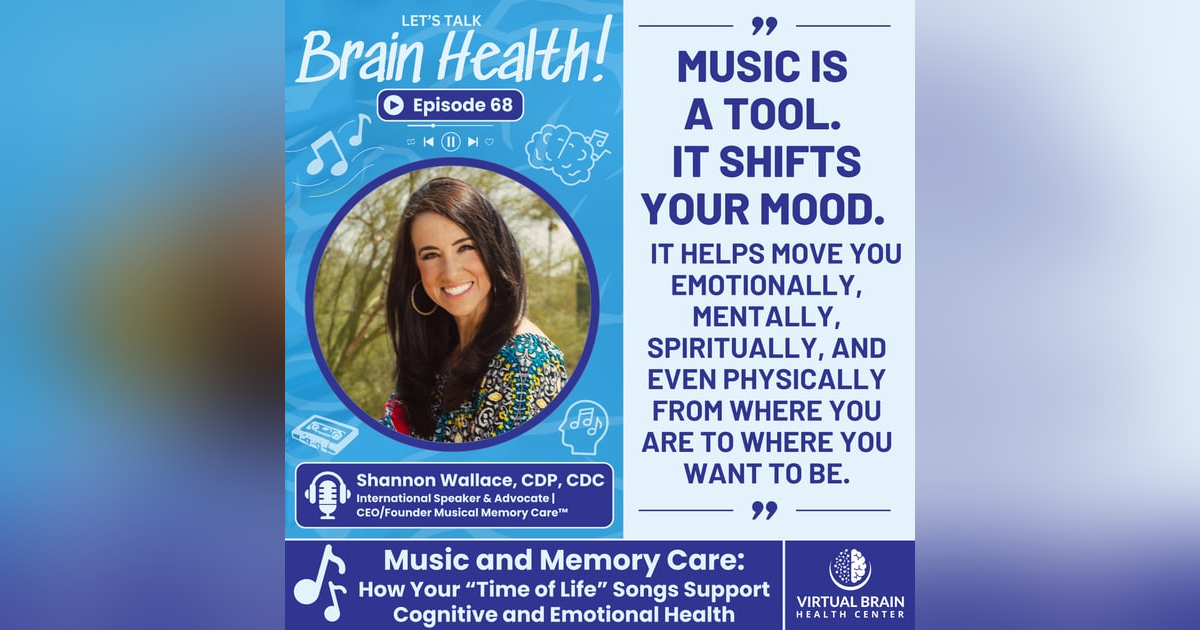



Music reaches your brain fast! It activates memory, movement, emotion, and connection in seconds.
In this episode, host Dr. Krystal L. Culler, DBH, MA, sat down with Shannon Wallace, CDP, CDC, creator of Musical Memory Care to explore how music functions as a whole-brain and body workout. We focus on one powerful idea—the “time of your life” effect.
Research shows the music you loved between roughly ages 13 and 27 leaves a lasting imprint. Those songs shape identity. They anchor memory. They often remain accessible even during cognitive change.
Shannon shares how she moved from professional jazz vocalist to serving older adults in memory care communities. What began as singing for residents evolved into an intentional, research-informed program that integrates rhythm, movement, emotional expression, and identity support.
We explore:
- Why time-of-life music remains accessible in dementia
- How music activates the limbic system and supports emotional regulation
- The role of rhythm in movement, including Parkinson’s support
- Why intentional facilitation matters in memory care settings
- How music supports dignity, identity, and human connection
- Practical ways you can use music today for brain health
You will hear real-world stories from Shannon’s work in memory care. Stories of individuals who had not spoken in years yet responded to music. Stories of rhythm supporting walking and daily tasks. Stories that reinforce this truth. Music is not entertainment alone. It is a neurological tool.
If you are a caregiver, clinician, or family member supporting someone with cognitive change, this conversation gives you some practical suggestions. Play their music, not yours. Use rhythm to support movement. Build playlists rooted in their adolescence and young adulthood. Intention matters.
If you are focused on your own brain health, start here:
- Create a “time of your life” playlist
- Use music to regulate mood and stress
- Pair rhythm with movement for exercise
- Share meaningful songs to deepen social connection
Music does not require perfection. It asks for presence.
About Shannon Wallace, CDP, CDC
Shannon Wallace is a professional international jazz vocalist and the creator of Musical Memory Care, an interactive program serving active older adults and individuals living with all stages of dementia. Her work has reached participants across North America and in more than 40 countries. She is a Certified Dementia Practitioner and Dementia Care Certified professional who integrates music, movement, and compassion into structured memory care experiences.
Brain health lives in daily moments. Music is one of the most accessible tools you already have.
00:00 Why Music Hits Fast: A Whole Brain + Body Workout
00:49 Meet Shannon Wallace & the Musical Memory Care Mission
02:23 The Grant Question That Changed Everything (Volunteering in Memory Care)
05:48 Music Like Fitness: Intentionality, Regulation, and Engagement
08:09 Your “Time of Life” Music Bump: Why Certain Songs Stick Forever
11:41 Music for Mood & Nervous System Regulation (Limbic System, Empathy, Shifting State)
15:10 Why Music Still Connects in Dementia—and the Need for Intentional Care
20:45 Inside the Musical Memory Care Program: Reading the Room + Multi-Sensory Design
23:32 Proof in Practice: Vivian Speaks Again & Building Trust Through Personal Connection
29:28 Try This at Home: Playlists, Movement, Sharing Songs + Parkinson’s Rhythm Hack
36:24 Closing Wisdom: Work-Life Balance, Where to Find Shannon, and Final Takeaways
Resources
Download the free infographic on how music is a whole brain-body workout!
Learn more about Shannon and her Musical Memory Care™ program on her website.
Connect with Shannon on LinkedIn or her professional website for her vocal talent or speaking.
Listen to our previous podcast conversation with Eyleen Braaten, Executive Director of the Giving Voice Chorus and Neuroscientist, Dr. Patricia Izbicki, Ph.D., to learn how singing can impact your brain.

Founder/CEO
As an advocate for the human’s adventurous and creative spirit through interactive expression and communication, professional and international vocal jazz musician Shannon Wallace, CDP, CDC has created the first-ever, interactive, in-person, live online and on-demand Musical Memory Care™ workshop program that serves active adults and those of all ages living with all stages of dementia or cognitive impairment, along with their care partners.
To date, the program has reached participants (live online) in all of North America and 40 countries around the world. Program supporters include Barrow Neurological Institute, AARP, the Alzheimer’s Association, the Alive Inside Foundation and the Virtual Brain Health Center, among others.
Wallace’s career spans 30-years in international music, television, marketing and public policy/advocacy. Shannon is a Certified Dementia Practitioner (CDP) through the National Council of Certified Dementia Practitioners (NCCDP) and is Dementia Care Certified (CDC) through Dementia Care Education.