
 Apple Podcasts
 Spotify
 Amazon Music
  RSS Feed
 Preventive Neurology: Brain Care Today to Protect Tomorrow with Dr. Kellyann Niotis, MD
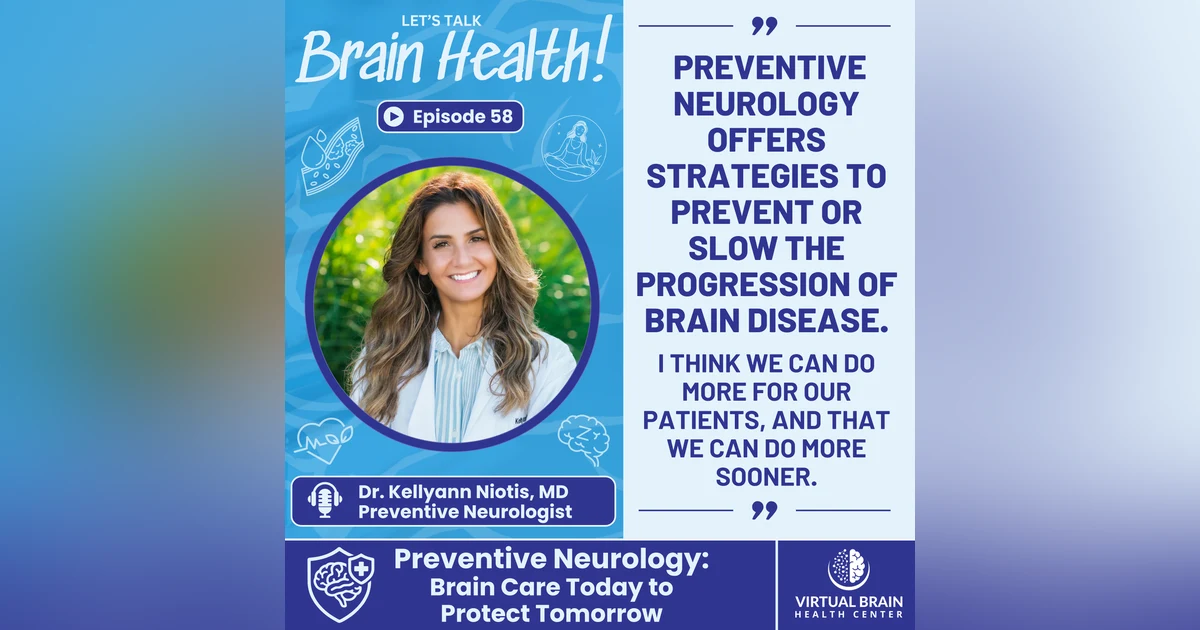
In this episode of the Let's Talk Brain Health Podcast, we welcome Dr. Kellyann Niotis, MD, the world’s first fellowship-trained preventive neurologist, who shares her insights on early detection and risk reduction for neurodegenerative diseases, including Alzheimer's disease, Parkinson's disease, and Lewy body dementia.
Dr. Niotis discusses the emerging field of preventive neurology, the role of blood biomarkers and genetic testing, and the importance of lifestyle choices in maintaining brain health.
She also highlights the impact of cholesterol management, sleep studies, and the significance of personalized care approaches.
Join us as we dive into a comprehensive discussion about the future of brain health and the proactive steps we can take today for healthier brains tomorrow.
00:00 Introduction to Dr. Kellyann Niotis, MD
02:47 What is Preventive Neurology?
06:08 The Role of Biomarkers in Early Detection
13:52 Lifestyle Modifications and Brain Health
17:12 Cholesterol and Brain Health
24:15 The Impact of Statins on Cognition
26:05 Underutilized Tools in Brain Health
30:11 Rapid Fire Questions and Final Thoughts
Resources
-
Connect with Kellyann on Instagram @drkellyannniotis
-
Visit her website and learn more about her new clinic on their website
Research
-
Learn more about the research-informed brain health risks mentioned in this episode from the “Dementia prevention, intervention, and care: 2024 report of the Lancet standing Commission” Report
-
Read more about Dr. Lisa Misconi’s research on how estrogen receptors are unregulated in perimenopause in this research article
00:00:02,640 --> 00:00:06,240
Welcome to the Let's Talk Brain
Health podcast, a public health
2
00:00:06,240 --> 00:00:08,880
educational initiative of the
virtual Brain Health Center.
3
00:00:09,200 --> 00:00:12,240
I'm your host, Doctor Crystal
Color, and I'm so glad you're
4
00:00:12,240 --> 00:00:14,880
here.
On this podcast, I sit down with
5
00:00:14,880 --> 00:00:18,240
incredible guests to explore all
things brain health and
6
00:00:18,240 --> 00:00:20,520
Wellness.
Together, we'll talk about how
7
00:00:20,520 --> 00:00:24,440
to care for your total brain
health, mind, body, and spirit
8
00:00:24,800 --> 00:00:28,160
while sharing the latest brain
Health Science practical tips
9
00:00:28,440 --> 00:00:30,720
and strategies you can use every
day.
10
00:00:31,240 --> 00:00:34,240
By prioritizing your brain
health, you're taking an
11
00:00:34,240 --> 00:00:37,320
important step towards living a
happier, healthier life.
12
00:00:37,840 --> 00:00:40,560
So let's dive in and welcome
today's guest.
13
00:00:41,680 --> 00:00:45,080
We'd like to welcome Doctor
Kellyanne the Otis to the Let's
14
00:00:45,080 --> 00:00:49,240
Talk Brain Health podcast.
Doctor Neotus is the world's
15
00:00:49,240 --> 00:00:51,680
first fellowship trained
preventative neurologist
16
00:00:51,680 --> 00:00:54,760
specializing in risk reduction
for neurodegenerative diseases
17
00:00:54,760 --> 00:00:57,520
such as Alzheimer's,
Parkinson's, and Lewy body
18
00:00:57,680 --> 00:01:00,160
dementia.
She completed her neurology
19
00:01:00,160 --> 00:01:02,880
training at New York
Presbyterian Weill Cornell,
20
00:01:03,040 --> 00:01:05,480
where she served as Chief
resident and the inaugural
21
00:01:05,480 --> 00:01:08,920
McGraw Fellow in Neurology
Research, followed by a
22
00:01:08,920 --> 00:01:11,480
fellowship and movement
disorders at the Icahn School of
23
00:01:11,480 --> 00:01:15,480
Medicine at Mount Sinai.
She is the founder of preventive
24
00:01:15,480 --> 00:01:18,600
neurology practice in New York
City and Director of Parkinson's
25
00:01:18,600 --> 00:01:21,200
and Lewy Body Dementia
Prevention Research at the
26
00:01:21,200 --> 00:01:25,320
Institute for Neurodegenerative
Diseases in Florida, where her
27
00:01:25,320 --> 00:01:28,920
work focuses on early detection
and personalized risk reduction
28
00:01:28,920 --> 00:01:32,200
strategies.
Dr. Niotis is passionate about
29
00:01:32,200 --> 00:01:34,880
advancing the field of
preventive neurology not only
30
00:01:34,880 --> 00:01:37,000
through clinical care and
research, but also through
31
00:01:37,000 --> 00:01:41,040
advocacy for policy change and
expanding access to education
32
00:01:41,040 --> 00:01:43,600
and treatment.
Her expertise has been featured
33
00:01:43,600 --> 00:01:47,400
in media outlets such as CNN,
and she has received numerous
34
00:01:47,400 --> 00:01:49,600
honors and awards recognizing
her work.
35
00:01:50,000 --> 00:01:53,120
Previously, Doctor Niotis led
the preventative neurology
36
00:01:53,120 --> 00:01:57,760
program at the Doctor Peter
Adias Practice Early Medical and
37
00:01:57,760 --> 00:02:00,880
oversaw the nation's first
Alzheimer's prevention clinic at
38
00:02:00,880 --> 00:02:04,000
Weill Cornell New York
Presbyterian, where she launched
39
00:02:04,000 --> 00:02:07,400
research initiatives in
Parkinson's and Lewy body
40
00:02:07,400 --> 00:02:10,759
dementia prevention.
Her research has been published
41
00:02:10,759 --> 00:02:14,920
in Neurology, Nature, Mental
Health, Frontiers and Aging,
42
00:02:14,920 --> 00:02:19,720
Neuroscience, Aging and Disease,
Movement Disorders, the Journal
43
00:02:19,720 --> 00:02:23,240
of Alzheimer's Disease,
Alzheimer's and Dementia, and
44
00:02:23,240 --> 00:02:26,560
the Journal of the Prevention of
Alzheimer's Disease, and she
45
00:02:26,560 --> 00:02:30,320
also has presented at national
and international conferences.
46
00:02:31,120 --> 00:02:34,360
Kellyanne, is there any
additional information about
47
00:02:34,360 --> 00:02:37,320
your background that you'd like
to share with our audience?
48
00:02:37,960 --> 00:02:41,840
I think you all learned how much
of A nerd I am, so maybe to add
49
00:02:41,880 --> 00:02:45,160
some character.
I'm also an avid scuba diver.
50
00:02:45,160 --> 00:02:48,760
I really love the ocean and on
side really am passionate about
51
00:02:48,760 --> 00:02:51,960
conservation there.
And I'm a dog mom to a lovely
52
00:02:51,960 --> 00:02:55,680
goldendoodle who's six years old
and who is obsessed with ball,
53
00:02:55,680 --> 00:03:00,200
so he keeps me really busy.
Nice, we're so.
54
00:03:00,200 --> 00:03:03,840
Grateful you're here.
We are all fellow dog lovers,
55
00:03:03,840 --> 00:03:06,320
all three of us.
Today we have at least one
56
00:03:06,320 --> 00:03:09,800
thread in common and I think for
many of us tuning in share the
57
00:03:09,800 --> 00:03:12,200
mutual excitement around the
brain.
58
00:03:12,520 --> 00:03:15,600
I think it would be great though
after hearing your extensive
59
00:03:15,600 --> 00:03:19,320
bio, you've mentioned this
buzzword that has probably
60
00:03:19,320 --> 00:03:22,240
sparked a lot of our listeners
interest.
61
00:03:22,360 --> 00:03:26,400
What is a preventative
neurologist and what drew you to
62
00:03:26,400 --> 00:03:29,520
this emerging field?
Yeah, great question.
63
00:03:29,520 --> 00:03:34,480
Preventive neurology isn't a
fully recognized field yet.
64
00:03:34,920 --> 00:03:38,360
The American Academy of
Neurology put out a position
65
00:03:38,360 --> 00:03:44,120
statement in 2023, Which aims to
have preventive neurology being
66
00:03:44,120 --> 00:03:46,680
this thriving field by the year
2050.
67
00:03:46,960 --> 00:03:49,920
I think we can do more for our
patients and we can do more
68
00:03:49,920 --> 00:03:52,080
sooner.
But just to give you some
69
00:03:52,080 --> 00:03:54,720
background, what is preventive
neurology?
70
00:03:54,720 --> 00:03:59,360
It's a field really dedicated to
the early detection and early
71
00:03:59,360 --> 00:04:03,000
intervention of at risk
individuals who are at risk for
72
00:04:03,000 --> 00:04:06,680
diseases such as Alzheimer's,
Parkinson's, neurodegenerative
73
00:04:06,680 --> 00:04:09,520
diseases, but all neurological
diseases on a whole.
74
00:04:09,520 --> 00:04:12,320
That could be Ms. that can be
stroke.
75
00:04:12,600 --> 00:04:16,600
The vision is really broad.
My particular niche is in
76
00:04:16,680 --> 00:04:20,000
neurodegenerative diseases,
Alzheimer's, Parkinson's, Lewy
77
00:04:20,000 --> 00:04:22,079
body.
But again, there's lots of
78
00:04:22,079 --> 00:04:25,320
different neurodegenerative or
neurological diseases that ought
79
00:04:25,320 --> 00:04:28,720
to have a more prevention
focused mind.
80
00:04:29,280 --> 00:04:33,880
And really what drew me to this
space was thinking and seeing
81
00:04:33,880 --> 00:04:38,200
patients in the later stages of
dementia and a Parkinson's
82
00:04:38,200 --> 00:04:42,800
disease and realizing how little
options we had for them.
83
00:04:42,800 --> 00:04:45,640
And seeing this kind of
explosion of research,
84
00:04:45,680 --> 00:04:49,600
specifically at the time in the
space of dementia and how there
85
00:04:49,600 --> 00:04:52,320
was more evidence coming out
that there are things that we
86
00:04:52,320 --> 00:04:56,480
could be doing earlier on in
disease to potentially delay or
87
00:04:56,480 --> 00:04:58,680
even hopefully prevents their
progression.
88
00:04:58,680 --> 00:05:03,200
Yet no physicians that I trained
with at the time, we're really
89
00:05:03,200 --> 00:05:06,120
focused on that.
And I was lucky enough to find
90
00:05:06,200 --> 00:05:09,600
an amazing mentor, Richard
Isaacson, who really showed me a
91
00:05:09,600 --> 00:05:14,040
new way towards prevention and
learn so much from him and only
92
00:05:14,040 --> 00:05:17,160
continue to bring that work to
other diseases like Parkinson's
93
00:05:17,160 --> 00:05:20,320
and Lewy Body.
You've worked with some of the
94
00:05:20,320 --> 00:05:23,760
most forward thinking brain
health clinics and you still are
95
00:05:23,760 --> 00:05:27,440
continuing that work now.
How is this shaped your current
96
00:05:27,440 --> 00:05:30,400
approach to care that you'd like
to highlight for us today?
97
00:05:30,960 --> 00:05:34,320
Yeah, I never stopped learning.
Pretty much feel like I'm a
98
00:05:34,640 --> 00:05:38,520
continuous student even now.
I'm always learning, but I've
99
00:05:38,520 --> 00:05:41,200
been fortunate enough to have
amazing mentors, like I
100
00:05:41,200 --> 00:05:44,480
mentioned, Richard Isaacson,
Peter Tia is another amazing
101
00:05:44,480 --> 00:05:47,320
mentor.
A lot of my mentors happened to
102
00:05:47,320 --> 00:05:51,280
be men, which I feel very
fortunate enough because they
103
00:05:51,280 --> 00:05:55,080
really did elevate and showed me
a way towards prevention that I
104
00:05:55,080 --> 00:05:58,520
never thought about.
But as a woman, I have other
105
00:05:58,520 --> 00:06:02,280
interests that maybe don't
always align with those of the
106
00:06:02,280 --> 00:06:05,800
opposite sex.
I've been able to gain my
107
00:06:05,800 --> 00:06:08,720
understanding of prevention
through them, but then also
108
00:06:08,720 --> 00:06:12,600
bring this lens of female health
and what that means and how
109
00:06:12,600 --> 00:06:15,400
women may be disproportionately
impacted by some of these
110
00:06:15,400 --> 00:06:18,160
diseases.
And how our care has to differ
111
00:06:18,400 --> 00:06:22,360
based not just on factors like
people's genetics, but also
112
00:06:22,360 --> 00:06:27,040
their biological sex.
Getting into genetics or these
113
00:06:27,040 --> 00:06:31,360
new diagnostic tests that are
starting to come to market and
114
00:06:31,360 --> 00:06:33,760
there's a lot of research going
on in the different
115
00:06:33,760 --> 00:06:36,840
neurodegenerate diseases.
What have you seen about the
116
00:06:36,840 --> 00:06:39,120
blood biomarker test and how do
you think they're going to be
117
00:06:39,120 --> 00:06:41,200
implemented in the coming years
for the different
118
00:06:41,200 --> 00:06:43,560
neurodegenerate diseases as
screening tools?
119
00:06:44,360 --> 00:06:49,200
1st, I'm beyond excited because
it's been a long time coming.
120
00:06:49,200 --> 00:06:53,840
We haven't had objective outcome
measures to monitor disease
121
00:06:53,840 --> 00:06:57,760
progression in any real
meaningful way that was easily
122
00:06:57,760 --> 00:07:01,160
accessible and not invasive and
cost effective.
123
00:07:01,160 --> 00:07:05,480
But I think these biomarkers
will really pave the way for the
124
00:07:05,480 --> 00:07:10,240
future of preventive neurology,
not only allowing us to identify
125
00:07:10,240 --> 00:07:13,560
disease earlier, but also
allowing us to identify who may
126
00:07:13,560 --> 00:07:18,240
be at risk earlier and then
hopefully allow us to monitor
127
00:07:18,240 --> 00:07:20,880
the efficacy of the
interventions that we're saving
128
00:07:20,880 --> 00:07:23,440
people.
A lot of the research in
129
00:07:23,440 --> 00:07:27,960
prevention has been criticized
because it's so difficult to
130
00:07:27,960 --> 00:07:31,240
show that you've actually done
something to underlying disease
131
00:07:31,240 --> 00:07:35,760
progression for diseases that
form over years and decades,
132
00:07:35,920 --> 00:07:38,840
having some sort of objective
outcome measures going to
133
00:07:38,840 --> 00:07:42,120
improve clinical trials, give
more evidence for prevention,
134
00:07:42,120 --> 00:07:44,280
but also better personalized
care.
135
00:07:44,680 --> 00:07:50,560
My word of caution is that these
new emerging tools are available
136
00:07:50,560 --> 00:07:53,160
and new ones are coming out
regularly.
137
00:07:53,160 --> 00:07:57,120
But what I think is really
important to emphasize is that
138
00:07:57,440 --> 00:08:01,720
these biomarkers have been
studied in people who have
139
00:08:01,960 --> 00:08:06,240
clinical symptoms, not in at
risk or asymptomatic
140
00:08:06,240 --> 00:08:10,120
individuals.
We haven't yet identified what a
141
00:08:10,120 --> 00:08:14,480
normal range is for people who
don't have cognitive symptoms,
142
00:08:14,480 --> 00:08:18,720
and we don't really understand
how dynamic these biomarkers
143
00:08:18,720 --> 00:08:23,040
are, how variable they can be
based on the time of day, based
144
00:08:23,040 --> 00:08:25,320
on if someone exercised that
morning.
145
00:08:25,600 --> 00:08:27,720
A lot of the research that we're
doing at the Institute of
146
00:08:27,720 --> 00:08:31,000
Neurodegenerative Disease is on
that because we're of course
147
00:08:31,000 --> 00:08:34,080
interested in learning how these
biomarkers change with disease
148
00:08:34,080 --> 00:08:37,400
and affected people.
But it's also really important
149
00:08:37,400 --> 00:08:40,919
to understand people who are at
risk, whether that's just family
150
00:08:40,919 --> 00:08:43,640
history or genetics, and
understand how these biomarkers
151
00:08:43,640 --> 00:08:46,360
may present differently in
different people and what they
152
00:08:46,360 --> 00:08:49,760
mean for that individual.
One really cool thing, just to
153
00:08:49,760 --> 00:08:53,160
nerd out for a second that we
found, and we need more for this
154
00:08:53,160 --> 00:08:56,440
puzzle, but I'm just excited to
talk about it, is that Tau
155
00:08:56,440 --> 00:09:00,520
levels actually seem to
fluctuate on a monthly basis
156
00:09:00,520 --> 00:09:02,720
based on women's menstrual
cycle.
157
00:09:02,920 --> 00:09:05,920
And that's actually super
important to know because the
158
00:09:05,920 --> 00:09:09,880
time of someone cycle that we're
testing these biomarkers may
159
00:09:10,120 --> 00:09:13,760
really change what we think
about or how we interpret the
160
00:09:13,760 --> 00:09:16,200
results.
We have so much to learn.
161
00:09:16,200 --> 00:09:19,480
They're not ready for prime time
yet, but they are going to be in
162
00:09:19,480 --> 00:09:20,920
the future.
I really believe that.
163
00:09:21,680 --> 00:09:26,320
How do you use these blood
biomarker tools to detect risk
164
00:09:26,320 --> 00:09:29,360
for early interventions given
that what you just said, for
165
00:09:29,360 --> 00:09:33,600
example, 34 year old patient
comes in the worried I have a
166
00:09:33,600 --> 00:09:38,200
concern because mom or dad has a
dementia or maybe it's not
167
00:09:38,200 --> 00:09:41,320
characterized well in an
asymptomatic young person who
168
00:09:41,320 --> 00:09:43,000
has a concern about these
things?
169
00:09:43,760 --> 00:09:48,360
1 I try to stay away from the
term worried because everyone's
170
00:09:48,360 --> 00:09:50,440
at risk.
Everyone with the brain is at
171
00:09:50,440 --> 00:09:53,120
risk.
I appreciate that they're being
172
00:09:53,200 --> 00:09:57,640
proactive about their care, but
you make a really interesting
173
00:09:57,640 --> 00:10:01,040
and important point, which is
that if we start collecting a
174
00:10:01,040 --> 00:10:03,160
ton of data, there'll be a lot
of noise.
175
00:10:03,160 --> 00:10:05,560
And how do we sort through that
noise?
176
00:10:05,800 --> 00:10:08,680
These tools have to be used
appropriately in the right
177
00:10:08,680 --> 00:10:10,720
clinical context.
Like I mentioned, we are
178
00:10:10,720 --> 00:10:14,880
studying them in 34 year olds
and 40 year olds and so forth in
179
00:10:14,880 --> 00:10:18,240
our research cohort.
But more practically speaking,
180
00:10:18,280 --> 00:10:21,680
if someone comes in to me and
they're really overall healthy
181
00:10:21,680 --> 00:10:25,080
and I take a family history and
their family members didn't have
182
00:10:25,080 --> 00:10:28,400
disease until their 70s or 80s,
then the likelihood that we're
183
00:10:28,400 --> 00:10:32,920
going to detect an abnormal
biomarker finding in a 32 year
184
00:10:32,920 --> 00:10:36,640
old is pretty low.
That said, it may and in the
185
00:10:36,640 --> 00:10:40,160
future turn out to be really
valuable to establish a
186
00:10:40,160 --> 00:10:43,320
baseline, just like we
established baselines for other
187
00:10:43,520 --> 00:10:47,000
tests like cholesterol panels.
And then we can see how that
188
00:10:47,000 --> 00:10:50,880
individuals might change over
time and if they start entering
189
00:10:50,880 --> 00:10:55,000
more of a risk range.
I think the future is a little
190
00:10:55,000 --> 00:10:58,360
uncertain, but I can see a lot
of potential to use these tools
191
00:10:58,360 --> 00:11:01,520
and young people, middle-aged
people and older people.
192
00:11:02,080 --> 00:11:06,240
And getting to the same point
about precision medicine or
193
00:11:06,240 --> 00:11:11,080
individualized personal
diagnostics or baseline
194
00:11:11,080 --> 00:11:14,680
following a patient, besides the
blood biomarkers that are being
195
00:11:14,680 --> 00:11:21,480
studied, does your institute use
any digital tools right now as
196
00:11:21,480 --> 00:11:24,080
baseline other than what
typically is done like the
197
00:11:24,080 --> 00:11:27,200
Montreal Cognitive assessment or
some other type of more
198
00:11:27,200 --> 00:11:30,880
sophisticated neuropsychological
assessment, Any type of short
199
00:11:30,880 --> 00:11:33,960
tools rather than these very
complicated, sometimes complex
200
00:11:33,960 --> 00:11:38,560
and very multi hour assessments?
Or are you referring to things
201
00:11:38,560 --> 00:11:40,680
like vocal analysis and so
forth?
202
00:11:41,240 --> 00:11:43,600
Yeah.
So vocal analysis, exactly.
203
00:11:43,600 --> 00:11:46,680
There's some AI tools that are
available and there's some other
204
00:11:47,080 --> 00:11:49,880
digital AI tools that are
available.
205
00:11:49,880 --> 00:11:53,520
There's a couple startups in the
northeastern part of the United
206
00:11:53,520 --> 00:11:55,840
States that are interested in
this area.
207
00:11:55,960 --> 00:11:59,400
Are you all using any of those?
We aren't using them.
208
00:11:59,400 --> 00:12:03,720
And that's because, to be
honest, I don't feel like I need
209
00:12:03,720 --> 00:12:08,040
a tool to tell me who's at risk.
I know based on my clinical
210
00:12:08,040 --> 00:12:12,040
assessment who's at risk.
And the question for me is not,
211
00:12:12,040 --> 00:12:14,360
is this person at risk or not?
It's what are we going to do
212
00:12:14,360 --> 00:12:16,480
about it once we find out that
they're at risk?
213
00:12:16,960 --> 00:12:21,080
While I think a lot of these new
emerging diagnostics help in
214
00:12:21,080 --> 00:12:25,440
terms of early identification,
for me, where the bottleneck is
215
00:12:25,440 --> 00:12:28,640
not in identifying the risk of
these people, it's getting them
216
00:12:28,640 --> 00:12:32,320
the treatment that they need.
There's a large group of
217
00:12:32,520 --> 00:12:35,880
potentially asymptomatic
patients that are preclinical
218
00:12:35,960 --> 00:12:38,160
and whether these tools are
going to pick up something
219
00:12:38,160 --> 00:12:41,000
they're not even aware of
Whether you're using that
220
00:12:41,000 --> 00:12:45,080
besides saying, yes, you're at
risk because of family history,
221
00:12:45,080 --> 00:12:47,720
for example, or you have faulty
lifestyle that needs to be
222
00:12:47,720 --> 00:12:49,160
adjusted.
Because we know that untreated
223
00:12:49,160 --> 00:12:52,400
hypertension for the controlled
diabetes, obesity and all those
224
00:12:52,400 --> 00:12:54,880
other conditions are already
going to put you at higher risk,
225
00:12:54,880 --> 00:12:56,960
regardless of whether you have a
family history.
226
00:12:57,800 --> 00:13:00,840
There's a lot of different AI
models that are integrating both
227
00:13:00,840 --> 00:13:04,600
MRI data, like you said, vocal
data, biomarker data, and giving
228
00:13:04,600 --> 00:13:09,040
people scores of who's at risk.
I can see the utility in that,
229
00:13:09,040 --> 00:13:14,080
but I personally don't find that
particularly valuable right now.
230
00:13:14,280 --> 00:13:17,640
I do think the biomarkers are
extremely valuable, but like I
231
00:13:17,640 --> 00:13:21,680
said, we don't understand what a
normal threshold is yet.
232
00:13:21,680 --> 00:13:23,240
We need a lot more research
there.
233
00:13:23,960 --> 00:13:27,200
I suspect that a lot of your
conversations focus in on the
234
00:13:27,200 --> 00:13:30,560
research that's probably caught
a lot of our listeners interest.
235
00:13:30,600 --> 00:13:35,480
And you can pick up probably any
study or news line article now
236
00:13:35,480 --> 00:13:39,160
that will tell you, you can
mitigate your risk of X
237
00:13:39,200 --> 00:13:43,120
lifestyle risk factor by X
number of percentage if you
238
00:13:43,120 --> 00:13:47,280
focus on a whole laundry list of
risk factors.
239
00:13:47,280 --> 00:13:50,760
And you know, we're always
growing more and understanding
240
00:13:50,840 --> 00:13:54,200
of the X leads to the Y when it
comes to brain health.
241
00:13:54,240 --> 00:13:56,720
I'm excited to dive into with
you today, Kelly.
242
00:13:56,720 --> 00:13:59,520
And we're going to focus on one
risk factor in particular that I
243
00:13:59,520 --> 00:14:02,720
don't think we have really
explored yet on the podcast
244
00:14:02,720 --> 00:14:06,920
today in terms of cholesterol.
But before we do that, would you
245
00:14:06,920 --> 00:14:10,120
like to give us this overall
view of how much can people
246
00:14:10,120 --> 00:14:13,880
actually control through their
lifestyle modifications,
247
00:14:13,880 --> 00:14:18,160
especially for those that may
have pre genetic disposition for
248
00:14:18,160 --> 00:14:21,280
Alzheimer's disease?
What is this inspiration or hope
249
00:14:21,600 --> 00:14:25,040
and why do you spend so much
time talking with people about
250
00:14:25,040 --> 00:14:28,680
lifestyle risk factors to
mitigate risk in general for
251
00:14:28,680 --> 00:14:30,320
neurodegenerative?
Diseases.
252
00:14:30,800 --> 00:14:34,640
Great question and I wish that I
had a perfect answer for that.
253
00:14:34,640 --> 00:14:38,800
I would be lying if I could say
that I knew exactly X amount was
254
00:14:39,040 --> 00:14:42,840
preventable due to lifestyle,
due to medical comorbidities,
255
00:14:42,840 --> 00:14:46,400
but I really don't The best data
that we have of course is The
256
00:14:46,400 --> 00:14:49,640
Lancet Commission report which
says that at least 45% of
257
00:14:49,640 --> 00:14:53,320
dementia cases is preventable.
That's not including Parkinson's
258
00:14:53,320 --> 00:14:55,840
disease.
There's definitely less out
259
00:14:55,840 --> 00:14:59,080
there on Parkinson's prevention,
although more studies are coming
260
00:14:59,080 --> 00:15:00,920
out.
They're identifying risk
261
00:15:00,920 --> 00:15:02,480
factors.
Of course we understand
262
00:15:02,480 --> 00:15:06,280
traumatic brain injuries.
Modifiable social isolation
263
00:15:06,280 --> 00:15:09,920
could be risk factors for both.
They share a lot in common.
264
00:15:09,920 --> 00:15:15,160
I think the 45% of dementia
cases being preventable is
265
00:15:15,200 --> 00:15:18,560
probably an underestimate.
I think there are a lot of risk
266
00:15:18,560 --> 00:15:21,520
factors that are fully addressed
by The Lancet Commission's
267
00:15:21,520 --> 00:15:24,000
report.
More than half of dementia cases
268
00:15:24,000 --> 00:15:27,520
are preventable.
I believe that I fully empower
269
00:15:27,520 --> 00:15:30,960
patients to take control of
their brain health as soon as
270
00:15:30,960 --> 00:15:32,600
possible.
Yeah.
271
00:15:32,600 --> 00:15:35,400
And I think for people that may
have followed along in recent
272
00:15:35,400 --> 00:15:38,160
years, it's the number of
Atlantic Commission reports of
273
00:15:38,200 --> 00:15:41,640
preventable cases keeps climbing
as well as the risk factors.
274
00:15:41,640 --> 00:15:43,080
Do we add a couple more each
time?
275
00:15:43,080 --> 00:15:45,960
Because we finally say after
reviewing the scientific
276
00:15:45,960 --> 00:15:49,040
literature of we feel confident
enough that there is enough
277
00:15:49,320 --> 00:15:51,840
evidence from all of these
research studies when we pull
278
00:15:51,840 --> 00:15:55,920
them together to say yes.
And social isolation was a risk
279
00:15:55,920 --> 00:15:57,720
factor that's recently come
online.
280
00:15:57,960 --> 00:16:00,600
Hearing loss.
Even though most clinicians, I
281
00:16:00,600 --> 00:16:03,200
think would have agreed, like we
could have told you this a while
282
00:16:03,200 --> 00:16:06,320
ago, but it was we had enough
research across the board when
283
00:16:06,320 --> 00:16:10,200
we pulled these data from all
across the world as well to
284
00:16:10,200 --> 00:16:12,040
eliminate some of those risk
factors.
285
00:16:12,040 --> 00:16:14,760
I like to think the next couple
years when The Lancet Commission
286
00:16:14,760 --> 00:16:17,080
reconvenes, that number may
still go up.
287
00:16:17,200 --> 00:16:20,360
But speaking with experts like
yourself, 2 neurologists at see
288
00:16:20,360 --> 00:16:23,920
and treat many patients at
Cutting Edge Institute, we have
289
00:16:23,920 --> 00:16:27,120
this confidence now that yes,
there is likely still going to
290
00:16:27,120 --> 00:16:30,880
be more that we know and uncover
as well as sums that don't
291
00:16:30,880 --> 00:16:33,880
always make that list because
we're really split on things
292
00:16:33,880 --> 00:16:36,400
like nutrition.
I'd suspect you spend a lot of
293
00:16:36,400 --> 00:16:38,680
your time talking about
nutrition, but to get enough
294
00:16:38,680 --> 00:16:42,680
evidence where we're going to
globally agree, I don't know, we
295
00:16:42,680 --> 00:16:44,880
may have to agree to disagree on
some of those.
296
00:16:44,880 --> 00:16:48,200
And same things with sleep.
I sure you spend a lot of time.
297
00:16:48,440 --> 00:16:51,080
I always joke with people when
we do education, it's like,
298
00:16:51,080 --> 00:16:53,840
here's the scientific evidence
of the Atlanta Commission
299
00:16:53,840 --> 00:16:57,720
report, and then here's also a
long list of risk factors that
300
00:16:57,880 --> 00:16:59,960
still have enough evidence
behind that.
301
00:17:00,440 --> 00:17:02,960
Who knows if we're going to
consensus on anytime soon.
302
00:17:02,960 --> 00:17:05,640
But I guarantee if you talk with
your healthcare providers,
303
00:17:05,920 --> 00:17:07,640
they're not overlooking these
big ones.
304
00:17:07,640 --> 00:17:10,640
And they are likely on those
screens that you go down your
305
00:17:10,640 --> 00:17:13,839
laundry list for.
And we know with heart health,
306
00:17:14,400 --> 00:17:18,040
cholesterol is a big one.
That's the one that many people
307
00:17:18,040 --> 00:17:20,760
have the connection with is
heart health and brain health.
308
00:17:21,160 --> 00:17:25,000
But can you tell us why that's
so important of a risk factor
309
00:17:25,000 --> 00:17:26,880
that you want to highlight for
us today?
310
00:17:26,880 --> 00:17:30,000
And what should our listeners
know about that risk factor?
311
00:17:30,480 --> 00:17:34,080
Yeah, this is one of my favorite
risk factors because I'm also,
312
00:17:34,080 --> 00:17:36,120
underneath all of this, a lipid
nerd.
313
00:17:36,440 --> 00:17:39,280
I didn't intend to become a
lipid nerd, but my path is
314
00:17:39,360 --> 00:17:41,960
crossed with an amazing
lipidologist.
315
00:17:41,960 --> 00:17:45,840
Doctor Tom Dayspring really
taught me so much about
316
00:17:45,840 --> 00:17:49,320
peripheral lipidology.
And when I kept asking questions
317
00:17:49,320 --> 00:17:52,920
about brain lipidology, he had
no choice but to start diving
318
00:17:52,920 --> 00:17:54,520
deeper in the literature with
me.
319
00:17:54,560 --> 00:17:58,200
We really started learning about
this together and it really
320
00:17:58,200 --> 00:18:01,960
blows my mind how many
neurologists don't understand
321
00:18:01,960 --> 00:18:06,240
that the lipid system in the
brain is completely distinct
322
00:18:06,240 --> 00:18:11,880
from the peripheral lipid system
and that one of the most
323
00:18:12,200 --> 00:18:15,800
significant genetic risk factors
for Alzheimer's disease, which
324
00:18:15,800 --> 00:18:19,440
is APOE, is a lipid transport
gene.
325
00:18:19,760 --> 00:18:23,800
The thought that cholesterol
isn't somehow related to brain
326
00:18:23,800 --> 00:18:27,160
health is really wild.
Doctor Alzheimer's realized this
327
00:18:27,160 --> 00:18:30,480
when he did autopsies on
Alzheimer's patients when he was
328
00:18:30,480 --> 00:18:33,440
first described describing the
disease, how there were these
329
00:18:33,440 --> 00:18:36,720
little lipid droplets stuck
inside the astrocytes of
330
00:18:36,720 --> 00:18:38,280
patients that were affected by
this.
331
00:18:38,280 --> 00:18:41,560
The reason I want to highlight
this is because so many people
332
00:18:41,720 --> 00:18:46,160
carry this high risk gene a
Bowie and those people a Bowie
333
00:18:46,200 --> 00:18:51,960
four and those people who carry
a Bowie 4 have known higher risk
334
00:18:51,960 --> 00:18:55,360
of cardiovascular disease,
atherosclerotic disease, heart
335
00:18:55,360 --> 00:18:59,640
attack, but also higher risk of
stroke and also higher risk of
336
00:18:59,640 --> 00:19:02,720
neurodegenerative diseases like
Alzheimer's and Lewy body.
337
00:19:03,040 --> 00:19:05,920
And a lot of that has to do with
peripheral cholesterol
338
00:19:05,920 --> 00:19:08,440
transport.
We understand these people are
339
00:19:08,640 --> 00:19:12,640
more likely to throw down
atherogenic LDL or APO B
340
00:19:12,640 --> 00:19:16,640
particles to cause blockages in
the vessels that lead to the
341
00:19:16,640 --> 00:19:21,600
brain and inside the brain.
But also APOE 4 changes the way
342
00:19:21,600 --> 00:19:24,600
that the brain transports
cholesterol.
343
00:19:24,760 --> 00:19:28,240
People who carry this APOE 4
gene are not as efficient at
344
00:19:28,240 --> 00:19:31,680
getting cholesterol between
brain cells, between astrocytes
345
00:19:31,680 --> 00:19:35,720
and neurons, and the cholesterol
gets stuck inside these
346
00:19:35,720 --> 00:19:39,040
astrocytes and can cause a lot
of neurotoxicity and
347
00:19:39,040 --> 00:19:42,360
cytotoxicity.
And this is one way that APOE 4,
348
00:19:42,360 --> 00:19:45,280
for example, can lead to
neurodegenerative diseases.
349
00:19:45,760 --> 00:19:49,640
It is a sore subject for me
because a lot of patients will
350
00:19:49,640 --> 00:19:52,600
come in and they'll say my
cholesterol numbers all look
351
00:19:52,600 --> 00:19:54,960
great.
And I look at them and I'm like,
352
00:19:55,120 --> 00:19:58,480
who said that these look great?
For what do these look great?
353
00:19:58,760 --> 00:20:03,000
If we're in the business of
preventing disease, then we
354
00:20:03,000 --> 00:20:06,880
can't let you walk around in
your 30s and 40s with.
355
00:20:07,360 --> 00:20:11,640
An apo B level of nearly 100 or
an LDL cholesterol of nearly
356
00:20:11,640 --> 00:20:14,840
100, It's just a matter of time
before that's going to start
357
00:20:15,120 --> 00:20:18,080
causing issues for the heart,
but also for the brain.
358
00:20:18,080 --> 00:20:21,600
I think there's a lot of fear
amongst patients in terms of
359
00:20:21,600 --> 00:20:24,320
getting their cholesterol
treated and the thought of them
360
00:20:24,320 --> 00:20:27,880
being on a medication for the
rest of their life can be a
361
00:20:27,880 --> 00:20:31,120
little overwhelming.
But I really, and I would hope
362
00:20:31,120 --> 00:20:35,400
that the listeners here today
are taking away this message
363
00:20:35,400 --> 00:20:38,600
that we can be equal
opportunists and sometimes
364
00:20:38,600 --> 00:20:41,040
because of our genetics, we need
medications.
365
00:20:41,040 --> 00:20:43,720
And these medications can be
wildly helpful.
366
00:20:44,080 --> 00:20:46,920
And the earlier that we start
addressing this risk factor, the
367
00:20:46,920 --> 00:20:50,400
better.
That was my question for you was
368
00:20:50,400 --> 00:20:53,680
for the person that's hesitant
because this seems to be a
369
00:20:53,680 --> 00:20:57,320
lifestyle risk factor that can
actually present very early in
370
00:20:57,320 --> 00:20:58,920
life.
Because I look back to even
371
00:20:58,920 --> 00:21:03,200
being an undergrad when having
peers have this first factor
372
00:21:03,200 --> 00:21:06,960
come on in our late teens and
early 20s.
373
00:21:06,960 --> 00:21:09,560
And that can be a very quick
barrier that comes up because
374
00:21:09,560 --> 00:21:13,320
this is a very atypical thing.
But yet when you have a genetic
375
00:21:13,640 --> 00:21:18,400
predisposition, that's not
actually that uncommon at times.
376
00:21:18,400 --> 00:21:21,440
And yet that can be 1 where we
become very resistant.
377
00:21:21,440 --> 00:21:25,280
And also it happened to the ones
that were like athletes.
378
00:21:25,280 --> 00:21:28,520
I remember college athletes that
ran track that see the
379
00:21:28,520 --> 00:21:31,520
nutritionists that are doing the
lifestyle things, and it becomes
380
00:21:31,520 --> 00:21:35,040
that conversation of where does
the interplay of lifestyle and
381
00:21:35,040 --> 00:21:39,160
genetics almost come online?
And it was very strange, right?
382
00:21:39,360 --> 00:21:42,240
You're late teen and you're in
your early 20s, and we never
383
00:21:42,240 --> 00:21:45,680
heard of anybody with high
cholesterol, let alone taking up
384
00:21:45,960 --> 00:21:48,400
medication for it.
I remember that was like one of
385
00:21:48,400 --> 00:21:52,120
the first things where it just
sounds so atypical and then let
386
00:21:52,120 --> 00:21:56,400
you think when that Fast forward
down the lifespan level of
387
00:21:56,400 --> 00:21:59,480
awareness that could be.
Yeah, absolutely.
388
00:21:59,480 --> 00:22:04,680
And it's not to dismiss diet.
I've been humbled by people who
389
00:22:04,680 --> 00:22:07,880
have come to me and have said
no, I'm going to do a complete
390
00:22:07,880 --> 00:22:11,200
overhaul on my diet and then
we'll recheck my cholesterol
391
00:22:11,200 --> 00:22:14,000
levels.
Diet can move the needle and
392
00:22:14,000 --> 00:22:17,440
especially for people who carry
the safe OE 4 gene because they
393
00:22:17,680 --> 00:22:20,480
tend to absorb more cholesterol
from their food.
394
00:22:20,480 --> 00:22:22,440
It's part of what this gene
does.
395
00:22:22,840 --> 00:22:26,600
They actually do have a pretty
dramatic response to reducing
396
00:22:26,600 --> 00:22:29,800
things like saturated fats.
But at the end of the day,
397
00:22:29,800 --> 00:22:33,040
sometimes we're up against our
genetics and we have no no other
398
00:22:33,040 --> 00:22:35,840
choice.
And no matter how well we live
399
00:22:35,840 --> 00:22:38,720
our life and how great we eat
and how much we're sleeping and
400
00:22:38,720 --> 00:22:41,640
exercising, sometimes we just
need a medication and.
401
00:22:42,160 --> 00:22:44,840
It seems like this is the great
time to have that lifestyle
402
00:22:44,840 --> 00:22:47,840
conversations with your
providers to find what your
403
00:22:47,840 --> 00:22:51,360
options are, to find your
threshold for change, of where
404
00:22:51,360 --> 00:22:54,720
you're willing to try and where
does lifestyle meet medication
405
00:22:54,960 --> 00:22:58,000
opportunities really to support
where you are today and where
406
00:22:58,000 --> 00:23:00,960
your goals are to be.
I think this is the great chance
407
00:23:01,000 --> 00:23:04,480
of many times where provider
education can be really
408
00:23:04,480 --> 00:23:07,800
important, as well as noticing
yourselves where your threshold
409
00:23:07,800 --> 00:23:10,880
is and where you can try and how
far you're able to go.
410
00:23:11,160 --> 00:23:13,320
And that might be the balance of
where you work with your
411
00:23:13,320 --> 00:23:16,840
healthcare providers, where
health coaches might come online
412
00:23:16,840 --> 00:23:19,520
and other supports that you have
on your healthcare team.
413
00:23:19,880 --> 00:23:24,000
But great resources to lean in
on go back to you as well as any
414
00:23:24,000 --> 00:23:27,520
final messages for people on
this particular lifestyle risk
415
00:23:27,520 --> 00:23:30,480
factor that you want to
highlight before we dive into
416
00:23:30,480 --> 00:23:33,440
the next topic area with you in.
Job.
417
00:23:34,120 --> 00:23:36,000
I just think the earlier the
better.
418
00:23:36,200 --> 00:23:40,480
You're never too young to get a
full lab test done which
419
00:23:40,480 --> 00:23:44,600
includes metabolic tests, lipid
tests, nutritional tests.
420
00:23:44,600 --> 00:23:48,280
You just never know until you
start doing the testing what
421
00:23:48,320 --> 00:23:52,440
might be a risk factor for you.
And if this flags on your panel
422
00:23:52,440 --> 00:23:56,000
then I would not ignore it.
So if you have all that on your
423
00:23:56,000 --> 00:23:58,600
annual screen, I believe
cholesterol is one that's pretty
424
00:23:58,600 --> 00:24:02,160
normal on those annual screens
to make sure to to your provider
425
00:24:02,160 --> 00:24:04,360
about it, because now you've
heard it here or at least you
426
00:24:04,360 --> 00:24:07,320
got a little bit more extra
education on even if it's that
427
00:24:07,320 --> 00:24:10,960
higher norm of you still want to
follow up with your providers.
428
00:24:11,280 --> 00:24:14,480
Kellyanne, there's been an
ongoing belief system in the
429
00:24:14,480 --> 00:24:18,280
public that statins are bad,
that they can cause cognitive
430
00:24:18,280 --> 00:24:20,600
issues.
What is the up to date?
431
00:24:20,720 --> 00:24:24,160
You know that in taking it to
statin groups can negatively
432
00:24:24,160 --> 00:24:27,000
affect cognition.
Yeah, good question.
433
00:24:27,280 --> 00:24:31,880
Unfortunately we don't have the
best quality studies in this
434
00:24:31,880 --> 00:24:35,800
space.
Most of the evidence seems to
435
00:24:35,800 --> 00:24:39,400
point to statins being overall
good and protective for brain
436
00:24:39,400 --> 00:24:41,360
health and lower risk for
dementia.
437
00:24:41,360 --> 00:24:43,840
But again, there's no
one-size-fits-all.
438
00:24:44,080 --> 00:24:47,320
It is true that certain people
who get on statins have brain
439
00:24:47,320 --> 00:24:49,680
fog.
They feel they have an attention
440
00:24:49,680 --> 00:24:51,800
slower processing.
That's a fact.
441
00:24:51,800 --> 00:24:55,200
It's a known risk factor side
effect of statin use.
442
00:24:55,640 --> 00:24:58,120
Maybe it happens in 5% or less
of people.
443
00:24:58,400 --> 00:25:01,240
If that happens to you, it's
probably related to the fact
444
00:25:01,240 --> 00:25:03,840
that the statins can cross
through the blood brain barrier
445
00:25:03,840 --> 00:25:06,000
and change cholesterol
production or suppress
446
00:25:06,000 --> 00:25:07,560
cholesterol production in the
brain.
447
00:25:07,560 --> 00:25:11,200
And cholesterol is an important
molecule or brain needs
448
00:25:11,200 --> 00:25:14,280
cholesterol for lots of other
things like neurotransmitter
449
00:25:14,280 --> 00:25:16,800
synthesis and cell membrane
health and fluidity.
450
00:25:17,120 --> 00:25:20,640
While that effect of statins,
meaning they're effective
451
00:25:20,720 --> 00:25:23,400
suppressing or reducing
production of cholesterol
452
00:25:23,600 --> 00:25:26,880
everywhere in the brain included
might actually be desirable in
453
00:25:26,880 --> 00:25:29,320
some people, it might not be in
other people.
454
00:25:29,520 --> 00:25:32,120
And we really wouldn't know that
until we put someone on it.
455
00:25:32,120 --> 00:25:35,320
And I would love to say that
we're going to have an amazing
456
00:25:35,320 --> 00:25:37,960
clinical trial that's going to
give us the answers.
457
00:25:37,960 --> 00:25:41,400
But statins are so cheap.
There's very little incentive to
458
00:25:41,400 --> 00:25:44,280
run such a beautiful clinical
trial that's going to last
459
00:25:44,280 --> 00:25:48,000
decades to really test whether
statins are associated with a
460
00:25:48,000 --> 00:25:50,560
lower risk of dementia.
My practice is no
461
00:25:50,560 --> 00:25:53,080
one-size-fits-all.
It might work for somebody, but
462
00:25:53,080 --> 00:25:54,480
it might not work for somebody
else.
463
00:25:55,200 --> 00:25:57,240
Thanks.
I was going to lead into this
464
00:25:57,280 --> 00:26:00,040
next section because I know you
could probably talk about each
465
00:26:00,040 --> 00:26:03,280
one of these for 1/2 an hour.
So I'll make it very brief.
466
00:26:03,320 --> 00:26:06,080
And I was thinking about my own
answer to this question, but
467
00:26:06,160 --> 00:26:08,000
obviously I'm going to let you
say what you think.
468
00:26:08,240 --> 00:26:12,120
Are there particular tools that
are still underutilized in
469
00:26:12,120 --> 00:26:15,400
mainstream healthcare that can
make a big difference in
470
00:26:15,400 --> 00:26:19,240
prevention of brain
deterioration, memory thinking
471
00:26:19,240 --> 00:26:21,560
problems?
Good question.
472
00:26:21,920 --> 00:26:24,840
The first thing that came to my
mind is actually sleep studies.
473
00:26:25,160 --> 00:26:28,760
This is not added to The Lancet
Commission's list yet, but it's
474
00:26:28,760 --> 00:26:31,760
hard for me to believe that
sleep apnea won't be added to
475
00:26:31,760 --> 00:26:33,640
the list of modifiable risk
factors.
476
00:26:33,640 --> 00:26:35,360
I think that's huge for brain
health.
477
00:26:35,360 --> 00:26:37,960
You're depriving your brain of
oxygen during sleep.
478
00:26:37,960 --> 00:26:40,280
Like how could that not be a
problem?
479
00:26:40,560 --> 00:26:43,160
And I really think sleep apnea
is under diagnosed.
480
00:26:43,520 --> 00:26:46,720
There are now ways that we can
do simple at home sleep studies.
481
00:26:46,720 --> 00:26:49,800
And the argument is always from
clinicians that they're not as
482
00:26:49,800 --> 00:26:52,600
good as sleep studies that are
done in sleep labs.
483
00:26:52,600 --> 00:26:55,320
But those aren't that practical
for people.
484
00:26:55,560 --> 00:26:58,000
I think we have now cool
screening tools that we can send
485
00:26:58,000 --> 00:27:00,600
people home with and do an at
home sleep study and get a good
486
00:27:00,600 --> 00:27:03,320
read on one night.
It might not be a perfect test,
487
00:27:03,320 --> 00:27:06,000
and if you have a high clinical
suspicion you might want to do
488
00:27:06,080 --> 00:27:09,880
more extensive testing, but I
think it's a really cheap and
489
00:27:09,880 --> 00:27:13,000
underutilized tool.
What do you think about owning a
490
00:27:13,000 --> 00:27:16,000
blood pressure monitor?
I think it's really smart to
491
00:27:16,000 --> 00:27:17,640
have a blood pressure cuff at
home.
492
00:27:17,920 --> 00:27:20,960
When we go into the doctor's
office, the chance that we're a
493
00:27:20,960 --> 00:27:24,480
little excited and maybe anxious
about the visit is high.
494
00:27:24,640 --> 00:27:27,520
The chance we may get a high
reading is not uncommon.
495
00:27:27,560 --> 00:27:31,520
I find that it's better to get
patients in their home and their
496
00:27:31,520 --> 00:27:34,440
comfortable environment and have
them do about a week long blood
497
00:27:34,440 --> 00:27:38,080
pressure log just so we can see
what the variability in their
498
00:27:38,080 --> 00:27:41,360
blood pressure recordings are
and really determine is blood
499
00:27:41,360 --> 00:27:43,720
pressure an issue for this
person and if so, we should
500
00:27:43,720 --> 00:27:46,240
maybe think about it earlier
rather than later.
501
00:27:46,240 --> 00:27:50,520
So this add on question about.
So there's a series of tests,
502
00:27:50,520 --> 00:27:54,880
some of them are commonly done
by primary care providers such
503
00:27:54,880 --> 00:27:59,680
as hemoglobin A1C or fasting
blood sugars, lipid checks, the
504
00:27:59,680 --> 00:28:03,240
standardized tests, maybe even
vitamin deficiencies, B12,
505
00:28:03,240 --> 00:28:05,280
thyroid tests.
How do you help?
506
00:28:05,280 --> 00:28:08,520
Like the patient comes to your
specialized clinic and they may
507
00:28:08,520 --> 00:28:10,520
have already seen a primary care
provider.
508
00:28:11,040 --> 00:28:14,000
I presume most of these tests
have already been done, but how
509
00:28:14,000 --> 00:28:18,680
do you prioritize which tests
are the most valuable for a
510
00:28:18,680 --> 00:28:22,040
person's personal risk profile?
I presume most of it's
511
00:28:22,040 --> 00:28:24,600
historical and just there's
certain tests that are typically
512
00:28:24,600 --> 00:28:27,240
done on somebody who has a
concern, but now we're dealing
513
00:28:27,240 --> 00:28:30,040
with maybe somebody who may have
symptoms.
514
00:28:30,040 --> 00:28:32,960
That's where I'm thinking about
the asymptomatic patient who's
515
00:28:32,960 --> 00:28:35,960
concerned about their brain
health in terms of the testing
516
00:28:35,960 --> 00:28:38,720
to do, routine blood testing and
things like that.
517
00:28:39,160 --> 00:28:42,080
I think that everyone should
have those basic things checked,
518
00:28:42,080 --> 00:28:44,920
and they probably have had them
checked with their primary care
519
00:28:44,920 --> 00:28:48,120
doctor, but their primary care
doctor, because they're the
520
00:28:48,120 --> 00:28:50,840
guardian of every other organ
system, they can't be the
521
00:28:50,840 --> 00:28:54,080
guardian of the brain.
So us neurologists have to be
522
00:28:54,320 --> 00:28:56,760
the guardian of the brain.
And that means that we have to
523
00:28:56,760 --> 00:29:01,280
go to the basement of the brain
sometimes and help weigh in on
524
00:29:01,280 --> 00:29:04,720
risk factors that affect what's
happening outside the brain.
525
00:29:05,000 --> 00:29:07,360
All of these things that you
mentioned like metabolic
526
00:29:07,360 --> 00:29:10,840
screenings, nutritional
screenings, maybe even hormonal
527
00:29:10,840 --> 00:29:15,040
screens for the right person can
be informative to someone's
528
00:29:15,040 --> 00:29:18,360
risk.
What I do in my practice and
529
00:29:18,560 --> 00:29:21,360
many ways to do this is I really
look to the person's family
530
00:29:21,360 --> 00:29:25,560
history, ask them about their
family member who is affected by
531
00:29:25,560 --> 00:29:29,080
whatever disease, Alzheimer's,
Parkinson's, whatever it was,
532
00:29:29,080 --> 00:29:32,160
and really try to understand
their family history and try to
533
00:29:32,160 --> 00:29:35,600
figure out what potential things
in their family history led to
534
00:29:35,600 --> 00:29:38,120
their disease.
Did they have high cholesterol?
535
00:29:38,560 --> 00:29:41,480
Were they overweight?
Did they have diabetes?
536
00:29:41,480 --> 00:29:45,160
Like those are clues for the
individual that's sitting in
537
00:29:45,160 --> 00:29:46,880
front of you.
What could it be potentially
538
00:29:46,880 --> 00:29:50,400
driving their risk?
Great answer by a neurologist.
539
00:29:51,080 --> 00:29:55,000
Thank you.
Don't know how our time went by
540
00:29:55,000 --> 00:29:58,640
so quickly, but we're getting to
the end of our conversation and
541
00:29:58,640 --> 00:30:01,760
we like to make sure we get to
give our listeners some rapid
542
00:30:01,760 --> 00:30:03,680
takeaways from their brilliant
brain.
543
00:30:03,680 --> 00:30:06,280
Kellyanne.
So some surprise questions
544
00:30:06,280 --> 00:30:09,600
because we know the brain love,
novelty and challenge and
545
00:30:09,880 --> 00:30:12,480
probably a little bit of a
challenge for you because you
546
00:30:12,480 --> 00:30:14,360
were a self-proclaimed brain
nerd.
547
00:30:14,360 --> 00:30:17,720
I'm sure people already saw your
bio, but we're going to see how
548
00:30:17,720 --> 00:30:19,560
you do.
OK.
549
00:30:19,800 --> 00:30:24,760
One book or a possibly Seminole
research study that shifted your
550
00:30:24,760 --> 00:30:28,040
thinking on brain health that
you'd like to share with our
551
00:30:28,040 --> 00:30:31,680
audience today.
Oh, OK, great question.
552
00:30:31,960 --> 00:30:34,720
I'm going to go with a mentor of
mine, Lisa Moscone.
553
00:30:34,960 --> 00:30:39,040
While I was working with her at
Weill Cornell, she was working
554
00:30:39,040 --> 00:30:43,040
on estrogen scans and following
women through perimenopause and
555
00:30:43,040 --> 00:30:45,880
menopause.
And she published amazing work.
556
00:30:45,880 --> 00:30:48,520
And if you haven't checked it
out, I'm a huge fan of hers
557
00:30:48,760 --> 00:30:52,000
showing how the brain going
through menopause actually up
558
00:30:52,000 --> 00:30:55,120
regulates estrogen receptors,
which is something we thought,
559
00:30:55,240 --> 00:30:58,400
wait, how?
But it's like the brain's effort
560
00:30:58,400 --> 00:31:01,640
to try to suck in as much of the
remaining estrogen from the
561
00:31:01,640 --> 00:31:05,080
blood as possible because
estrogen so neuroprotective.
562
00:31:05,560 --> 00:31:10,600
When I first started down the
prevention path, I recognize
563
00:31:10,600 --> 00:31:14,240
that there was this difference
between men and women in terms
564
00:31:14,240 --> 00:31:16,960
of men being at higher risk for
Parkinson's, women being at
565
00:31:16,960 --> 00:31:19,960
higher risk for Alzheimer's.
But how do you wrap your head
566
00:31:19,960 --> 00:31:21,880
around that?
And there's probably so many
567
00:31:21,880 --> 00:31:26,040
avenues to explain that.
But because hormone replacement
568
00:31:26,040 --> 00:31:30,200
therapy for women has been so
shut out, the work of people
569
00:31:30,200 --> 00:31:34,200
like Doctor Moscone who are
showing us that, hey, hormones
570
00:31:34,200 --> 00:31:38,000
are important for brain health,
something's happening in our
571
00:31:38,000 --> 00:31:43,200
brains during mid, mid life or
later in life related to
572
00:31:43,200 --> 00:31:45,400
hormonal shifts.
That's really changed the way
573
00:31:45,400 --> 00:31:48,960
that I think about hormones and
really why I integrate them so
574
00:31:48,960 --> 00:31:52,600
heavily in my practice.
We will include a link to that
575
00:31:52,600 --> 00:31:55,880
research in her book in the show
notes below so people can find
576
00:31:55,880 --> 00:31:58,600
that.
As a preventative neurologist,
577
00:31:58,720 --> 00:32:02,720
what is your one non negotiable
for caring for your own
578
00:32:02,720 --> 00:32:05,360
brilliant brain?
I love it.
579
00:32:05,360 --> 00:32:08,640
So movement.
I try to do something active
580
00:32:08,640 --> 00:32:11,480
every single day.
It doesn't have to be intense,
581
00:32:11,720 --> 00:32:16,360
it just has to be consistent.
We all do a lot of desk work, so
582
00:32:16,360 --> 00:32:19,560
I try my best to get up and walk
around as much as possible if
583
00:32:19,560 --> 00:32:21,840
I'm not able to exercise that
day.
584
00:32:22,840 --> 00:32:27,240
How can our listeners find out
more about you or follow your
585
00:32:27,240 --> 00:32:29,920
own work?
Oh, great question.
586
00:32:29,920 --> 00:32:33,120
You can see my Instagram, I post
pretty regularly on there.
587
00:32:33,120 --> 00:32:36,640
I'm a science nerd, so a lot of
the content that I post is just
588
00:32:36,640 --> 00:32:41,200
about new research in the space.
If you like higher touch, less
589
00:32:41,200 --> 00:32:43,880
maybe accessible content than
follow me.
590
00:32:43,880 --> 00:32:47,640
Although I do try to give some
super helpful tips for the
591
00:32:47,640 --> 00:32:50,320
everyday person.
That's Doctor Kellyanne Niotes
592
00:32:50,720 --> 00:32:53,240
on Instagram and then my
website, which is
593
00:32:53,240 --> 00:32:57,400
www.drkellyanneiotis.
And coming in October, we'll
594
00:32:57,400 --> 00:33:00,560
have our new practice website
fully launched, which will be
595
00:33:00,560 --> 00:33:04,640
preventiveneuro.com.
And we will include links to all
596
00:33:04,640 --> 00:33:07,360
those below in the show notes.
And yes, you do provide
597
00:33:07,360 --> 00:33:10,320
wonderful informative videos.
So I encourage all of our
598
00:33:10,320 --> 00:33:12,680
listeners to be sure to check
those out.
599
00:33:13,160 --> 00:33:17,000
I wasn't sure you have the final
last word with our listeners.
600
00:33:17,000 --> 00:33:20,640
What's the key message you hope
they have from our conversation
601
00:33:20,640 --> 00:33:25,360
today as the take away?
The take away for me always is
602
00:33:25,360 --> 00:33:28,520
that it's never too late to
start caring about your brain
603
00:33:28,520 --> 00:33:30,760
health.
A lot of people worry that
604
00:33:30,920 --> 00:33:34,040
they're in their 60s or 70s and
there's nothing that they can do
605
00:33:34,040 --> 00:33:36,400
anymore, but I just don't
believe that's true.
606
00:33:36,400 --> 00:33:38,880
So never too early, and
definitely never too late to
607
00:33:38,880 --> 00:33:42,080
start caring.
We hope today's conversation
608
00:33:42,080 --> 00:33:45,120
highlights a powerful shift and
how we approach brain health,
609
00:33:45,480 --> 00:33:49,040
one that's rooted in early
detection, personalized care,
610
00:33:49,040 --> 00:33:51,400
and a belief that prevention is
possible.
611
00:33:51,840 --> 00:33:54,040
It's clear that brain health
isn't something we should wait
612
00:33:54,040 --> 00:33:56,240
to think about.
It's something we can take
613
00:33:56,240 --> 00:33:59,640
action on today.
Doctor Niotes, it reminds us
614
00:33:59,640 --> 00:34:03,160
that neurodegenerative diseases
often begin developing decades
615
00:34:03,160 --> 00:34:06,760
before symptoms appear, which
means prevention truly starts
616
00:34:06,760 --> 00:34:10,159
now, not later.
The future of neurology isn't
617
00:34:10,159 --> 00:34:13,360
just about treating disease.
It's about protecting and
618
00:34:13,400 --> 00:34:16,480
optimizing the brain long before
symptoms start.
619
00:34:16,840 --> 00:34:20,600
Doctor Kellyanne Niotis, thank
you so much for letting us pick
620
00:34:20,639 --> 00:34:23,880
your brilliant brain on the
Let's Talk Brain Health podcast.
621
00:34:24,639 --> 00:34:28,239
Thank you for investing your
time and energy into your
622
00:34:28,239 --> 00:34:31,760
personal brain care by listening
to today's episode of the Let's
623
00:34:31,760 --> 00:34:35,159
Talk Brain Health Podcast.
I hope our conversation gave you
624
00:34:35,159 --> 00:34:38,920
fresh insights, a bit of
inspiration, or practical steps
625
00:34:38,920 --> 00:34:42,159
that you can take on your own
personal brain care journey.
626
00:34:42,600 --> 00:34:45,480
If you enjoyed today's
conversation, I'd like to ask
627
00:34:45,480 --> 00:34:48,320
you to please share this episode
with someone who could benefit
628
00:34:48,320 --> 00:34:50,840
from it or consider leaving us a
review.
629
00:34:51,360 --> 00:34:54,600
If you have questions or a topic
in brain health you'd like me to
630
00:34:54,600 --> 00:34:58,480
explore, please e-mail me
anytime at podcast at
631
00:34:58,480 --> 00:35:02,200
virtualbrainhealthcenter.com.
I'd love to hear from you.
632
00:35:02,480 --> 00:35:06,480
We have so many more exciting
topics ahead, and I can't wait
633
00:35:06,480 --> 00:35:09,520
to continue this lifelong
journey of better brain health
634
00:35:09,520 --> 00:35:12,760
together with you and our
growing virtual community.
635
00:35:13,240 --> 00:35:16,320
Until next time, remember to
give your brain the care it
636
00:35:16,320 --> 00:35:19,520
deserves and make your brain
health a priority.

Preventive Neurologist
Dr. Kellyann Niotis is the world’s first fellowship-trained preventive neurologist, specializing in risk reduction for neurodegenerative diseases such as Alzheimer’s, Parkinson’s, and Lewy Body Dementia. She completed her neurology training at NewYork-Presbyterian/Weill Cornell, where she served as Chief Resident and the inaugural McGraw Fellow in Neurology Research, followed by a fellowship in movement disorders at the Icahn School of Medicine at Mount Sinai.
She is the founder of Preventive Neurology Practice in New York City and Director of Parkinson’s and Lewy Body Dementia Prevention Research at the Institute for Neurodegenerative Diseases (IND) in Florida, where her work focuses on early detection and personalized risk reduction strategies.
Dr. Niotis is passionate about advancing the field of preventive neurology—not only through clinical care and research but also through advocacy for policy change and expanding access to education and treatment. Her expertise has been featured in media outlets such as CNN, and she has received numerous honors and awards recognizing her work.
Previously, Dr. Niotis led the preventive neurology program at Dr. Peter Attia’s practice, Early Medical, and oversaw the nation’s first Alzheimer’s Prevention Clinic at Weill Cornell/NewYork-Presbyterian, where she launched research initiatives in Parkinson’s and Lewy Body Dementia prevention. Her research has been published in Neurology, Nature Mental Health, Frontiers in Aging Neuroscience, Aging & Disease, Movement Disorders, Journal of Alzheimer’s Disease, Alzheimer’s &… Read More