
 Apple Podcasts
 Spotify
 Amazon Music
  RSS Feed
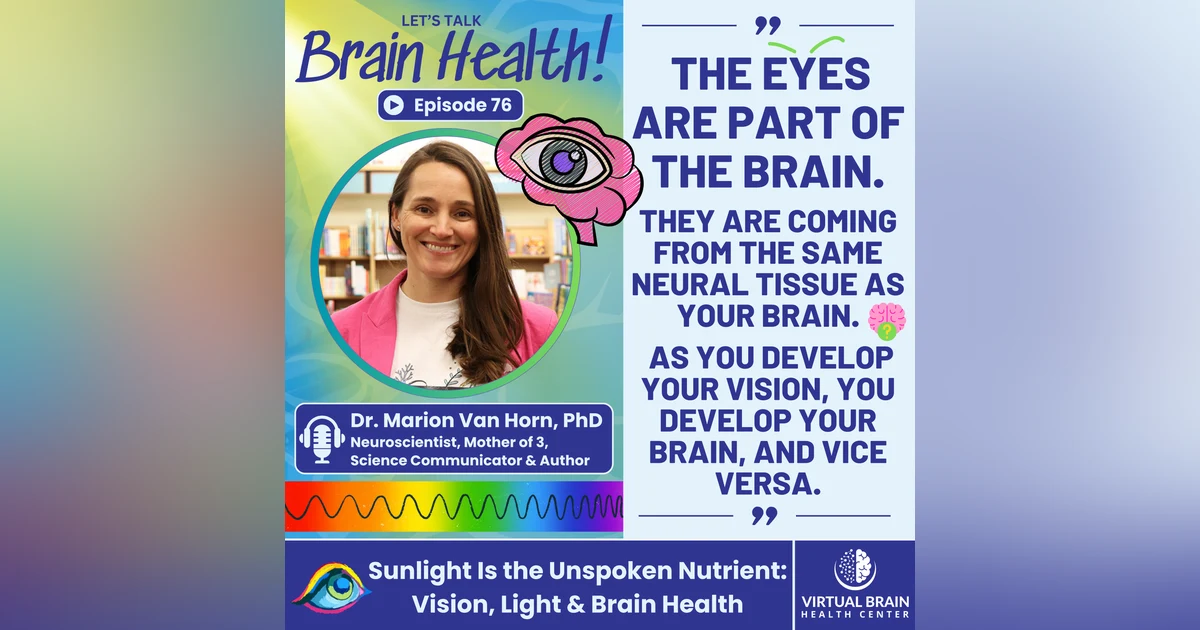
 Sunlight Is the Unspoken Nutrient: Vision, Light & Brain Health with Dr. Marion Van Horn, PhD
When was the last time you stepped outside and just looked up?
Not at your phone. Not at a screen. Just up — at the sky, the light, the world around you. If it has been a while, your brain has noticed. And this week's guest is going to tell you exactly why that matters.
In this episode of the Let's Talk Brain Health! Podcast, Dr. Krystal Culler sits down with Dr. Marion Van Horn — neuroscientist, science communicator, and mother of three — for a conversation that will change the way you think about your eyes, your light environment, and your brain health.
Vision is not just seeing. It is how your brain regulates your mood, sets your sleep, manages your emotions, and builds its picture of the world — all in milliseconds. And natural light — something most of us walk past every day — is one of the most powerful inputs our brains receive. Dr. Marion calls it the unspoken nutrient. And after this episode, you will never think about sunlight the same way again.
This episode also features a special collaboration —'Take a Brain
Break'—' coloring page created by Dr. Marion Van Horn, Dr. Maria Zamfir, and Dr. Krystal Culler. Find it free in the show notes.
What You'll Learn in This Episode
🧠 How the brain actually learns to see — and why vision is not automatic at birth
🧠 What neuroplasticity means for visual development across the lifespan
🧠 Why natural sunlight is the unspoken nutrient your brain needs every day
🧠 The relationship between light, circadian rhythms, sleep, and mood
🧠 What screens and artificial light are doing to your brain and body
🧠 How visual pathways connect directly to emotional centers — including the amygdala
🧠 Why going outside when you feel overwhelmed works neurologically — not just psychologically
🧠 How the two eyes work together to create three-dimensional vision
🧠 Why vision loss is a modifiable risk factor for dementia — and why your annual eye exam matters
🧠 Practical steps to protect your visual brain health starting today
Key Takeaways
✔ Natural light is the unspoken nutrient — get outside within the first hour of waking, even for a few minutes
✔ Vision actively regulates how you feel and how you interact with the world — it is so much more than seeing
✔ Your eyes are part of your brain — protecting your vision is protecting your brain
✔ Going outside changes your gaze, your nervous system, and your emotional state
✔ Uncorrected vision loss increases dementia risk — prioritize your annual eye exam at every age
✔ Small consistent habits — morning light, noticing the sunrise, watching the moon — add up over time
Earn FREE CEs
This podcast qualifies for the following credit types: AMA PRA Category 1, ANCC, AAPA, APA, ASWB, and IPCE. Join the Learn at Pinnacle app to earn FREE CE credit for listening to this episode!
Support the Podcast
If you enjoyed this episode, please help us grow the conversation around better brain health:
Follow or subscribe to the Let's Talk Brain Health! Podcast
Leave a rating or review
Share this episode with a friend, colleague, or fellow brain health advocate
Thank you for investing your time and energy into your brain health. A special thank you to Dr. Marion Van Horn, PhD for reminding us that one of the most powerful things we can do for our brains costs nothing at all. Go outside. Look up.
Resources:
Explore Marion’s work and resources on her website
Connect with Marion on Social media @marion.phd on Instagram
Download Our “Let’s Take A Brain Break” coloring page on our website
Continue to learn from The Neuron Family on Instagram or their newsletter
Check out The Neuron Family’s colouring books on its website or LinkTr.ee