
 Apple Podcasts
 Spotify
 Amazon Music
  RSS Feed
 The Brain Behind Addiction: Inside A Transformational Care Model-Where Hope Meets Science with Dr. Amber Deckard, Psy.D.
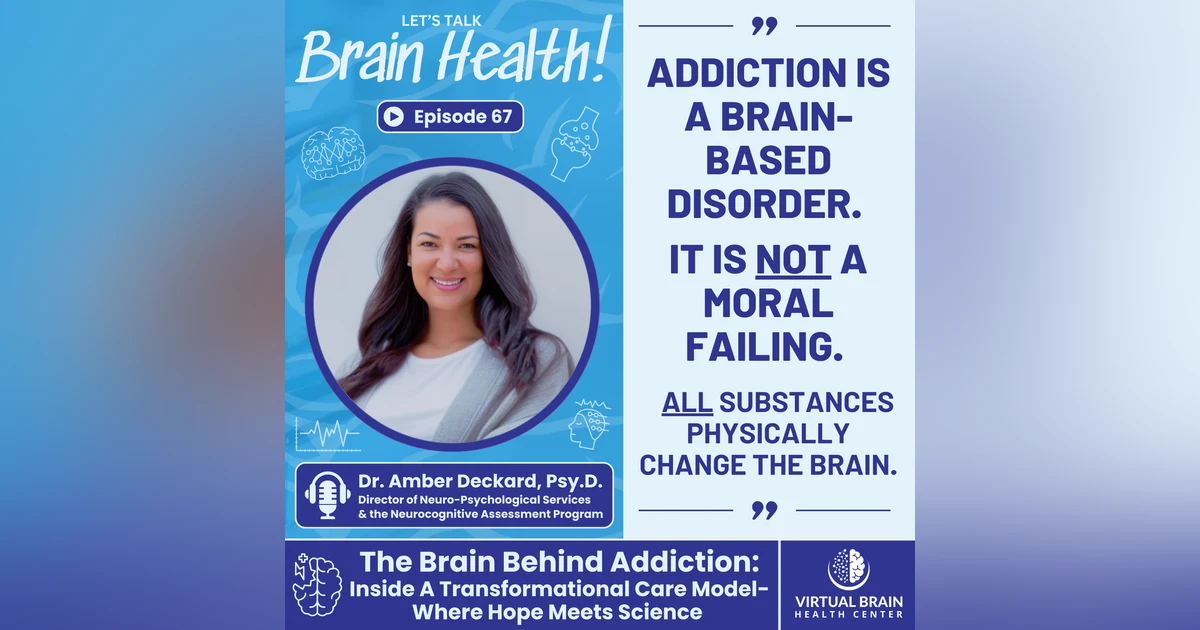
In this episode, Dr. Amber Deckard, a neuropsychologist and leader in neurocognitive assessments at Caron's neuropsychological services, shares insights into the brain-first approach to addiction treatment.
She explains how viewing addiction as a brain-based disorder rather than a moral failing changes the treatment paradigm. We delve into the latest brain science, revealing how substances physically alter brain areas responsible for reward, motivation, memory, decision-making, and self-control, challenging the misconception that addiction is a moral failing.
Dr. Deckard discusses the impacts of substances on brain function and the importance of a holistic, evidence-based, and multidisciplinary approach to recovery.
She highlights the role of various therapeutic modalities, including neurofeedback, hyperbaric oxygen therapy, and personalized treatment planning, in supporting brain health and recovery.
The episode aims to shift perspectives on addiction, emphasizing the brain's capacity for healing and the crucial role of integrated care.
00:00 Introduction to the Brain First Approach
00:05 Meet Dr. Amber Deckard, PsyD
02:16 Understanding Addiction as a Brain-Based Disorder
05:04 The Role of Family in Recovery
07:38 Advanced Neurocognitive Assessment Tools
13:54 Personalized Treatment Plans
23:30 The Power of Neurofeedback
29:12 The Comprehensive, Multimodal Approach to Brain Health
33:25 Dr. Deckard's Personal Brain Care
35:41 Message of Hope and Conclusion
Resources
- Learn more about Caron’s Neurospychological Service’s and its cutting-edge Neurocognitive Assessment Program on their website.
- Connect with Dr. Amber Deckard on LinkedIn.
- Listen to learn more about Brain HQ’s brain training program in our previous podcast episode “What the Latest Brain Training Science Means for Your Brain Health: A Conversation with the Lead Developer of BrainHQ, Dr. Henry Mahncke, Ph.D.”
00:00:02,640 --> 00:00:06,240
Welcome to the Let's Talk Brain
Health podcast, a public health
2
00:00:06,280 --> 00:00:08,920
educational initiative of the
virtual Brain Health Center.
3
00:00:09,200 --> 00:00:12,240
I'm your host, Doctor Crystal
Color, and I'm so glad you're
4
00:00:12,240 --> 00:00:14,880
here.
On this podcast, I sit down with
5
00:00:14,880 --> 00:00:18,240
incredible guests to explore all
things brain health and
6
00:00:18,240 --> 00:00:20,520
Wellness.
Together, we'll talk about how
7
00:00:20,520 --> 00:00:24,480
to care for your total brain
health, mind, body, and spirit
8
00:00:24,800 --> 00:00:28,160
while sharing the latest brain
Health Science practical tips
9
00:00:28,440 --> 00:00:30,720
and strategies you can use
everyday.
10
00:00:31,240 --> 00:00:34,240
By prioritizing your brain
health, you're taking an
11
00:00:34,240 --> 00:00:37,320
important step towards living a
happier, healthier life.
12
00:00:37,840 --> 00:00:40,560
So let's dive in and welcome
today's guest.
13
00:00:44,280 --> 00:00:47,000
Today we're talking about
addiction through a new lens,
14
00:00:47,160 --> 00:00:50,880
the brain First approach.
My guest, Doctor Amber Deckard,
15
00:00:50,880 --> 00:00:54,320
leads Karen's Neuropsychological
Services and its cutting edge
16
00:00:54,320 --> 00:00:57,840
Neurocognitive assessment
program, bringing over a decade
17
00:00:57,840 --> 00:01:01,360
of hands on neuropsychology
experience to the evaluation and
18
00:01:01,360 --> 00:01:04,560
treatment of cognitive,
psychological and substance use
19
00:01:04,560 --> 00:01:08,600
disorders. the US Marine Corps
veteran turned leader, Doctor
20
00:01:08,600 --> 00:01:12,080
Deckard combines military honed
experience discipline with
21
00:01:12,080 --> 00:01:15,760
clinical insight to guide a
multidisciplinary team focused
22
00:01:15,760 --> 00:01:18,280
on evidence based
neurorestorative care.
23
00:01:18,720 --> 00:01:21,560
Her expertise includes the
assessment of brain injuries,
24
00:01:21,920 --> 00:01:27,240
pharmacology, chronic pain,
dementia, ADHD and Co occurring
25
00:01:27,240 --> 00:01:30,800
psychiatric conditions.
Before joining Karen, Dr.
26
00:01:30,800 --> 00:01:34,080
Deckard founded a concierge
neuropsychology practice and
27
00:01:34,080 --> 00:01:37,160
served as director of Training
and clinical supervisor across
28
00:01:37,160 --> 00:01:39,040
multiple memory and Wellness
centers.
29
00:01:39,520 --> 00:01:42,640
She holds a Doctor of Clinical
Psychology with a specialization
30
00:01:42,640 --> 00:01:46,320
in neuropsychology from Nova
Southeastern University, where
31
00:01:46,320 --> 00:01:48,360
she now serves as an adjunct
professor.
32
00:01:48,800 --> 00:01:52,120
Her leadership is rooted in
clear communication, rigorous
33
00:01:52,120 --> 00:01:55,560
standards, and a belief that
resilience and collaboration.
34
00:01:55,560 --> 00:01:59,400
Dr. Meaningful Recovery.
Doctor Deckard, welcome to
35
00:01:59,400 --> 00:02:02,800
today's podcast.
Is there anything else about
36
00:02:02,800 --> 00:02:05,400
your background that you'd like
to share with our audience
37
00:02:05,400 --> 00:02:07,800
today?
Thank you for having me.
38
00:02:08,199 --> 00:02:12,360
I would say maybe just to add
what drew me to neuropsychology
39
00:02:12,920 --> 00:02:18,240
was the power of the connection
between brain, behavior and
40
00:02:18,240 --> 00:02:20,760
emotional health.
During my time working with
41
00:02:20,760 --> 00:02:25,880
patients who struggled with an
array of concerns from trauma
42
00:02:25,880 --> 00:02:30,640
and addiction, I started seeing
a pattern where people weren't
43
00:02:31,200 --> 00:02:34,080
failing treatment.
Their brains needed healing
44
00:02:34,080 --> 00:02:36,520
first.
When that clicked, everything
45
00:02:36,520 --> 00:02:39,480
changed for me.
I'm so grateful you shared that
46
00:02:39,480 --> 00:02:42,000
because one of the things I
think is so important on this
47
00:02:42,000 --> 00:02:46,560
podcast is it's not only our
expertise that our guests bring,
48
00:02:46,560 --> 00:02:50,160
but it's the part that their
brains in their hearts seem to
49
00:02:50,160 --> 00:02:53,320
bring them into the spaces in
the communities that they serve.
50
00:02:53,320 --> 00:02:56,040
So I'm grateful that you've
shared that for us today,
51
00:02:56,320 --> 00:02:58,880
especially if we're going to
drive into the topic of
52
00:02:58,880 --> 00:03:01,520
addiction as a brain based
disorder.
53
00:03:01,520 --> 00:03:04,840
And I thought one of the best
ways to really start this
54
00:03:04,840 --> 00:03:08,320
conversation is just to combat
one of the most common myths
55
00:03:08,320 --> 00:03:11,960
surrounding this space that I
hear people have always come to
56
00:03:11,960 --> 00:03:14,880
our virtual brain Health Center
about as they're trying to
57
00:03:14,880 --> 00:03:18,680
better understand addiction very
broadly of any type.
58
00:03:18,680 --> 00:03:22,400
It can be from dopamine
addiction to substance use to
59
00:03:22,640 --> 00:03:25,240
why we're still relying on
caffeine in the mornings.
60
00:03:25,560 --> 00:03:29,520
This whole idea that it's just a
lack of willpower or people are
61
00:03:29,600 --> 00:03:32,240
lazy.
What does the latest brain
62
00:03:32,240 --> 00:03:36,160
science actually tell us about
addiction as a brain based
63
00:03:36,160 --> 00:03:38,200
disorder?
Yes I agree.
64
00:03:38,200 --> 00:03:42,680
So addiction is a brain based
disorder and it's not a moral
65
00:03:42,680 --> 00:03:45,440
failing.
Substances physically change the
66
00:03:45,440 --> 00:03:48,920
brain and whatever that
substance is as you mentioned
67
00:03:49,040 --> 00:03:54,400
dopamine addiction or gambling
and addiction to gaming,
68
00:03:54,400 --> 00:03:57,120
addiction to any type of
substance from alcohol to
69
00:03:57,120 --> 00:03:59,520
fentanyl.
It does physically change the
70
00:03:59,520 --> 00:04:05,000
brain, especially in the areas
that are responsible for reward
71
00:04:05,000 --> 00:04:09,080
and motivation and memory and
decision making and
72
00:04:09,080 --> 00:04:11,600
self-control.
Think of those as the primary
73
00:04:11,600 --> 00:04:14,240
networks.
The primary I call the CEO,
74
00:04:14,360 --> 00:04:16,440
right, the executor of the
brain.
75
00:04:16,959 --> 00:04:20,720
Those substances change that
that part of the brain.
76
00:04:20,720 --> 00:04:23,560
And then to me it's really
important to say how do we
77
00:04:23,560 --> 00:04:28,480
expect somebody to engage in
life or remember something or
78
00:04:28,920 --> 00:04:30,640
engage meaningfully in
treatment.
79
00:04:30,760 --> 00:04:34,600
So we expect them to attend
groups or individual sessions
80
00:04:34,600 --> 00:04:40,120
and learn the information and
encode it and consolidate it.
81
00:04:40,320 --> 00:04:45,400
And then how do we expect them
to retain it and recall it and
82
00:04:45,400 --> 00:04:49,960
apply it if their brain is not
functioning properly?
83
00:04:50,600 --> 00:04:52,520
So we know that the brain is
changing.
84
00:04:52,520 --> 00:04:55,800
We know that there are
significant impacts, but yet in
85
00:04:56,120 --> 00:05:00,560
many arenas, we continue to
think that this is primarily a
86
00:05:00,560 --> 00:05:04,440
moral failing, that it's a
choice, that it's lack of
87
00:05:04,440 --> 00:05:06,680
intelligence.
And what we really want to
88
00:05:06,680 --> 00:05:11,720
change this to is this is about
how the brain regulates impulse
89
00:05:11,720 --> 00:05:14,680
control, makes decisions and how
it thinks.
90
00:05:15,080 --> 00:05:19,000
So it is the primary organ to
focus on is the brain.
91
00:05:19,480 --> 00:05:23,440
Treat it and then we can treat
the substance use disorder, the
92
00:05:23,520 --> 00:05:25,680
mental health disorder and the
whole person.
93
00:05:26,320 --> 00:05:29,680
It's a shift in a conversation
for a lot of us to think about
94
00:05:29,680 --> 00:05:32,400
that, not just the person that
may be coming in with the
95
00:05:32,400 --> 00:05:36,080
concern, but for those in their
immediate support network.
96
00:05:36,360 --> 00:05:39,040
How do you think that
conversation changes or shifts
97
00:05:39,040 --> 00:05:42,360
when families start to
understand addiction through
98
00:05:42,360 --> 00:05:44,360
that ledge?
Does that start to shift the
99
00:05:44,360 --> 00:05:47,280
change in the recovery journey
for everyone involved?
100
00:05:48,040 --> 00:05:51,040
Yes, I think that the shift in
the recovery journey is
101
00:05:51,040 --> 00:05:54,880
significant for the family
system and the relationships.
102
00:05:55,280 --> 00:05:59,160
We know that substance use
impacts marital partner
103
00:05:59,160 --> 00:06:01,680
relationships, parent child
relationships, sibling
104
00:06:01,680 --> 00:06:04,720
relationships, social
relationships, workplace
105
00:06:04,720 --> 00:06:08,400
relationships.
So allowing these individuals
106
00:06:08,480 --> 00:06:11,240
and more than just saying this
is a shift in the understanding
107
00:06:11,240 --> 00:06:12,880
of it being a brain based
disorder.
108
00:06:13,400 --> 00:06:17,040
But when we talk about treating
a whole person, saying we're
109
00:06:17,040 --> 00:06:19,960
able to work with the family
system, we're not just doing
110
00:06:19,960 --> 00:06:21,600
individual or group therapy,
right?
111
00:06:21,600 --> 00:06:25,680
But focusing on the family
system and their network of
112
00:06:25,680 --> 00:06:30,680
relationships allow them to also
tell their side of the story and
113
00:06:30,680 --> 00:06:34,040
work through their experiences
and bring them back together.
114
00:06:34,040 --> 00:06:37,240
But also understanding that how
maybe they view their family
115
00:06:37,240 --> 00:06:41,560
member of maybe they stole from
them, maybe they were extremely
116
00:06:41,560 --> 00:06:46,040
hurt, maybe there's generational
trauma, whatever that is saying,
117
00:06:46,040 --> 00:06:49,400
how do we heal the family system
and help them also understand
118
00:06:49,400 --> 00:06:52,960
that we want to treat the brain
that this is not something that
119
00:06:52,960 --> 00:06:56,280
they are making a choice to
purposefully hurt their family
120
00:06:56,280 --> 00:06:58,760
member.
Even though in the moment it may
121
00:06:58,760 --> 00:07:01,760
seem like that, it may feel like
it, it may look like it, but
122
00:07:01,760 --> 00:07:05,040
helping them all come to the
realization that there is an
123
00:07:05,040 --> 00:07:08,600
underlying cause for this
underlying source that needs to
124
00:07:08,600 --> 00:07:12,200
be addressed first.
I think so much has changed in
125
00:07:12,200 --> 00:07:15,600
the field of neuroscience and
neuropsychological assessment,
126
00:07:15,600 --> 00:07:18,560
especially now that we can see
images of the brain.
127
00:07:18,560 --> 00:07:21,480
And I know I can always speak
from my personal experience of
128
00:07:21,680 --> 00:07:24,440
someone that has had family
members with addiction.
129
00:07:24,440 --> 00:07:29,160
It's when I first saw brain
imaging scans of what addiction
130
00:07:29,160 --> 00:07:33,720
can look like in the brain that
I then began to better
131
00:07:33,720 --> 00:07:38,480
understand their behavior or a
repeated behavior or why they
132
00:07:38,520 --> 00:07:42,120
may have had this cyclic
behavior and was unable to get
133
00:07:42,120 --> 00:07:44,320
out of the loop.
Because I finally then could
134
00:07:44,320 --> 00:07:46,600
understand what was better
happening because I could see
135
00:07:46,600 --> 00:07:48,960
the imaging.
I could see the areas of the
136
00:07:48,960 --> 00:07:52,800
brain that were impacted and was
then better able to understand
137
00:07:52,800 --> 00:07:55,600
the behavior, at least for
myself, and navigating that in
138
00:07:55,600 --> 00:07:57,840
my own journey, what I was
learning and studying.
139
00:07:57,840 --> 00:08:02,600
Because now the pictures were
worse, a lot more to, I think,
140
00:08:02,680 --> 00:08:06,520
link this behavior to the
imaging and now this treatment
141
00:08:06,520 --> 00:08:09,320
plan that an individual was
going to be going through.
142
00:08:09,600 --> 00:08:12,560
And now you leave Karen's
neurocognitive assessment
143
00:08:12,560 --> 00:08:17,080
program, which uses advanced
tools like QEG and PET scan.
144
00:08:17,080 --> 00:08:20,720
So what kind of insights do
these tools uncover that
145
00:08:20,720 --> 00:08:24,640
standard assessments often miss?
That's a great question.
146
00:08:24,680 --> 00:08:27,600
That's a big part of this when
we link the two together, the
147
00:08:27,600 --> 00:08:29,760
brain being the primary organ of
focus.
148
00:08:29,760 --> 00:08:32,520
And then why do these cognitive
assessments matter?
149
00:08:32,840 --> 00:08:35,559
And you spoke beautifully about
what, when I first see the image
150
00:08:35,559 --> 00:08:37,000
and I'm like, oh, now this makes
sense.
151
00:08:37,000 --> 00:08:40,960
I can link all of this together.
One of the areas that I tend to
152
00:08:40,960 --> 00:08:43,880
focus on when I'm giving a talk
or just generally speaking to
153
00:08:43,880 --> 00:08:46,760
patients is when you think about
imagery.
154
00:08:47,160 --> 00:08:50,760
And many times you'll see a
treatment centers or especially
155
00:08:50,760 --> 00:08:53,080
in the field of psychology or
behavioral cell help, you'll see
156
00:08:53,080 --> 00:08:55,000
a tree use.
And we understand the root
157
00:08:55,000 --> 00:08:59,520
system and the overall
connections and the electrical
158
00:08:59,520 --> 00:09:02,520
systems in a tree.
But the one of the images that I
159
00:09:02,520 --> 00:09:08,200
use as a part of this program is
an upside down body in a tree.
160
00:09:08,520 --> 00:09:12,320
And thinking of the broad
canopy, the beautiful canopy as
161
00:09:12,360 --> 00:09:14,320
all of those things that we
touched on, right?
162
00:09:14,320 --> 00:09:18,800
Family systems, relationships,
mood, emotions, behaviors, all
163
00:09:18,800 --> 00:09:22,440
of the things that everybody
overtly sees, right?
164
00:09:22,440 --> 00:09:24,960
And we attribute that to a moral
failing.
165
00:09:25,360 --> 00:09:28,560
And then the trunk of the tree
be more of that human
166
00:09:29,080 --> 00:09:33,040
physiological body and taking
into account all of the things
167
00:09:33,040 --> 00:09:37,400
that impact the physiological
symptom or the physiological
168
00:09:37,400 --> 00:09:42,600
system secondary to substance
use, trauma, depression,
169
00:09:42,600 --> 00:09:46,200
anxiety, and then bringing it
down to the base where this
170
00:09:46,200 --> 00:09:48,600
body's upside down is now the
brain.
171
00:09:49,080 --> 00:09:52,160
And I use that as the root
system to really say when you
172
00:09:52,160 --> 00:09:56,800
think about a tree system, the
canopy can be far spread and
173
00:09:56,800 --> 00:10:01,280
beautiful, but the root system
is always significantly wider.
174
00:10:01,520 --> 00:10:05,000
The root system spans broader
than the canopy for a tree.
175
00:10:05,480 --> 00:10:10,920
Understanding that the overall
root system of addiction, of
176
00:10:10,920 --> 00:10:15,120
mental health, saying what came
first, What do we focus on as a
177
00:10:15,120 --> 00:10:17,800
part of that?
When we spoke a few moments ago
178
00:10:17,800 --> 00:10:21,880
about the reward system, right?
Understanding that with
179
00:10:21,880 --> 00:10:26,120
substance use in the reward
system, every day can feel flat
180
00:10:26,440 --> 00:10:29,600
or unpredictable.
Feeling out of control that
181
00:10:29,600 --> 00:10:32,800
something is driving you, that
you need something even when
182
00:10:32,880 --> 00:10:36,160
willpower wise you don't want
this substance, but your brain
183
00:10:36,160 --> 00:10:38,840
is telling you that you need it
or you have to have it to be
184
00:10:38,840 --> 00:10:42,600
able to function, to feel
better, to feel less anxious, to
185
00:10:42,600 --> 00:10:46,280
feel maybe less flat.
Understanding the frontal lobe,
186
00:10:46,320 --> 00:10:50,080
understanding executive
functioning and how somebody
187
00:10:50,080 --> 00:10:55,000
plans and organizes and how they
struggle to resist impulses.
188
00:10:55,560 --> 00:10:58,160
Do you just give into your
impulses or is your executive
189
00:10:58,160 --> 00:11:02,040
functioning piece of your brain
functioning below expectation
190
00:11:02,040 --> 00:11:05,920
and therefore you really
struggle to resist the impulses
191
00:11:05,920 --> 00:11:08,720
even though morally you don't
want to?
192
00:11:08,800 --> 00:11:12,000
You don't want to engage in this
behavior, but yet here we are
193
00:11:12,000 --> 00:11:15,640
time and time again.
Emotional regulation, mood
194
00:11:15,640 --> 00:11:20,320
swings, irritability, anxiety
and saying I don't want to be
195
00:11:20,320 --> 00:11:23,640
anxious, I don't want to feel
this way, but yet I'm back in
196
00:11:23,640 --> 00:11:25,880
the same loop and I can't get
out of my own way.
197
00:11:26,360 --> 00:11:29,640
It really allows us to
understand the brain when we're
198
00:11:29,640 --> 00:11:34,760
using FDG, PET, QEG,
neuropsychological assessment
199
00:11:35,280 --> 00:11:40,080
and a full history and physical.
We understand the whole body,
200
00:11:40,080 --> 00:11:42,720
the whole person.
The history and physical gives
201
00:11:42,720 --> 00:11:46,440
us that collateral piece to
understand where some of these
202
00:11:46,440 --> 00:11:50,600
things stem from.
We understand if the importance
203
00:11:50,600 --> 00:11:54,240
of let's say significant alcohol
use and there's a thiamine
204
00:11:54,240 --> 00:11:58,280
deficiency, then the thiamine
deficiency is going to impact
205
00:11:58,280 --> 00:12:00,600
both physical body and the
brain.
206
00:12:01,120 --> 00:12:04,520
And how do we treat that?
If there's imbalance cortisol
207
00:12:04,520 --> 00:12:06,640
levels, how does that impact the
brain?
208
00:12:06,640 --> 00:12:09,760
And how do we go about
understanding the impacts to the
209
00:12:09,760 --> 00:12:12,600
patient and their anxiety and
their regulation?
210
00:12:13,040 --> 00:12:18,400
It also tells us, as far as the
FGG PET goes, it tells us blood
211
00:12:18,400 --> 00:12:22,680
flow and it while FGG PET
primarily looks at glucose
212
00:12:22,720 --> 00:12:25,160
uptake as a part of that.
When you're looking at the
213
00:12:25,160 --> 00:12:29,000
imaging, usually we can see
where the uptake is flowing in
214
00:12:29,000 --> 00:12:30,720
the brain.
If there's a reduction in that
215
00:12:30,720 --> 00:12:33,480
area, it also aligns with
reduced blood flow.
216
00:12:34,000 --> 00:12:36,760
We want to understand if the
brain is not getting healthy
217
00:12:36,760 --> 00:12:40,520
oxygenated blood flow to certain
areas with the QEG, we want to
218
00:12:40,520 --> 00:12:44,680
understand electrical activity,
is it fast wave activity, is a
219
00:12:44,680 --> 00:12:47,360
slow wave activity.
So basically is your brain
220
00:12:47,360 --> 00:12:50,800
processing information, the
connections, are they too slow?
221
00:12:51,040 --> 00:12:54,800
Is it too fast?
And then switching that into how
222
00:12:54,800 --> 00:12:57,240
do we tie that all together
functionally?
223
00:12:57,600 --> 00:13:01,760
So if we see let's say in the
temporal lobe on a FDG PET scan,
224
00:13:01,760 --> 00:13:03,320
we can see those reduced blood
flow.
225
00:13:03,840 --> 00:13:07,080
And on the QE e.g, we can see
some of that cortical
226
00:13:07,080 --> 00:13:10,720
involvement that may be
impacting a language area on the
227
00:13:10,720 --> 00:13:14,640
temporal lobe in a memory area.
And then on functional testing,
228
00:13:14,880 --> 00:13:19,080
we see that their auditory and
visual memory is below
229
00:13:19,080 --> 00:13:22,440
expectation and they struggle to
produce some words.
230
00:13:22,680 --> 00:13:25,800
We are able to tie all of that
together and show there's
231
00:13:25,800 --> 00:13:31,200
multiple pieces of the brain
impacted by their substance use.
232
00:13:31,600 --> 00:13:35,800
And then the next step is how do
we target our treatment to help
233
00:13:35,800 --> 00:13:38,600
them heal the part of their
brain that is impacting their
234
00:13:38,600 --> 00:13:42,080
functioning the most, so they
can engage meaningfully in
235
00:13:42,080 --> 00:13:46,040
treatment and therefore with the
goal of sustained recovery in
236
00:13:46,040 --> 00:13:47,920
the long term?
Wow.
237
00:13:48,320 --> 00:13:51,200
I think if we didn't know how
interconnected the mind and the
238
00:13:51,200 --> 00:13:55,480
body were for a level of detail,
when you can go into one place
239
00:13:55,800 --> 00:13:59,800
that will really take the time
to look at that and to put the
240
00:13:59,800 --> 00:14:04,920
pieces of the puzzle together
through tests and then figure it
241
00:14:04,920 --> 00:14:07,160
out.
Would you mind telling us more
242
00:14:07,160 --> 00:14:10,520
that about how once you have
those results and that
243
00:14:10,520 --> 00:14:13,600
personalized data, because this
is unique to every individual,
244
00:14:13,600 --> 00:14:18,160
as we always say, like one brain
is so unique to its patterns.
245
00:14:18,160 --> 00:14:21,280
And that of course would also
change over time as well.
246
00:14:21,600 --> 00:14:25,480
And when you start to see those,
how do you see that in outcomes
247
00:14:25,480 --> 00:14:28,680
once you start to take your more
personalized Taylor approach for
248
00:14:28,680 --> 00:14:30,440
someone?
Can you walk us through that?
249
00:14:31,200 --> 00:14:33,000
Sure.
But once individuals have gone
250
00:14:33,000 --> 00:14:35,720
through, and I like that you
said that an individualized
251
00:14:35,720 --> 00:14:39,000
assessment process, once they go
through the assessment piece and
252
00:14:39,000 --> 00:14:42,440
we have all of the objective
data, we sit down together and
253
00:14:42,440 --> 00:14:45,720
we review next steps and
recommendations and that looks
254
00:14:45,720 --> 00:14:49,920
different for every individual.
If I can just use an example, if
255
00:14:49,920 --> 00:14:53,680
we have an individual who has a
history of substance use, but
256
00:14:53,680 --> 00:14:58,240
they also have a significant
history of borderline
257
00:14:58,240 --> 00:15:00,640
personality disorder, for
example, and that shows up on
258
00:15:00,640 --> 00:15:04,680
their objective testing that
their trajectory forward or
259
00:15:04,680 --> 00:15:07,960
their recommendations would
include some of those same
260
00:15:07,960 --> 00:15:09,800
things.
Some individual therapy, group
261
00:15:09,800 --> 00:15:14,480
therapy, family therapy, support
groups, but they also include
262
00:15:14,800 --> 00:15:16,960
specialized treatment.
So we may recommend them
263
00:15:16,960 --> 00:15:19,920
specifically for dialectic
behavioral therapy or DBT,
264
00:15:19,920 --> 00:15:23,600
right, to say we want to focus
on something that may serve as a
265
00:15:23,600 --> 00:15:27,040
barrier to your treatment, which
is the borderline personality
266
00:15:27,040 --> 00:15:31,080
symptoms and characteristics.
We may also have individuals
267
00:15:31,080 --> 00:15:35,120
whose primary symptom
presentation is severe cognitive
268
00:15:35,120 --> 00:15:38,560
impairment.
If that is the individualized
269
00:15:38,560 --> 00:15:41,080
case, then what we're going to
do is focus on neuro restorative
270
00:15:41,080 --> 00:15:44,760
care that would still engage in
individual sessions and group
271
00:15:44,760 --> 00:15:49,000
sessions, but we may focus more
so on helping restore their
272
00:15:49,000 --> 00:15:52,200
brain with brain training.
I'm sure you've heard of it.
273
00:15:52,200 --> 00:15:55,960
The brainhq.com is an excellent
resource for brain
274
00:15:55,960 --> 00:15:59,400
rehabilitation.
We may recommend hyperbaric
275
00:15:59,400 --> 00:16:02,920
oxygen therapy, which kind of
ties when you think about the
276
00:16:02,920 --> 00:16:05,320
FGG PET.
So we're saying we're seeing
277
00:16:05,320 --> 00:16:09,000
areas of the brain that are
under perfused or hypo perfused.
278
00:16:09,440 --> 00:16:13,560
So we may recommend hyperbaric
oxygen therapy to help reperfuse
279
00:16:13,840 --> 00:16:16,080
the brain.
A good way to think of that is
280
00:16:16,400 --> 00:16:18,520
for your listeners, especially
if we told everybody while
281
00:16:18,520 --> 00:16:21,160
they're listening for the
remainder of the podcast to sit
282
00:16:21,160 --> 00:16:25,040
on their hand and continue
sitting on it until the end,
283
00:16:25,480 --> 00:16:27,560
it's going to go down.
And if we told them to sit on it
284
00:16:27,560 --> 00:16:30,680
for probably another couple
weeks or so, it might fall off.
285
00:16:30,960 --> 00:16:36,320
We need healthy oxygenated blood
flow to tissue in order for it
286
00:16:36,320 --> 00:16:39,880
to regenerate.
Overall goal is knowing that
287
00:16:39,880 --> 00:16:42,920
neuroplasticity in the brain or
the ability for the brain to
288
00:16:42,920 --> 00:16:47,320
create, work around networks and
heal itself and neurogenesis,
289
00:16:47,320 --> 00:16:50,680
the creation of new neurons in
the brain that the goal is to
290
00:16:50,680 --> 00:16:53,920
help understand that is
happening naturally.
291
00:16:54,000 --> 00:16:58,200
So the natural recovery, the
cone of spontaneous recovery is
292
00:16:58,200 --> 00:17:01,960
going to occur, but how can we
help maybe speed up that
293
00:17:01,960 --> 00:17:05,560
timeline so that they can engage
more meaningfully in the
294
00:17:05,560 --> 00:17:08,480
therapeutic process?
And in doing so, it would be
295
00:17:08,480 --> 00:17:11,839
hyperbaric oxygen therapy, but
also have options for spiritual
296
00:17:11,839 --> 00:17:16,200
fitness, nutritional counseling,
physical fitness, the overall
297
00:17:16,200 --> 00:17:18,240
things that we know when we
treat the whole person and the
298
00:17:18,240 --> 00:17:21,319
whole body.
The goal is every single piece
299
00:17:21,319 --> 00:17:23,880
of that where we can see that
there is a deficit.
300
00:17:24,200 --> 00:17:27,680
We want to help them get to a
better level of functioning both
301
00:17:27,680 --> 00:17:32,560
cognitively, mentally,
neurologically and physically to
302
00:17:32,560 --> 00:17:37,000
help improve their chances of
recovery through increased
303
00:17:37,000 --> 00:17:41,040
neurogenesis.
So it's a true interdisciplinary
304
00:17:41,160 --> 00:17:45,560
holistic approach to self-care
that's very individualized to
305
00:17:45,560 --> 00:17:47,480
where they are.
And it seems you give them
306
00:17:47,480 --> 00:17:51,600
recommendations as well as they
have a role in the process as
307
00:17:51,600 --> 00:17:54,640
well as to where their goals are
and where they're aiming to go
308
00:17:54,640 --> 00:17:57,120
to as well as where they're
prioritizing.
309
00:17:57,120 --> 00:18:00,400
It seems like at this moment in
time, what may be important for
310
00:18:00,680 --> 00:18:03,640
where they're striving to be?
Because you've leaned into the
311
00:18:03,640 --> 00:18:05,920
whole point.
As neuroscience shows, this
312
00:18:06,000 --> 00:18:10,240
brain has this incredible
capacity and ability to heal,
313
00:18:10,240 --> 00:18:12,640
and we can do it through
multiple modalities.
314
00:18:12,640 --> 00:18:15,560
And you feel eloquently
highlighted all these different
315
00:18:15,560 --> 00:18:20,080
areas where we can have supports
really through a biopsychosocial
316
00:18:20,080 --> 00:18:22,680
approach.
It can be biology, it can be
317
00:18:22,680 --> 00:18:26,000
through spirituality, it can be
through our social supports and
318
00:18:26,000 --> 00:18:28,720
our networks.
And yet when we seem to tap into
319
00:18:28,720 --> 00:18:34,000
all those multiple dimensions of
our Wellness and well-being, we
320
00:18:34,000 --> 00:18:37,160
really can better support
ourselves as well as the mental
321
00:18:37,160 --> 00:18:39,680
health that we are striving to
support.
322
00:18:39,680 --> 00:18:42,200
And you really encapsulated all
that well.
323
00:18:42,520 --> 00:18:46,120
And your response.
How do you best understand that
324
00:18:46,120 --> 00:18:48,920
for people with their outcomes
and their support and recovery?
325
00:18:48,920 --> 00:18:53,200
Do you find one modality works
really well because you seem to
326
00:18:53,280 --> 00:18:57,680
have this multi faceted approach
and do you seem that's the best
327
00:18:57,680 --> 00:19:00,520
approach from what you seem to
run at your center?
328
00:19:00,520 --> 00:19:03,040
Is this holistic approaching
care?
329
00:19:03,920 --> 00:19:06,600
Yes, we know that certain things
work better going back to we
330
00:19:06,640 --> 00:19:09,720
know that CBT works better for
borderline personality disorder
331
00:19:09,720 --> 00:19:13,640
than let's say CBT.
However, what we've really
332
00:19:13,640 --> 00:19:16,760
realized is that this
comprehensive approach and
333
00:19:16,760 --> 00:19:20,640
having it all in one space
really running into when we hear
334
00:19:20,640 --> 00:19:23,680
patients feedback about I've
been doing this for years, I've
335
00:19:23,680 --> 00:19:26,880
been in and out of treatment for
years or I've been seeing a
336
00:19:26,880 --> 00:19:31,080
therapist for years or I have
this doctor over here.
337
00:19:31,080 --> 00:19:35,480
But I was recommended to go see
XY and Z specialist and I can't
338
00:19:35,480 --> 00:19:37,680
get into them for six months or
nine months.
339
00:19:37,680 --> 00:19:40,520
Or I had an appointment but it
was cancelled and now it's six
340
00:19:40,520 --> 00:19:43,160
months later.
We noticed that when it's all in
341
00:19:43,160 --> 00:19:46,480
one place and it's accessible to
the patients to engage in
342
00:19:46,480 --> 00:19:49,160
simultaneously, we're not
reinventing the wheel.
343
00:19:49,280 --> 00:19:53,200
We know that nutritional
counseling in of itself is
344
00:19:53,200 --> 00:19:55,880
important.
We know that spiritual Wellness
345
00:19:55,880 --> 00:19:58,040
is important.
And we know that individuals
346
00:19:58,040 --> 00:20:02,320
that have this faith base have a
stronger chance of recovery.
347
00:20:02,400 --> 00:20:05,280
And we know that the physical
piece and getting the body back
348
00:20:05,280 --> 00:20:08,720
in shape is important.
And when you're not engaging in
349
00:20:08,720 --> 00:20:11,120
physical fitness, there's a
higher risk for calling the
350
00:20:11,120 --> 00:20:13,560
decline.
What we're simply doing is
351
00:20:13,560 --> 00:20:16,560
taking all of these pieces that
have been.
352
00:20:17,000 --> 00:20:20,480
Researched and are backed
scientifically and in
353
00:20:20,480 --> 00:20:24,240
neuroscience and saying let's
put them all in one place.
354
00:20:24,520 --> 00:20:29,800
One model of care and at the
basis of this model of care is
355
00:20:30,320 --> 00:20:34,400
instead of being subjective,
someone come in and say I feel
356
00:20:34,400 --> 00:20:38,680
anxious or I feel down or I'm
having trouble thinking.
357
00:20:39,160 --> 00:20:44,800
The basis of this model is
objective assessment, numbers
358
00:20:44,800 --> 00:20:50,280
based, scientifically based
findings, and then making an
359
00:20:50,280 --> 00:20:53,480
individualized treatment plan
that encapsulates the entire
360
00:20:53,480 --> 00:20:56,360
body and everything that we
already know that works per
361
00:20:56,360 --> 00:20:58,800
person.
So I can't say that there's one
362
00:20:58,800 --> 00:21:01,960
thing that I know works better
than the other, but when I know
363
00:21:01,960 --> 00:21:04,960
that all of these things have
been proven to work in history
364
00:21:05,360 --> 00:21:08,840
and we put them all into one
place simultaneously to give the
365
00:21:08,840 --> 00:21:12,240
most comprehensive care package,
that's where we're seeing the
366
00:21:12,240 --> 00:21:15,040
significant impact to
individuals, both mental health
367
00:21:15,440 --> 00:21:18,760
side and also substance use
disorder treatment side.
368
00:21:19,680 --> 00:21:22,120
I'm so glad you shared that
because it trends with
369
00:21:22,160 --> 00:21:23,720
everything we see in brain
health.
370
00:21:23,720 --> 00:21:26,240
It's multimodal lifestyle
interventions.
371
00:21:26,240 --> 00:21:28,560
That's where the science goes.
And it's very hard to
372
00:21:28,560 --> 00:21:32,840
disentangle once we say we've
given you nutritional education
373
00:21:32,840 --> 00:21:35,040
and physical exercise at these
intervals.
374
00:21:35,040 --> 00:21:37,920
And of course, they include the
brain training with Brain HQ as
375
00:21:37,920 --> 00:21:39,640
well.
And those interventions as well
376
00:21:39,640 --> 00:21:43,080
as it's very hard to break them
apart and say it's been 1
377
00:21:43,080 --> 00:21:45,960
leading factor and everything
seems to come, come back to this
378
00:21:45,960 --> 00:21:48,760
multimodal intervention and
support.
379
00:21:48,760 --> 00:21:51,640
And I look back to even when I
did my doctoral training on
380
00:21:51,640 --> 00:21:55,080
integrated care is it matters in
one location.
381
00:21:55,080 --> 00:21:57,880
And we know these referral drop
off rates, I believe at that
382
00:21:57,880 --> 00:22:01,760
time to behavioral health
providers was well over 70 or
383
00:22:01,760 --> 00:22:05,440
80% is the amount of people who
will not follow up.
384
00:22:05,440 --> 00:22:08,120
And then by the time they make
the appointment at the higher
385
00:22:08,120 --> 00:22:10,960
percentage after that, that they
even show up to the first
386
00:22:10,960 --> 00:22:14,120
appointment is abysmal.
So it's like the idea that we do
387
00:22:14,120 --> 00:22:17,240
need these integrated care
centers where these
388
00:22:17,240 --> 00:22:20,920
multidisciplinary providers are
all in one spot is the best
389
00:22:21,280 --> 00:22:24,920
chance of success and likelihood
for people to get a
390
00:22:24,920 --> 00:22:27,240
comprehensive integrated care
approach.
391
00:22:27,280 --> 00:22:31,040
So I'm so grateful you took the
time to walk us through all the
392
00:22:31,040 --> 00:22:34,160
modalities of your program and
what it is you are doing.
393
00:22:34,400 --> 00:22:37,320
I want to ask for you to
highlight one more aspect for us
394
00:22:37,320 --> 00:22:40,720
because I do think it's unique
in the aspect of what you are
395
00:22:40,720 --> 00:22:44,560
doing there because it is
becoming a bit more mainstream,
396
00:22:44,560 --> 00:22:47,040
especially under this brain
health arm and with the work
397
00:22:47,040 --> 00:22:50,000
you're doing there is, if you
wouldn't, telling us a bit more
398
00:22:50,000 --> 00:22:53,480
about neurofeedback and those
types of similar therapies I
399
00:22:53,480 --> 00:22:56,960
think are becoming more common
or it's one that people are
400
00:22:57,280 --> 00:23:02,120
actively seeking out as I think
some of it depends on maybe the
401
00:23:02,120 --> 00:23:04,920
diagnosis someone may have and
if it's billable and
402
00:23:04,920 --> 00:23:08,080
reimbursable through insurance.
But this seems to also be one
403
00:23:08,080 --> 00:23:12,960
that people are more akin to
paying possibly out of pocket as
404
00:23:12,960 --> 00:23:16,240
well as we're seeing more
science behind this space.
405
00:23:16,240 --> 00:23:20,080
So how does it help the brain
rebuild or rewire itself?
406
00:23:20,080 --> 00:23:22,640
Or what would you like people to
know about it success that
407
00:23:22,640 --> 00:23:25,200
you're seeing in your
programming as well in terms of
408
00:23:25,200 --> 00:23:28,240
using neurofeedback?
Neurofeedback.
409
00:23:28,400 --> 00:23:35,360
Is best described as real time
EEG training so real time brain
410
00:23:35,360 --> 00:23:41,200
training, electrical brain
training used to optimize and
411
00:23:41,280 --> 00:23:44,520
kind of rewire brain waves or
brain wave patterns.
412
00:23:44,800 --> 00:23:49,400
We've seen it enhance attention,
mood regulation, executive
413
00:23:49,400 --> 00:23:52,240
functioning.
It's also had some impacts on
414
00:23:52,600 --> 00:23:58,160
sleep and overall improved sense
of energy, less fatigue feeling.
415
00:23:58,600 --> 00:24:02,400
It is popular.
It's one of the neurotherapies
416
00:24:02,400 --> 00:24:06,320
that we use and I would say in
the civilian world, it's one of
417
00:24:06,320 --> 00:24:08,120
the more affordable
neurotherapy.
418
00:24:08,120 --> 00:24:10,040
So you're correct.
It's going to be leaned on a bit
419
00:24:10,040 --> 00:24:13,840
heavier maybe than transcranial
magnetic stimulation or more
420
00:24:13,840 --> 00:24:16,280
than hyperbaric oxygen therapy.
And it's well known.
421
00:24:17,000 --> 00:24:20,920
A colleague of mine here at
Karen, I'll use his terminology.
422
00:24:20,920 --> 00:24:24,280
He likes to say that
neurofeedback is physical
423
00:24:24,280 --> 00:24:28,560
therapy for the brain.
Basically, if you broke your
424
00:24:28,560 --> 00:24:33,040
knee and then in recovery you
were told, OK, we're going to
425
00:24:33,680 --> 00:24:36,440
assign you 12 weeks of physical
therapy.
426
00:24:36,800 --> 00:24:39,440
You wouldn't think twice about
going to your physical therapy
427
00:24:39,440 --> 00:24:42,520
appointment and being put
through maybe some rigorous
428
00:24:42,520 --> 00:24:45,640
training that maybe is a little
bit uncomfortable at times, but
429
00:24:45,640 --> 00:24:49,400
it pushes you to improve your
functioning so that you can
430
00:24:49,400 --> 00:24:52,080
ambulate independently and
return to your baseline.
431
00:24:52,760 --> 00:24:55,560
Neurotherapy or neurofeedback is
no different.
432
00:24:55,640 --> 00:24:57,840
It is training the brain.
I would say maybe the difference
433
00:24:57,840 --> 00:25:02,120
is it's not uncomfortable, it's
not painful, but basically it's
434
00:25:02,120 --> 00:25:06,640
focusing on the brain and the
central nervous system to help
435
00:25:07,120 --> 00:25:11,680
manifest change in the neural
activity as the goal to
436
00:25:12,200 --> 00:25:16,880
stimulate you with the feedback
to return you back to an
437
00:25:16,880 --> 00:25:20,240
improved level of functioning
and get you closer to your
438
00:25:20,240 --> 00:25:22,200
baseline.
And that's that takes us back
439
00:25:22,200 --> 00:25:25,360
that baseline matters.
So that's why the brain mapping
440
00:25:25,360 --> 00:25:29,400
or the QEG and the FTG pad and
the neuro psych testing are
441
00:25:29,400 --> 00:25:33,480
important so that we understand
the baseline, so that we have an
442
00:25:33,480 --> 00:25:37,960
objective data-driven comparison
for pre and post.
443
00:25:37,960 --> 00:25:42,400
So after neurofeedback we can
test again and say yes, we
444
00:25:42,400 --> 00:25:46,120
achieved this level of
improvement, not just
445
00:25:46,160 --> 00:25:49,320
subjectively, I guess I feel
better, but we can actually see
446
00:25:49,440 --> 00:25:52,880
domains of the brain showing
standard deviations of
447
00:25:52,880 --> 00:25:55,800
improvement.
And thinking about some of those
448
00:25:55,800 --> 00:25:59,600
improvements, and I know this
may be a broad question to ask,
449
00:25:59,920 --> 00:26:04,400
are there any early signs that
the brain is beginning to heal
450
00:26:04,400 --> 00:26:08,280
even before maybe some of the
behavior catches up that people
451
00:26:08,280 --> 00:26:13,200
may want to make note of?
Objectively, I couldn't say
452
00:26:13,360 --> 00:26:18,000
anything regarding earlier signs
simply because of when we're
453
00:26:18,000 --> 00:26:20,720
testing and retesting and
there's a pretty big stand in
454
00:26:20,720 --> 00:26:24,880
between that.
But subjectively, as far as our
455
00:26:24,880 --> 00:26:28,880
patients have reported, they
have reported an array of
456
00:26:28,880 --> 00:26:33,040
things, again, individualized.
We recently had a veteran that
457
00:26:33,040 --> 00:26:36,840
reported before we could see it
objectively on paper that
458
00:26:36,840 --> 00:26:41,400
reported feeling more energized,
feeling more positive, reported
459
00:26:41,480 --> 00:26:45,520
reduced depression, the
symptoms, reduced anxiety,
460
00:26:45,640 --> 00:26:48,120
increased ability to focus and
concentrate.
461
00:26:48,560 --> 00:26:52,880
We weren't able to see that
objectively until about the
462
00:26:52,880 --> 00:26:57,600
month and a half the two-month
mark out on objective data.
463
00:26:57,800 --> 00:27:02,200
But those reports came in, I
want to say about two weeks
464
00:27:02,680 --> 00:27:07,160
after engaging in hyperbaric and
also with neurofeedback.
465
00:27:07,880 --> 00:27:10,520
I appreciate you sharing that.
I think this is always the one
466
00:27:10,520 --> 00:27:12,720
that's the balance.
Because even with health tech
467
00:27:12,720 --> 00:27:16,600
data coming online and so many
of us having these wearables or
468
00:27:16,800 --> 00:27:19,560
we're tracking things that still
some of the times you wake up
469
00:27:19,560 --> 00:27:22,280
and you're like your sleep's
telling you we're slept great
470
00:27:22,280 --> 00:27:26,000
that night and you're thinking I
do not because I know how I have
471
00:27:26,000 --> 00:27:28,280
felt.
And so it's this balance of the
472
00:27:28,800 --> 00:27:32,600
data we're using and we want
good data that's indicating
473
00:27:32,600 --> 00:27:34,920
this.
But also having this balance of
474
00:27:34,920 --> 00:27:38,040
real world use and then having
it in the clinical setting.
475
00:27:38,040 --> 00:27:41,280
But still being able to say if
these things are working for us
476
00:27:41,280 --> 00:27:43,760
still subjectively and it's
good, that's still enough
477
00:27:43,760 --> 00:27:46,560
motivation to keep going on the
right path.
478
00:27:46,560 --> 00:27:49,320
And it's finding that balance.
And I think we've had authors
479
00:27:49,320 --> 00:27:53,280
write how many books about this
around behavior change, and it's
480
00:27:53,280 --> 00:27:57,320
just enough to help us know when
we're trying on this path of I
481
00:27:57,320 --> 00:27:59,920
think lifestyles changes.
They always joke, it's not going
482
00:27:59,920 --> 00:28:03,240
to be the one salad that's going
to overhaul your healthy diet.
483
00:28:03,240 --> 00:28:06,200
But where is enough of these
intervals that just let us know
484
00:28:06,200 --> 00:28:08,280
we're on the insights for these
right path?
485
00:28:08,360 --> 00:28:11,880
Because this holistic brain
healthy lifestyle that ideally
486
00:28:11,880 --> 00:28:14,960
is a lot of what your whole
program is looking at is it
487
00:28:14,960 --> 00:28:17,800
takes a long time for these
change, but where we can
488
00:28:17,800 --> 00:28:22,360
acknowledge these small things
along the way is always helpful
489
00:28:22,840 --> 00:28:25,120
for us.
And it seems like we have
490
00:28:25,120 --> 00:28:28,240
covered a lot of ground in a
short amount of time.
491
00:28:28,240 --> 00:28:31,800
So I want to make sure as we're
winding down that we have
492
00:28:31,800 --> 00:28:34,440
covered the topic that we have
set out today.
493
00:28:34,520 --> 00:28:37,040
Is there anything that we may
have missed that might have been
494
00:28:37,040 --> 00:28:41,880
a misconception or something you
want to set straight around the
495
00:28:41,880 --> 00:28:46,560
conversation about brain health
and recovery that you think the
496
00:28:46,560 --> 00:28:49,840
science should be emphasized in
today's conversation?
497
00:28:50,720 --> 00:28:54,000
I think maybe 2 points that only
based on some of the questions
498
00:28:54,000 --> 00:28:57,960
that we get with this model, we
recognize that there are
499
00:28:58,120 --> 00:29:03,400
multiple mechanisms and pieces
to this model and we don't have
500
00:29:03,400 --> 00:29:06,800
the answer yet to say, OK, but
what is the most significant
501
00:29:06,800 --> 00:29:11,560
mechanism of change?
That's because we are in the
502
00:29:11,560 --> 00:29:16,120
field of treating patients.
We are not solely researchers.
503
00:29:16,440 --> 00:29:21,760
In the near future, yes, our
goal is to move into a research
504
00:29:21,760 --> 00:29:24,080
study separate from what we're
doing as far as treating
505
00:29:24,080 --> 00:29:26,440
patients.
That would also have a control
506
00:29:26,440 --> 00:29:29,280
groups that we could maybe begin
to understand and maybe answer
507
00:29:29,280 --> 00:29:31,600
that question.
Between all of these mechanisms,
508
00:29:31,600 --> 00:29:33,320
what is the greatest mechanism
of change?
509
00:29:33,840 --> 00:29:37,520
We're not there yet, but I think
there's a powerful case to at
510
00:29:37,520 --> 00:29:39,720
least acknowledge where we have
done some separately.
511
00:29:39,720 --> 00:29:42,560
We've seen significant
improvement with neurofeedback
512
00:29:42,560 --> 00:29:44,880
alone.
We've also seen a significant
513
00:29:44,880 --> 00:29:48,080
improvement with hyperbaric
oxygen therapy alone.
514
00:29:48,480 --> 00:29:50,560
There's a brief case study, if
you don't mind me just
515
00:29:50,840 --> 00:29:56,520
mentioning that of a 21 year old
with traumatic brain injury and
516
00:29:56,720 --> 00:30:01,600
overdose secondary to fentanyl.
That individual had severe
517
00:30:01,600 --> 00:30:06,960
cognitive impairment, severe the
daily dysfunction, the ability
518
00:30:06,960 --> 00:30:11,280
of fine motor skills, reading
level was below 4th grade, the
519
00:30:11,280 --> 00:30:13,960
ability to ambulate.
We had urinary incontinence,
520
00:30:13,960 --> 00:30:16,840
fecal incontinence, so very
severe presentation.
521
00:30:17,520 --> 00:30:20,120
We understood when we speak
about it being individualized,
522
00:30:20,120 --> 00:30:23,640
we understood that person could
not go through an in depth
523
00:30:23,640 --> 00:30:26,360
assessment.
That person could not go into
524
00:30:26,440 --> 00:30:28,640
individual therapy or group
therapy.
525
00:30:28,640 --> 00:30:32,160
At this point we had to work on
Neuro Restorative care 1st.
526
00:30:32,720 --> 00:30:36,320
So that individual received 20
sessions of hyperbaric oxygen
527
00:30:36,320 --> 00:30:41,360
therapy at 1.5 atmospheric
pressures and then we did a post
528
00:30:41,360 --> 00:30:45,000
test before moving into the next
steps in decision making for
529
00:30:45,000 --> 00:30:47,640
where they would go and what
that would look like for their
530
00:30:47,640 --> 00:30:51,800
care.
And that individual showed on an
531
00:30:51,800 --> 00:30:54,440
FDG PET scan.
So again located that reduced
532
00:30:54,760 --> 00:31:00,120
perfusion in the brain.
They were -4 and -5 standard
533
00:31:00,120 --> 00:31:03,400
deviations below where they
should be for their age.
534
00:31:03,640 --> 00:31:08,600
Severe hypoperfusion.
Once we repeated the FTG PET
535
00:31:08,600 --> 00:31:12,360
scan after 20 sessions of
hyperbaric, their brain was
536
00:31:12,760 --> 00:31:15,800
there's only one area that was
broadly normal, but the rest of
537
00:31:15,800 --> 00:31:18,360
their brain was reperfused and
normal.
538
00:31:18,600 --> 00:31:22,040
Meaning we're getting healthy
oxygenated blood, increasing the
539
00:31:22,040 --> 00:31:24,560
chance of neurogenesis,
improving functioning.
540
00:31:24,920 --> 00:31:29,240
That individual after was able
to engage in the testing, was
541
00:31:29,240 --> 00:31:34,120
able to engage in a therapy
setting and following our last
542
00:31:34,120 --> 00:31:38,120
follow up with that individual
was still substance free and was
543
00:31:38,200 --> 00:31:41,680
holding a part time job.
Yes, our goal is to understand
544
00:31:41,680 --> 00:31:44,920
all the mechanisms separately,
but right now what we do know is
545
00:31:44,920 --> 00:31:49,320
working or is the comprehensive
multimodal approach.
546
00:31:49,720 --> 00:31:54,480
And I would say is the last take
away is mental health, substance
547
00:31:54,480 --> 00:31:59,520
use, Co occurring disorders that
the brain is at the center of
548
00:31:59,520 --> 00:32:03,120
everything, your mood, your
decisions, your relationships,
549
00:32:03,320 --> 00:32:07,600
your motivation.
In short, our goal is to have
550
00:32:08,280 --> 00:32:14,000
mainstream media and insurance
networks understand that brain
551
00:32:14,000 --> 00:32:19,480
health is treating the brain is
healthcare, it is a healthcare
552
00:32:19,480 --> 00:32:23,640
model, and that brain health is
mental health and that it should
553
00:32:23,640 --> 00:32:29,800
be treated no differently than a
physical injury to a part of the
554
00:32:29,800 --> 00:32:32,720
body or cancer.
It should be treated as a
555
00:32:32,720 --> 00:32:36,560
healthcare modality.
I think anyone tuning in
556
00:32:36,560 --> 00:32:39,480
understands why you're here
today as an expert on our
557
00:32:39,480 --> 00:32:42,920
podcast diving more into this
topic with us.
558
00:32:43,240 --> 00:32:46,000
This is my favorite time of the
podcast where I get to pick your
559
00:32:46,000 --> 00:32:50,240
brilliant brain for some
actionable takeaways for us.
560
00:32:50,560 --> 00:32:52,720
I'm going to ask a bit of a
personal question though.
561
00:32:52,720 --> 00:32:56,240
As an expert in behavioral
health and psychological care,
562
00:32:56,520 --> 00:33:00,880
what is your one non negotiable
for your personal brain care?
563
00:33:01,920 --> 00:33:08,560
Part of brain care maybe turns a
bit existential and I am a water
564
00:33:08,560 --> 00:33:13,840
baby.
For me my non negotiable is time
565
00:33:13,840 --> 00:33:19,960
in nature especially open water
shark swimming I.
566
00:33:20,360 --> 00:33:22,800
Say that's a new one for us on
the podcast.
567
00:33:23,520 --> 00:33:26,120
I love open water shark
swimming.
568
00:33:26,520 --> 00:33:30,960
There is something about being
in that environment that is so
569
00:33:30,960 --> 00:33:35,640
much greater than you, that is
unpredictable, that allows me to
570
00:33:35,640 --> 00:33:40,680
feel gratitude and grounding at
the same time.
571
00:33:41,320 --> 00:33:43,840
I get that it can be scary for a
lot of people.
572
00:33:44,080 --> 00:33:47,080
And even in those moments of
being able to recognize an
573
00:33:47,520 --> 00:33:51,200
ability to control the fear and
appreciate your surroundings in
574
00:33:51,200 --> 00:33:54,800
the midst of that, I think it
ties together all of the
575
00:33:54,800 --> 00:33:59,560
emotions and the cognitive
demands to be able to control
576
00:33:59,560 --> 00:34:02,760
your heart rate and your
breathing in those moments and
577
00:34:02,760 --> 00:34:04,960
just experience a sense of
gratitude.
578
00:34:05,800 --> 00:34:09,440
You explained that so lovely, so
thank you so much for sharing
579
00:34:09,440 --> 00:34:11,920
the way you take care of your
brilliant Brandy.
580
00:34:12,320 --> 00:34:15,639
How can our listeners learn more
about you and follow your work?
581
00:34:16,159 --> 00:34:19,320
If the listeners want to find
out more about the
582
00:34:19,320 --> 00:34:22,440
neurocognitive assessment
program, but a bit more about
583
00:34:22,760 --> 00:34:26,360
the work we're doing here or
some of my backgrounds, they can
584
00:34:26,360 --> 00:34:30,880
go on our website, karen.org.
And we are primarily the NAP
585
00:34:30,880 --> 00:34:33,520
program or neurocognitive
assistant program is located in
586
00:34:33,520 --> 00:34:35,840
Florida.
So if they look at what the
587
00:34:35,840 --> 00:34:38,719
Florida offerings are, they'll
be able to find my background
588
00:34:38,719 --> 00:34:43,880
there along with details for the
program and they can also reach
589
00:34:43,880 --> 00:34:46,000
out.
My contact information is on the
590
00:34:46,000 --> 00:34:47,880
website if they have follow up
questions.
591
00:34:48,600 --> 00:34:51,000
And thank you for making
yourself available to our
592
00:34:51,000 --> 00:34:54,480
listeners for questions, for
follow up, and for those
593
00:34:54,520 --> 00:34:58,720
listening who may be in recovery
or supporting someone through
594
00:34:58,720 --> 00:35:02,760
it, what message of hope would
you want them to take away from
595
00:35:02,760 --> 00:35:08,280
today's conversation?
The strongest message of hope is
596
00:35:08,720 --> 00:35:13,960
that the brain can heal with the
right support, just like any
597
00:35:13,960 --> 00:35:20,560
other organ, and that your loved
one and their struggles can make
598
00:35:20,640 --> 00:35:27,320
AU turn to be patient with them.
To understand that this is not a
599
00:35:27,320 --> 00:35:31,720
conscious choice that they are
making and that there is help
600
00:35:31,760 --> 00:35:35,600
there for them to heal their
brain and get them to a place of
601
00:35:36,120 --> 00:35:39,160
sustained recovery and to get
them back to a point of
602
00:35:39,160 --> 00:35:41,960
functioning where they can be
that loved one.
603
00:35:41,960 --> 00:35:46,560
They could be the father,
sister, brother, mother that you
604
00:35:46,560 --> 00:35:49,320
either imagined they could be or
that they once were.
605
00:35:50,120 --> 00:35:52,160
That sentiment is worth
repeating.
606
00:35:52,680 --> 00:35:55,920
The brain can heal.
Viewing addiction through a
607
00:35:55,920 --> 00:36:00,240
neurobiological lens opens new
possibilities for recovery,
608
00:36:00,520 --> 00:36:02,680
compassion, and lifelong brain
health.
609
00:36:03,240 --> 00:36:06,760
Doctor Amber Deckard, thank you
so much for letting me pick your
610
00:36:06,760 --> 00:36:09,600
brilliant brain on the Let's
Talk Brain Health Podcast.
611
00:36:10,280 --> 00:36:14,000
Thank you for investing your
time and energy into your
612
00:36:14,000 --> 00:36:17,480
personal brain care by listening
to today's episode of the Let's
613
00:36:17,480 --> 00:36:20,920
Talk Brain Health Podcast.
I hope our conversation gave you
614
00:36:20,920 --> 00:36:24,680
fresh insights, a bit of
infiration, or practical steps
615
00:36:24,680 --> 00:36:27,920
that you can take on your own
personal brain care journey.
616
00:36:28,360 --> 00:36:31,240
If you enjoyed today's
conversation, I'd like to ask
617
00:36:31,240 --> 00:36:34,080
you to please share this episode
with someone who could benefit
618
00:36:34,080 --> 00:36:36,600
from it or consider leaving us a
review.
619
00:36:37,080 --> 00:36:40,360
If you have questions or a topic
in brain health you'd like me to
620
00:36:40,360 --> 00:36:44,280
explore, please e-mail me
anytime at podcast at
621
00:36:44,280 --> 00:36:48,000
virtualbrainhealthcenter.com.
I'd love to hear from you.
622
00:36:48,280 --> 00:36:52,280
We have so many more exciting
topics ahead, and I can't wait
623
00:36:52,280 --> 00:36:55,280
to continue this lifelong
journey of better brain health
624
00:36:55,280 --> 00:36:58,560
together with you and our
growing virtual community.
625
00:36:59,000 --> 00:37:02,080
Until next time, remember to
give your brain the care it
626
00:37:02,080 --> 00:37:05,280
deserves and make your brain
health a priority.

Director of Neuro-Psychological Services
Dr. Amber Deckard leads Caron’s Neuropsychological Services and its cutting-edge Neurocognitive Assessment Program, bringing over a decade of hands-on neuropsychology experience to the evaluation and treatment of cognitive, psychological, and substance use disorders. A U.S. Marine Corps veteran turned clinical leader, Dr. Deckard combines military-honed discipline with deep clinical insight to guide a multidisciplinary team focused on evidence-based, neurorestorative care. Her expertise includes the assessment of brain injuries, polypharmacy, chronic pain, dementia, ADHD, and co-occurring psychiatric conditions.
Before joining Caron, Dr. Deckard founded a concierge neuropsychology practice and served as Director of Training and clinical supervisor across multiple memory and wellness centers. She holds a Doctor of Clinical Psychology with a specialization in neuropsychology from Nova Southeastern University, where she now also serves as an adjunct professor. Her leadership is rooted in clear communication, rigorous standards, and a belief that resilience and collaboration drive meaningful recovery.