

 Apple Podcasts

 Spotify

 Amazon Music
 RSS Feed
The Science of Pacing: Managing Your Energy for Everyday Brain Health with Elizabeth Svoboda
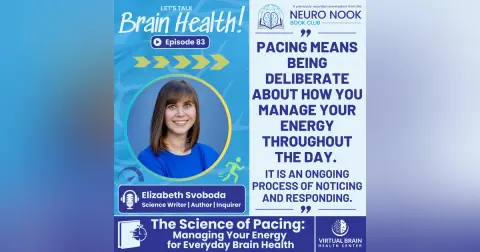
For distance runners, the art of pacing is as essential as breathing. Yet outside the sporting realm, regulating our tempo is far less intuitive — and we rarely connect our pacing mistakes to their ultimate consequences.
In this monthly gathering of the Neuro Nook Book Club , Dr. Krystal Culler and co-host Heather Elwell sit down with award-winning science writer Elizabeth Svoboda — author of The Art of Pacing: A Guide to Balancing Short-Term Demands with Long-Term Thriving, a gold medalist in the 2026 Living Now Book Awards.
Elizabeth is a contributor to Scientific American, Greater Good, The Boston Globe, and The New York Times, and her work has been anthologized in the Best American Science and Nature Writing series.
Drawing on conversations with elite athletes, mental skills coaches, and her own lifelong struggle with the push-and-crash cycle, Elizabeth makes a compelling case that how we manage our energy may be one of the most overlooked contributors to our brain health and long-term well-being.
What You’ll Learn in This Episode
🧠 What pacing actually is — being deliberate about how you manage your energy, both day to day and across the bigger picture of your life
🧠 What top athletes know about rest and recovery that most of us never learned — and why they build in far more padding than we would expect
🧠 The pacing spectrum — how to range flexibly between effort and rest without ping-ponging between burnout and withdrawal
🧠 Why pacing begins with meaning and purpose — and the Hero’s Journey Restorying Exercise that helps you align your daily life with the legacy you want to leave
🧠 How to find your pulse points — your natural energy peaks — and ride them instead of “wading through the mud”
🧠 Why flow states are essential to a well-paced life — and how to intentionally cultivate them
🧠 What “brief candles” are — short, powerful moments of connection that can change the trajectory of someone’s life in just a few minutes
🧠 The power of the “What’s the wise choice here?” framework for course-correcting in real time
Key Takeaways
✔ Pacing is a process of ongoing noticing and responding — check in, make the next wise choice, check in again
✔ No one teaches us how to pace — most of us learn it the hard way, through burnout and trial and error
✔ Rest should be commensurate with effort — recovery is not laziness, it is strategy
✔ Small, iterative course corrections — not dramatic overhauls — create the biggest long-term wins
✍️ Brain Health Rx from The Art of Pacing (author-approved!):
Let one question guide your pace: What’s the wise choice here? When you pause to reflect and tune into the wisdom of your body and brain, you can trust yourself to know what to do to support your natural rhythm in real time.
Earn FREE CEs
This podcast qualifies for 0.5 hours of FREE continuing education credit for the following healthcare professionals: Physicians (AMA PRA Category 1 Credit™), Nurses (ANCC), Pharmacists (ACPE), Physician Associates (AAPA), Dentists (ADA CERP), Dietitians (CDR), Social Workers (ASWB), Psychologists (APA), Athletic Trainers (BOC), and Interprofessional Continuing Education (IPCE).
Not seeing your profession listed? You will receive a Certificate of Participation to submit to your licensing board for possible credit approval.
Join the Learn at Pinnacle app to earn FREE CE credit for listening to this episode — available on the Apple App Store and Google Play.
Support the Podcast
If you enjoyed this episode, please:
- Follow or subscribe to the Let’s Talk Brain Health! Podcast
- Leave a rating or review
Thank you for investing your time and energy into your brain care. Thanks a myelin, Elizabeth Svoboda, for reminding us that pacing is a lifelong work of art in progress!
Resources
Review the Neuro Nook (book club) summary on The Art of Pacing
Connect with Elizabeth on Instagram
Get The Art of Pacing at your favorite bookseller (Bookshop.org)
Learn more about Ben Rogers’ Hero’s Journey Restorying Exercise