

 Apple Podcasts

 Spotify

 Amazon Music
 RSS Feed
What the Latest Brain Training Science Means for Your Brain Health: A Conversation with the Lead Developer of BrainHQ, Dr. Henry Mahncke, Ph.D.
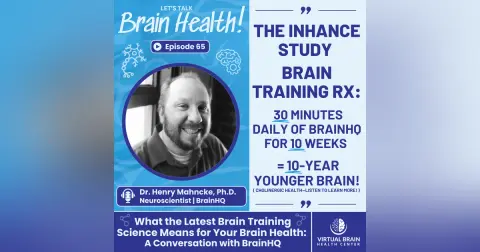
In this episode, we explore the science of brain fitness and how targeted brain training exercises can strengthen key brain systems with Dr. Henry Mahncke, Ph.D.. Dr. Mahncke shares his journey from studying neuroscience at UCSF to leading brain plasticity-based training at BrainHQ.
Learn how BrainHQ’s specific brain training program can improve memory, attention, decision-making, and overall brain resilience across 300+ published research studies.
Discover the profound impact of brain plasticity, the significance of the groundbreaking INHANCE study, and practical tips on incorporating brain training into your daily life.
Dr. Mahncke emphasizes that brain training is not just a trend but a scientific approach to maintaining and boosting brain health.
Tune in to find out how you can intentionally train your brain at any age and better understand the notion of cognitive fitness.
00:00 Introduction to Brain Fitness
00:24 Meet Dr. Henry Mahncke, Ph.D.
01:46 Personal Motivation and Early Career
03:13 Graduate School and Discovering Brain Plasticity
05:40 The Concept of Brain Fitness
09:19 Brain HQ: The Science Behind Brain Training
11:02 Understanding Brain Fitness and Training
20:50 The Enhanced Study and Neuromodulatory Systems
24:46 Exciting Beginnings: Launching the Study
25:11 Study Design: Brain HQ vs. Ordinary Games
26:18 Training Regimen and Compliance
26:35 Breakthrough Results: Acetylcholine Levels
27:43 Beyond Brain HQ: Broader Brain Health
29:56 The Importance of Intensity in Brain Training
32:58 Holistic Approach to Brain Health
39:45 Practical Tips for Brain Training
42:45 Final Thoughts and Encouragement
Resources
-
Try BrainHQ’s brain training exercises for free on their website.
-
Explore the science behind BrainHQ in over 300+ research studies.
-
Learn more about the INHANCE study’s media coverage and results in the research article.
-
Learn more about brain health in BrainHQ’s “Better Brain Health” blog.
-
Connect with Henry on LinkedIn.
0:02 Welcome to the Let's Talk Brain Health podcast, a public health educational initiative of the virtual Brain Health Center. I'm your host, Doctor Crystal Color, and I'm so glad you're here. On this podcast, I sit down with incredible guests to explore all things brain health and Wellness. Together, we'll talk about how to care for your total brain health, mind, body, and spirit while sharing the latest brain Health Science practical tips and strategies you can use everyday. By prioritizing your brain health, you're taking an important step towards living a happier, healthier life. So let's dive in and welcome today's guest. Keeping your brain sharp isn't just about doing puzzles or playing games. Targeted brain exercises can actually strengthen key brain systems, improve memory, attention and decision making, and even help your brain stay resilient as you age. Today we're diving into the science of brain fitness and how the right kind of brain training to make a real difference in your everyday life.
1:05 Doctor Henry Monka got his doctorate in neuroscience in the lab at UCSF that discovered the brain remains plastic, capable of chemical, physical and functional change throughout life. After a stint consulting at McKenzie and Co, he was recruited to lead the global team commercializing plasticity based training at Posit Science which makes Brain HQ Drainage. Q is the most scientifically validated brain training app on the market and has shown benefits in more than 300 reviewed studies. Such benefits include gains in cognition, attention, memory, speed, decision making and quality of life, depressive symptoms, confidence and control, health related quality of life, and real world activities including health outcomes, balance, driving and workplace activities.
1:54 BRING HQ is used by leading health and Medicare Advantage plans, by preeminent medical centers, clinics and communities, and by elite athletes, the military and other organizations. Focus on peak performance if we're going to talk brain fitness, I can't think of another brilliant brain to. Welcome to the podcast today, Henry. Is there any additional information about your background that you'd like to share with our audience? First of all, Crystal, it's really nice to be talking with you on the podcast today. Thank you for the invitation and the boy that did seem like a pretty comprehensive biography. I will add to it, Ed, your invitation, which is, hey, one thing that's not in that biography is one of the reasons I'm doing this work is because of my grandfather. So I'm actually named after my grandfather. His name was also Henry Monka, and he passed away in 1980 of Alzheimer's disease when I was a kid at that age. It's amazing.
2:48 If you look back at that time, the 70s and the early 80s, we didn't really know anything about brain health. They didn't even call it Alzheimer's disease, right? They just said he passed away of senile dementia. He may have heard that term. We don't use that term anymore, but that's how it's described. And I just remember going through that with my family and my dad in particular, and having had the amazing opportunity to come out and do a PhD in neuroscience. And I'll be doing this work in brain health. It's wonderful and amazing thing to do to come to work everyday and work on something that afflicted my grandfather and then so many other people as well. So I'll add that to my bio. I appreciate you sharing that personal connection. It seems so many other people enter the field with some type of connection with a loved one in brain health.
3:31 I think broader statistics show 8 out of 10 Americans are directly or indirectly impacted by broader brain health concerns. But I do have to ask, what brought you to focus specifically on this cognitive training component that you have honestly dedicated your entire career to this? Yeah, that's a wonderful question and really starts when I came to Graduate School. I came out to Graduate School to the University of California, San Francisco, and like almost everyone who starts in Graduate School, I wanted to go to study neuroscience because I wanted to understand the mysteries of how the brain works. I think every graduate student in neuroscience starts in that exact same place. Like, it's amazing, right? 3 1/2 lbs of wet goo inside your skull gives rise to every conscious experience and memory and the life event that's going to happen to you. And I joined a really remarkable lab at UCSF. I worked in the lab of Doctor Michael Mersnick, who's world famous in the world of neuroscience, which my parents remind me means nobody has ever heard of him. But nonetheless, what Mike is really credited for is this discovery of adult brain plasticity, right? He fundamentally discovered that the adult brain can change and rewire itself.
4:39 And when I started Graduate School, which again was a long time ago, but when I started Graduate School, we were told over and over again that, hey, the brain builds itself when you're a kid. But sometime after the age of 7 or 12 or 19, no one really knew quite when your critical period is over, your brain wiring is done. Your brain is now like a computer with fixed wiring. And we were told over and over again, all it does is wear out over time like any kind of machine. And that's what happens as we get old. And I remember to this day being in the UCSF library and opening up proceedings, the National Academy of Sciences, and discovering for the first time that new brain cells could be born in the adult brain. That work was actually done in songbirds, first of all things, and joining Mike Mersnick Lab, which really turned that whole idea on its head.
5:25 Work from Mike and then his students and then people all over the world showed us that none of that's true. The adult brain can reorganize and rebuild itself. I finished my graduate work. I decided I didn't want to be a professor. I worked in consulting, as you mentioned. I worked for the British government for a period of time on science and technology policy. But one day, Mike called me up, and he said, Henry, we've helped a lot of rats build better brains. We've helped a lot of monkeys build better brains. Don't you think it's about time to help people build some better brains? And I thought about my grandfather, and I thought about the fact that I lived in San Francisco, and everyone here needs to join a startup sooner or later. And that's what kicked me off on this path. And really today that's a myth of the brain. I think we're still debunking, correct, is that adult brains still have this ability to grow and change and re sculpt.
6:11 And I think that's a great way to kick off the conversation with you a bit is what exactly is this idea of brain fitness or cognitive fitness and brain training? Before we dive into the crux of the conversation with you and focusing on your work at Brain HQ, could you tell us what that idea of that concept is? Because it does build off of brain plasticity. But what is this idea of brain fitness? You put it absolutely perfectly, which is, hey, we have recognized from thousands and thousands of scientific publications that the brain is plastic. And that's a funny term, but scientists use this term to mean that the brain can change itself, it can build new connections, it can change its structure, its function, its chemistry and its health in that way. And that's science that's, again, really been around since the 90s and the 2000s.
6:58 But the implications of that science are only now finally becoming clear. And what I mean by that is once you really appreciate brain plasticity, appreciate that, hey, this is how the brain works. Your brain rebuilds itself in response to what you ask it to do. And hey, that happens when you're a little kid and it happens when you're middle-aged. It happens when you're old. It happens when your brain is healthy. It happens when your brain is unhealthy. It's just the fundamental operation of the brain is it's a machine that's continuously rebuilding and reorganizing itself. As soon as that idea really sinks in, you immediately recognize, hey, if I ask the brain to do the right kinds of things, I could probably build the right kinds of connections and the right kinds of structures and the right kind of chemistry. And if I could rebuild the brain in that way, maybe I could make a brain that was healthier or sharper or worked better. And it was that fundamental idea that, hey, we could take this basic science of brain plasticity, publish again thousands of scientific papers.
7:56 We're going to fill up a library, right? And could turn it into an applied science. Or anyone, you or me or anyone we know could take advantage of this scientific breakthrough to help make their own brain healthier. That's what the fundamental idea is. Put it another way, we've had a physical fitness revolution, right? 50 years ago, we all started to recognize that, hey, if we did the right kind of physical exercise, like, we would improve our bodily health. And if we improved our bodily health, we'd have a better life, right? We'd live longer and happier and healthier. But weirdly, that insight stopped at the neck. Everyone recognizes, hey, of course you can do things to take care of your physical health. And we never quite made the next logical step, which is, gosh, shouldn't we be able to take care of our brain health as well?
8:41 And I think that's because people have a little bit of a funny idea about the brain, right? If you talk to most people about the brain, they have a very psychological or spiritual view of the brain, which is fine. I get it completely right. The brain is our source of consciousness and our memories and our spirit and our hopes and dreams of the future and our memories of the past. But you and I both know that it's also 3 1/2 lbs of wet goo that sits inside your skull. And hey, it can be healthier or less healthy. Just like your heart can be healthier or less healthier. Just like your liver can be healthier or less healthy. And in the same way we've gotten a sense of how to control the health of our bodily systems, now we are finally recognizing, hey, to some extent, we have some control over the health of our brain systems as well.
9:21 And that's incredibly exciting. It is a time that's exciting, I think from so many times when I've done talks about brain health and Wellness in general and people always like, what's your top tip? And I'm like one that's really hard to do. But I parallel what you're saying is this idea that we have this idea of what physical fitness is, but what's brain fitness? And if we can build off this idea that you have this fitness routine for your physical body, what does that look like for your brain? You work at Brain HQ. So this is the great segue for me to ask you of what exactly is Brain HQ? Because this is one way that has a large science behind it. You have over 300 research studies, years of research behind this, that if people really want to find an evidence based tool and research to build out this idea of what brain fitness could look like from them, this may be a really strong evidence based point to start. So can you tell us about what Brain HQ is and what all domains of the brain does it challenge?
10:24 Let's build off on exactly what you were saying. Hey, what does physical fitness mean? I think we could all agree that, hey, you know, what physical fitness means is that our body can do the things that it's designed to do and that we want it to do. We can walk a long distance, we can climb stairs, we can swim, or we can move about, or we can pick up our kids, right? We have that sense. It can do what it's supposed to do. We have exactly the same sense for brain fitness. What does it mean to have a fit brain? What is brain fitness? It means a brain can do the things that our brain is supposed to to do. So what's our brain supposed to do? Supposed to pay attention. It's supposed to hold things in memory. It's supposed to make good decisions and think for us, right? And it's supposed to control our body effectively. And so that's what we mean by brain fitness. You have a fit brain if you can do those things quite well. And hey, you have a less fit brain. If you don't, that raises a natural question. Okay, Given that we can clearly see that some people have fitter brains for whatever reasons, and some people don't, hey, how could we manipulate that?
11:19 And in particular, if we have this idea that the brain is plastic, it can be rewired, How can we ask the brain to do things that are going to move it from a less fit to a more fit direction? And the answer here is just a tiny bit more complicated than physical fitness, right? With physical fitness, just about everything you do to some extent is going to help your physical fitness, right? And This is why most physical activity guidelines are pretty broad. Find something you like to walk, you like to run, you like to swim. Hey man, pick one and do it. That's all great. Bring fitness. Just a tiny bit more complicated. And I'm sure we'll dig into this in some more depth. To get a handle on this, you have to start to ask, hey, what makes a brain that is not so good at attention or working memory executive function different from a brain that is? And it turns out that it's very clear that brains that are not so great are noisy.
12:08 And what do I mean by noisy? What I mean is this right? Imagine your brains, an old radio. And if you remember old radios, you used to be able to tune them. And if you could tune onto the radio station, you could hear the music and the DJ saying everything very clearly. But if you were just a little bit off, there would be static, there would be noise, right? Harder to hear what's being said, harder to hear the music. And as a result, you might be listening to the radio and you don't pay attention to it as well. It's harder to remember what the DJ says. Harder to get home and think, oh, what was that song that I heard? And that's because that noise interferes with cognitive processing. Turns out that as we get older, but frankly also in virtually every neurological and psychiatric condition, the brain has internal noise or static. And we can see that when experiments in the lab in all kinds of ways.
12:54 If you ask young people to remember words, they can remember a lot of words, but if you introduce external noise, they can remember fewer words. Take a young person and you can give them the cognitive abilities of an old person just by introducing noise. And all kinds of other psychophysical evidence points this out. So we know that older brains are noisy in this way, and they're noisy and they're hearing and they're noisy and their vision. And that's actually what's contributing to problems and attention and working memory and executive function. So with that observation, the question becomes with the idea of brain plasticity, how can we take a noisy system and make it a high performing system? How can we improve the signal to noise ratio in the brain, one might say, so more signals getting through with less noise so we can think faster and better and more clearly. Turns out you can do that by asking the brain to be more fast and accurate.
13:40 What do I mean by that? So this is not about teaching tips. It's not about, hey, when you meet someone, rhyme their name so you have a mnemonic for it. And really we're trying to rebuild the machinery of the brain in a very bottom up way. So how can we ask the brain to be faster? We build computerized brain training exercises that are adaptive and require fast, accurate information processing to do them correctly. We're on a podcast. I can give you an auditory example if you like. Sure, that would be great. All right, I'm going to do my best to whistle. So one of the first brain training exercises we built, because we had done this in rats back in the day, was an exercise where you hear 2 little whistle sounds. And for each one you have to decide does it go up or does it go down. So you might hear hope that got throughout the podcast, and then you might hear one that went down. Now, hey, if you hear a big slow one that goes up and a big slow one that goes down, hey, everybody can hear. There's two of them.
14:33 Everyone can hear the first one swept up and the second one swept down. OK, if you get that, let's make it a little bit faster because we're trying to train your brain to be faster. So we'll make them shorter. And as that happens, you can typically keep doing it, but everyone sooner or later gets to a speed where they can no longer do it. You just can't hear that there are two of them anymore. Scientists call that masking forward or backward masking. Or if you hear that there are two, you heard that there were two, but you're not sure which one came first. Were both of them down or was one of them up? So as soon as that happens, we back off, we make the sound slower again. So we find your unique brains speed there for your threshold, so to speak, and we ask you to work at that level. And what's important about it is it's adaptive.
15:13 You're going to be at a level where you get a lot of them, but you're always going to get some of them wrong. And we do that because in order to drive brain plasticity can't be too easy, right? If you're doing something that's too easy, you get 100% right. That feels great. I guess people like to get everything right, but hey, your brain doesn't need to change if you can get everything right. So it's got to be harder than that, but it can't be too hard if it's so hard that you get most of them wrong. It's like trying to climb a Cliff face and you can't get a handhold on it, right? Your brain can't quite get a handle on how to do it. So your brain also doesn't rewire. So you have to maintain this adaptive control where it's exactly the right level of difficulty for each person's unique brain. And if you do that today and then you do it tomorrow and then you do it the next day, hey, you're going to start to get better at this task. Just in the same way, if you were practicing French or learning the piano or learning how to kick a soccer, brain plasticity is going to drive learning. You're going to get better at this task. So if you do that for a while, your brains going to get faster at hearing these little whistles. And then you might ask, OK, Henry, that's great, but I don't really care about whistles, right? Why would you give me a brain training exercise that did nothing but make me faster at hearing these whistles? The reason we pick that is because that kind of sound is actually incredibly important for human speech. So we can all do this together.
16:28 Everyone who's listening to the podcast can do this. If you take your thumb and your index finger and you put them on your voice box right here on your throat, and you make a sound like BA, like a baby BA. You do that a couple times, feel when your lips open and feel when your voice box starts to vibrate. BA, your lips open and your voice box starts to vibrate at exactly the same time. But now I'm going to ask you to make a different sound. Put that thumb and that index finger on your voice box again and make the sound Pennsylvania, like my Papa, My Papa. When you do that, Pennsylvania, your lips open just a little bit before your voice box starts to vibrate. Now that may seem like a very small difference, but that little gap, it's called a voice onset time.
17:09 And you're going to be thrilled to know that there are hundreds of scientists all over the world that study this as their primary field of research. And that gap is the difference between a BA and a PA. So if your brain can process information really quickly and accurately, you'll hear that little gap. And you can hear the difference between someone saying a BA and a Pennsylvania. But if you can't, if you're older and your brain is slowed down, or maybe you've had a concussion, or maybe you've had cancer treatment or maybe you've had COVID and your brain is slower and noisy, you can't hear that little gap. Everything you hear is going to sound smushed together and you're not going to be able to tell the difference between those Bahs and Bahs as OK, now you're not getting good quality information in your brain. It's harder to pay attention to what someone says, harder to remember it, harder to act on.
17:52 So by improving your brain speed with those weird little whistles, we actually start to turn your brain into a better information processor for human speech. So you can remember when you're going to the store and your partner says, hey, pick up some eggs and some celery and some milk. All that information gets in your brain better and faster. It gets stored. And when you're at the grocery store, you have a better memory. That's the idea behind these Brain HQ exercises. There are dozens of exercises targeting all kinds of areas of the brain. Fundamentally, each one of them is designed to make brain information processing faster and more accurate, and in doing so, improve your brain's ability to process information and then do things like attend and remember and act. So they all start to lead to real world applications. It's not just this arbitrary.
18:36 Hey, you have this game and it might just work out memory but doesn't actually help you in your day-to-day life. Yeah, that's exactly right. The art, if I may say so, and then certainly the science of building these exercises is just look at the real world stimuli one might say that a person has to interact with. What is it important for a person to hear and remember? Largely human speech, and we know a lot about kind of the acoustics of human speech. So we can build these very elemental exercises that mimic these aspects of a human speech to build a better speech information processor or envision. We can ask ourselves again, hey, what are the statistics, one might say, of the visual things that one encounters, right?
19:17 Things in the center of your vision and your peripheral vision, right? And then you can build exercises that kind of start off with these big bold stimuli that pop out. They're processed by the brain really easily. They drive a lot of synchronous activity across the brain. But gradually you can fade into very naturalistic scenes where it's hard to see things and things are more confusing with each other and they don't pop off Balkans background. So you can guide the brain into these naturalistic environments and then build a brain information processor that, hey, just works better. For example, when you're out driving so that when you, let's say, roll up to a stop sign and to dusk and right, and there's not great visual information. Nonetheless your peripheral vision is acting quickly and accurately so that if a car is about to hop in from the other intersection, you're going to see it before you get in. Each task is built on getting your brain to process real information, but in this very bottom up kind of step by step way.
20:11 And in that way you can think about it like, let's say you were an NBA player. One thing you're going to do is practice playing basketball. That's an important skill to be in the NBA. But hey, your physical trainer is also going to have you go to the gym and they're going to decompose every single thing you need to do to win a basketball game. And to, hey, I need to exercise your bicep this way, and I need you to exercise your legs this way, and I need you to exercise your core that way. And by building up those individual muscles, hey, when you get out on the court, you now have the physical ability now to be a winning NBA player. Brain HQ exercises are intended to work the same way. We decompose these real world cognitive things you have to do into these very elemental tasks. You exercise at them, you get better through brain plasticity.
20:51 And then, hey, when you're out in the world, you just have a better system to interact with all of the things that are coming into you in the world. And I'm so grateful for the examples you've shared because across your studies, you have studied with this from elite athletes, but also to your average adults. And it leads to an important study that recently came out, your enhanced study. So can you tell us a little bit about what was that study designed to test and what is so exciting about its results that is grabbing people's attention in the headlines? Yeah, the enhanced study has just had an amazing set of results. And you know, where it came from is when we started building these brain training exercises, in a way, we thought of them as cognitive training, a little bit like I just talked you through. We thought, hey, we're going to train these cognitive skills the way a psychologist might recognize, like basic aspects of attention or memory or executive function, but always at the same time, right?
21:45 We really came from a world of neuroscience. We thought about the brain as those 3 1/2 lbs of wet goo inside your skull and we thought hey, we can improve information processing in the way that I talked about. We can improve sickle to noise ratios and so forth and so on. But the very inception Doctor Mike Mersnick, our my PhD advisor and our founder said, hey, we are absolutely going to be doing a second set of things here. He said we're going to be improving the health of the brains neuromodulatory system. And what he meant by that is hey, the brain's got these amazing systems that release certain kinds of neurochemicals and these neurochemicals are broadly distributed across the brain and they contribute to broad aspects of brain state and brain health. For example, a lot of people perhaps have heard of serotonin, which is involved in mood and depressive disorders.
22:30 You have these serotonergic nerves that connect all over the brain and release serotonin at the right time. People may have heard of dopamine, similar kind of system projects across the entire brain, releases dopamine to be enforced to the brain that, hey, when you did something your brain likes, you should reorganize the brain to do more of it. There's a system called acetylcholine, which is involved in attention. Every time you're paying attention, your brain's releasing acetylcholine and that actually gives a signal to the brain that it's a good time to rewire itself because hey, you're paying attention to something important. So at the very beginning, 20 years ago, Mike said, hey, as well as improving the information processing abilities of the brain, we're probably rebuilding the health of these neuromodulatory systems. Now at the time we thought maybe there was some evidence for this in rats, but certainly no one had ever seen this in humans before.
23:17 So the enhanced study was designed to finally put that idea to the test. Could these kinds of brain training exercises, again, designed to improve these fundamental cognitive skills, could they have a deeper effect on almost the health of the brain as a biological organ by improving how these neuromodulatory systems work? We had the opportunity to work with an incredible collaborative group up in McGill in Canada at Tian de Villar Sadani, and that group had come up with something truly remarkable, which is a way to image the health of the acetylcholine system in the human brain. And here's the good news. To do that without cracking your skull open and putting a needle in it, right? They had a very specific marker that they can inject into a person. And that marker would essentially glom onto or stick to this aspect of the brain's acetylcholine system.
24:02 And you can image it using a technique called PET imaging. So for the first time, we could just look and see how healthy is a person's cholinergic system. And before we started these studies, that group had already shown that, hey, the cholinergic system declines by about 2 1/2% per year from the ages of 20 to 60 or 70. And we knew also that, hey, it actually declines quite rapidly with the onset of Alzheimer's disease and dementia. And in fact, if you go back to the 90s and look at what Alzheimer's researchers working on, the decline of the acetylcholine system in the brain was one of the earliest signs of Alzheimer's and dementia. It falls off quite rapidly. And that loss of acetylcholine is probably why those memory and thinking and attention problems emerge in Alzheimer's disease.
24:43 And in fact, the first Alzheimer's drugs, if you think of things like Aricept, they were drugs that were fundamentally designed to help more acetylcholine stay around in the brain, right? And those had some limited positive effects. So we've asked this question in a beautiful gold standard randomized controlled trial. Hey, does this kind of brain training and brain HQ, does it help improve the health of the acetylcholine system? And I got to tell you, Crystal, we were very excited to start this study and I simply did not know what we were going to see. Most studies, we have a pretty strong idea of what we're going to see, certain kinds of cognitive improvement or health improvement. But this was really a shot out there into the unknown. What happened in the study was funded by the National Institutes of Health and National Institutes of Aging through a wonderful SBIR grant.
25:23 And we got about 90 older adults. And this was done in Canada. So a bunch of them spoke English and a bunch of them spoke French. So that was fun. And half of them did brain HQ exercises designed to improve, again, that speed and accuracy of information processing. And the other half of them just did ordinary computer games, right? The kind of thing you might just kill time on your phone while you're on the subway or waiting in line. And it's a wonderful comparison because both of those things involve attention, right? Both of them involve thinking, but only one of them is really designed to drive brain plasticity, to reorganize the brain, to make it faster and more accurate. You might think of the ordinary games as just keeping your brain busy, so to speak. But what's nice is both groups, you can tell them quite legitimately, hey, we're testing a brain training program, right?
26:07 One of them happens to do Brain HQ, one of them happens to do computer games. But everyone thinks, hey, I'm doing something good for my brain. So you can maintain a very nice blind in the study. Everyone thinks they're doing something good. So then these researchers measured everyone's acetylcholine before training. They then trained for about 10 weeks and then they measured their acetylcholine afterwards. The study team did this for two years. And you're not allowed to look at the data along the way. You're just working really hard and finding these people and doing this PET imaging and you're going to see what happens. And how much training did they do over the course of the study? Both groups trained about 30 minutes a day, seven days a week. So we tried to really set it up as a habit for them, but none the less, an amount of time you can fit into your life. And both groups actually complied with the training pretty well, right? Everyone misses a few days, but you make them up and they really stuck with it.
26:51 And then what did we see at the end? Just a fantastic and amazing result. What we saw was that there were dramatic improvements in the level of acetylcholine in the folks who did the brain HQ training, and in particular in a region of the brain called the anterior cingulate gyrus, a part of the frontal cortex that's involved in complex attention and decision making and executive function. And those changes in the Brain HQ group were bigger than the ones in the control group. And just to pop the champagne moment, because this had never been shown before in humans that the health of this incredibly important neurochemical system could be modulated, right? A little bit like when I started Graduate School, everyone's belief about that system was it just wears out over time and there's nothing you can do about it.
27:35 And now we know for the first time that's not true. And in fact, when those researchers looked at almost every other brain region, they saw the same pattern of effects, that there were improvements in the folks who did Brain HQ across all the regions, the cortex and the basal ganglia. And the folks who did those computer games really showed no changes at all. And that's just remarkable. You asked at the beginning a little bit about hey, Brain fitness and we'll talk about things people can do besides Brain HQ. I do think that one issue we come across all the time is I do crossword puzzles or I play Candy Crush. Isn't that good enough for my brain? And we have study after study where we use those as control groups and we see that they don't drive cognitive improvement. Then I can talk more about why in a moment.
28:16 But in this neurochemical study, to show so clearly that even though these people have been paying attention and using their memory and thinking, hey, man, it just did not improve acetylcholine levels. It did not improve the health of the brain this way. That really teaches us something at a scientific level and a practical level around, hey, what do you have to do to build and strengthen brain health? It's not just keep your brain busy with any old thing in the world. It's really telling us that, hey, it's about activities that make your brain faster and more accurate. It's about activities that really adapt to your unique brain and keep you frankly, on your toes. And that threshold throughout training, hey, that's what really drives and builds A healthier brain. So incredibly exciting because hey, more acetylcholine of the brain means better cognition, and probably means reduced risk of dementia as well.
29:03 What an exciting study. Congratulations to you and your team and what a shift in the research, but also what a time it takes to get to a study of this type of level to shift a field as well. So I want to at least acknowledge that. But then also when I think about and just hearing it as well as having have read some of these research studies over time, like you said just years ago when you're useful field of view was a big deal for dry and how that could change for brain HQ and now to this. But it's also just seen and collectively from what I've read over the years in my own collective training, is how demanding our brain is of the level that it needs in order to change and to pivot, that it's just not the bare minimum.
29:50 It seems that our homegrown the bar on us, but we have the ability to do it. I think it's like this balance of what I'm bringing in, what I keep thinking about coming from the background and behavioral health and cognitive psychology is our brains are a little bit finicky. It's not just this low threshold. It really keeps raising this bar. And as you talk about what Brain HQ is challenged to do is we need this level of challenge, but we can get there. And our brains almost demand that from us to do that change and to drive that plasticity. You're absolutely right on the positive science, and the study was led by my colleague Dr. Mana Tara. And as you design a study like this, you have to make a million little decisions and every single one of them, you have to be like, is this going to affect the validity and then the likelihood of success in the study. And one of the things that Doctor Tara was very committed to was, hey, that intensity of training seven days a week, 30 minutes a day, She wanted that because she wanted people to set up a habit.
30:49 She thought, hey, fewer people will miss training if hey, man, I just, I'm doing this every day. She, like you just said, the very strong belief and we all believed it and she turned out to be right, which is, hey, you really do have to push the brain in this way in order to drive these kinds of health and this kind of structural remodeling on the brain. And you're absolutely right. And sometimes I think we think I'll just do a little more. I read books, I'm going to do a crossword puzzle once a week. Isn't that enough? And I wish it were. That would be wonderful news, right? But again, like exercise, if you're going to meaningfully change your heart health, right? If you're going to lower your blood pleasure or manage your cholesterol, it's not just go out for a little stroll once or twice a week for 15 minutes and enjoy the nature. You're going to need to get out there and sweat a little bit to change your body in that way and changing the brains exactly the right way.
31:36 But the good news is that's actually extremely feasible. Flip the thought around for a moment. My gosh. In that study, what they showed was they improved acetylcholine levels by about 2 1/2%, which is about 10 years of brain aging. So they got 10 years of brain aging benefit out of 10 weeks of brain training. Like that's not really a lot when you get right down to it. It's remarkable that we can remodel and restructure the brain so dramatically, frankly, in just 10 weeks, a day, the 10 weeks of training, 30 minutes. And 30 minutes a day, which I think for that point too is that's feasible for most of us. If you laid that out and you said this is the investment. Most of us, I think it always comes down to with it's money, time and your energy for. The cost?
32:21 Of what or the investment of what grain HQ is and your time and your energy that is all very feasible. It is not this out of the reach moment for many people. Now if you flipped it around where before when a lot of the times when it used to be back in the day they computerized training threshold was two 2 1/2 hours a day. Most of us would be like, I'm not even going to start because I can't commit to this. Because I can't commit to. This. This is feasible. This is a very feasible commitment, especially when you look at that kind of magnitude of benefit. Yeah, 10 years, most of us would be like, where can I sign up? So I'm going to ask you now too on this. What else are some of the reasonable recommendations or takeaways you have for people around this concept of brain fitness or wanting to invest in their cognitive health and care?
33:12 I'll say a couple things because as I mentioned, when we started this work, we really thought of this as building cognitive training exercises. And of course we got very good at that and we've gotten wonderful results. But I, I would say my thinking as a scientist and everyone here at Brain HQ is thinking has really changed and grown over the years, really two important ways. One of which is, hey, there's just a lot of evidence for a lot of things that can help improve brain health at this point. And obviously we're going to recommend brain training. It works really well, but it's very clear at this point that hey, physical exercise helps improve brain health, probably by releasing growth factors like BDNF and improving heart health, which is good for the brain as well. It's incredibly clear that maintaining good sleep habits contributes to brain health because, hey, when you sleep, your brain cleans itself and everything you learned during the day gets rehearsed while you're sleeping through a plastic brain process and sinks in, right?
34:01 The role of social contact has been incredibly clear. It's very clear that loneliness is a risk factor for poor brain health and that people who build and maintain good social relationships have better brain health. And So what that's really taught us, and I think most people in the field at this point is, hey, we need to be thinking about all kinds of real practical things that people can do in their life. Whether it's computerized brain training like Brain HQ, or whether it's moderate physical exercise or working on sleep hygiene, or just making sure you stay in touch with your friends and family. All those things are going to contribute in their own way to better brain health. And that's almost certainly the way that we are going to really tackle the dementias crisis in America, right? That we are going to figure out ways to build better brains and keep them healthy before they go on to dementia. The second thing I would say that our thinking has really changed about is, like I said, when we started this, we thought about building cognitive training exercises. We don't think about it that way anymore. We think about building brain training exercises. And that may sound exactly the same, but there is a difference here that's really become important to us and that's guided other things we think people can do. I no longer think of Brain HQ as training attention or memory or executive function or what have you. I think a brain HQ is providing speed and accuracy of training to large parts of the brain and then building a healthier brain as a biological system, right.
35:20 And by making the brain healthier, hey, you get cognitive improvement almost as a side effect, if I may put it that way. In the same way that the right kind of exercise builds A healthier heart and then you like lower your cholesterol and your blood pressure, doing the right kind of brain exercise builds A healthier brain and then hey, you have sharper attention and better speed and better working memory. Now that's a kind of interesting change in our thinking and it suggests some other things as well. Hey, what are other things people can do in the real world to train their speed and accuracy? When you think about it that way, there's actually all kinds of things. And then there's all kinds of things that don't probably do that. So I'll start with a negative right? When people come to me and they say, hey, I do crossword puzzles everyday. I say, hey, that's fantastic. If you like crossword puzzles, knock yourself out, but they do not make the brain faster and more accurate, right? You feel like your brain's busy, like you're sitting there thinking, feels like the wheels are turning. But hey, there's not systematic input coming through the brain that's making your brain faster and more accurate. In that sense, you're not driving system wide brain plasticity and improvements in brain health. You're just thinking about words, which is great. Again, if you like it, go right ahead. I do a lot of things that I enjoy. They're not necessarily training my brain. But hey, if we're going to improve your brain health, we need to go where the science takes us. Same things for things like Wordle or Sudoku, all these things where you're just sitting and thinking. But what are some things you can do that improve your speed and accuracy?
36:38 Well, there's a lot of physical fitness related things. Let's say you play ping pong or tennis. In order to do that, your brain has to become faster and more accurate. You can't just wait all day when someone serves you the ping pong ball. Your brain's got to respond accurately and hit it back and so forth. And hey, you can start an easy partners of ping pong and you can get faster and so forth as time go on. That's almost certainly good for your brain. Or think about learning music. If you're going to learn to play an instrument, a trumpet or a piano or whatever, you might enjoy playing a recorder. That helps your brain become faster and more accurate. You're hearing the notes you have to play to keep up. You have to become more accurate. You can start with easy music and go on to more complex music. These kinds of activities, I think almost certainly will be shown over time to help build brain health, probably not as effectively as a targeted brain training program.
37:25 These are great things that people can do to help maintain their brain health, really at any age or in any physical condition. I appreciate what you shared. I think so much more of what we see in the broader brain Health Science space is it's never just one thing. And no matter what area you target, it spills over into another. And I think that's the nice thing about the brain is it's never just organized into one specific area is so robust. It does seem to benefit more than one area. And I think that's so much of the brain Health Science is even when you target 1, like you said, you know your physical health well, physical fitness benefits your brain health. It's your brain fitness as well. So it's really hard to say when you get very specific to one that it doesn't help these other like social health.
38:11 And like you mentioned with sleep, they're all very interconnected on all very. Interconnected, and they're all very interconnected because the brain's all very interconnected. Every single part of the brain is not a hop, skip and a jump from any other part of the brain. And I think the other thing that's just exciting about being in the field at this point of time is, hey, what a hopeful and exciting time. 30 years ago, there we were thinking that, that, hey, when you get old, there's just nothing to be done. Might as well sit around and watch television. Your brain's going to wear out. Hey, your dad got Alzheimer's when he was 82. You're probably going to get Alzheimer's when you're 82. When that happens, I guess we'll put you in a home. And what a different world we live in now where you can look at all of this research from Brain HQ, from these other things like exercise or sleep, and you can take action, right, To help improve your brain health right now, to reduce your risk of dementia, to have a sharper and happier brain. And I think that's just tremendous. I think 25 years, 10 years, 20 years from now, we're going to look back and we're going to say, hey, we were just coming out of the dark ages, right?
39:08 Can you believe we used to just let people get old and tell them, hey, watch some TV reruns? Can you believe we had vets coming back from the war with blast injury and cognitive impairment? And we just told them, go back to school, go back to work, you'll be fine. Can you believe it that we had people like schizophrenia and bipolar disorder and we didn't figure out ways to improve the health of their brain in which given they had obvious brain health based disorders. So it's really exciting. It feels like we're coming out of The Cave, we're coming into the sunlight. We are getting more and more evidence based things that that people can do to improve their brain health. And just what a wonderful time to be part of the science and part of this brain health community. And I think it's always exciting to have conversations with experts like yourself where we can pull this forward for other people to hear about the science and how they can apply it. So I'm going to ask you now for someone who might just be starting, you know, thinking I want to start Brain HQ. How do you suggest that they could get started with this type of exercise or something along the lines of brain Fitness? What words of encouragement would you like to give them? First of all, anyone can come register for Brain HQ at www.brainhq.com and when you register you get a free exercise per day and hey, that's enough to train for a few days and get a sense, hey do I like this?
40:19 Is it for me? Can I get my head around what this is all about? And then subscribing is pretty inexpensive after that. And so we want anyone to be able to take it out for a spin and give it a try in that way. And that's what I would recommend. And how do you recommend for people to fit training into our busy lives? If the 30 minutes at first sounds overwhelming, how do you think it's a good place to get started? The great news about Brain HQ is when you do it for the first day, it's only 5 minutes, right? Gives you a little tutorial, you do 1 introductory exercise and hey, you're done. And then you come back the next day and you do the exercise you already did, so you're familiar with it and then it introduces one new one. So it ramps you on gently at that point. And then what I'd say is that study happened to be 30 minutes a day, seven days a week. We've done other studies that were twice a week for an hour a day.
41:05 You can break it up in such a way that it fits into your life. Now you do have to do a certain amount of it, right? It's not magic. Can't just do it once and then that's enough unfortunately. If you can figure out a way to fit 1 1/2 or two hours of this into your life each week, whether it's every day, a little bit or a couple days more intensively, hey, you will be on the road to better brain health and better brain fitness. And in that sense, it's like exercise, right? You do have to carve out a little time for it. When I talk to people and they say, oh, I'll fit it in whenever I have time, I know that I'm talking to someone who's not going to do any brain training. But when I talk to someone who says, OK, what I'm going to do is I'm going to do this for 20 minutes before I have lunch each day. And then when I finish, it'll be time for lunch. Or they fit it in to find a schedule. The same way that you would make a physical fitness commitment, like when am I going to, I go for a walk each day, I'm going to have this regular time making that same commitment to brain training.
41:53 Again, whether it's 2 * a week or whether it's five times a week or every day. Find something that works for your life and then fit it in. And then we have Brain HQ users who've done it every day for years and years. It's simply amazing to look at their training records. But hey, that the study we just talked about was 10 weeks of training and we have lots of users that train for a while, experience benefit. And hey, they go away for a while, they get busy, other things come up in their lives and a couple months later they come back and they boost themselves back up. And that's a perfectly great way to go about brain training. I would never want anyone not to start because they thought I got to do this everyday for the rest of my life. And who's got time for that? Don't worry about that. Just come and start. Do some, if you get busy, stop for a while, then just come back. And that's a great way to take care of your brain. I think it's a nice way to think about holistically that brain health, a lifelong journey for all of us and it's going to ebb and flow and it's like our physical fitness, our brain fitness is going to look like the same, but we can all make small shifts to invest in our time and our energy. It looks like that our time is winding down, but I want to make sure I get a few final questions for you as an expert in brain health and cognitive fitness and brain training. What's your one non negotiable for taking care of your own brain?
43:08 Of course, I'm going to say brain training with Brain HQ. We built it, we tested it. I love it. It's always got raised. It's getting better. But yeah, I trained my brain with Brain HQ on a regular basis and today it's good for me. I have my own brain health stories. I was driving up to Lake Tahoe a winter or two ago at night with my family in the car and all of a sudden a deer literally jumped off the edge of the highway and onto the road. And before I even noticed what was happening, I had stepped on the brake and stopped the car. I didn't even know why I was stopping the car. And then when the car stopped, I could finally see the deer. And I'm absolutely certain that the reason my visual system was working so well, even under very challenging conditions. Done quite a bit of Brain HQ training over my years. Yeah, Brain HQ is my is my one non negotiable.
43:50 If I had to pick a second one that wasn't that, I would say avoiding head injury. And there are just so many ways that people are at risk for a concussion, right? You're riding your bike, you're driving dangerously in a car, you trip over something and being more careful about the kinds of things we do and then wearing helmets and stuff like that when you're riding a bike or motorcycle. Avoiding head injury is incredibly important for good brain health over life. And I'm glad you shared both of those. One, thank you for sharing your personal experience. But also I think the head injury is 1. We tend to overlook with adults. We think so much we go straight to kids in the youth and we forget that it is for all ages and just the quick safety things we can do for everyone from all ages and stages of life.
44:34 If there are things that have piqued our listeners interest, where can they learn more about you and follow your work? They can go to www.brainhq.com, which even if you're not registering for brain training, got a wealth of information about brain health and brain training. There's a wonderful blog there that covers all kinds of aspects around brain health, whether it's sleep or exercise or social contact. We also have a fantastic YouTube channel you can go to, youtube.com/brain HQ. There's dozens and dozens of videos that explore the idea of brain HQ, what it is and how to do it and how it works. There's also quite a few webinars we've done on the science of brain health, both about the details of brain training, but other aspects of brain health as well. Whether it's again, sleep or exercise or even more fun things. We did a webinar about Brain HQ and magic recently where we had a magician join us and talk about, hey, how do magicians trick your memory and your attention. Take advantage of your cognitive cognitive abilities to do wonderful tricks.
45:28 All kinds of fun stuff on the YouTube channel and helpful and educational stuff about brain health as well. And we will have those links below for our listeners in the show notes. And if you had one key message that you want our listeners to take away from our conversation today, what would you like it to be? Oh, I hope the key message is you can actively take care of and maintain and even improve your brain health. I hope that if people walk away with one idea here, it's a brain is not a computer chip. It doesn't have RAM and memory, and most importantly, it doesn't wear out over time because your brain is not a computer chip. Because of brain plasticity, you can do all kinds of everyday things to help improve and maintain your brain health. And that's just an incredible revolution. We're in the middle right now.
46:11 So I hope that's a message of hope and empowerment because hey, our biggest challenge in this field is inertia, right? Most people aren't aware that they can do something, so they do nothing. But thanks to your podcast and all the great news that's been out there, and let's get people involved in taking care of their brain health. It's going to be good for them and good for all of us. Brain training isn't a trend, it's a science backed way to keep your mind strong and resilient. The right kind of brain exercises can boost key brain chemicals, improve membrane thinking, and help protect against age-related cognitive decline. The take away your brain responds to challenge and building your brain reserve is something anyone can start today. I hope we're all encouraged to go out and make your brain sweat.
46:53 Doctor Henry Monka, thank you so much for letting me pick your brilliant brain on the Let's Talk Brain Health Podcast. Thank you for investing your time and energy into your personal brain care by listening to today's episode of the Let's Talk Brain Health Podcast. I hope our conversation gave you fresh insights, a bit of infiration, or practical steps that you can take on your own personal brain care journey. If you enjoyed today's conversation, I'd like to ask you to please share this episode with someone who could benefit from it or consider leaving us a review. If you have questions or a topic in brain health you'd like me to explore, please e-mail me anytime at podcast at virtualbrainhealthcenter.com. I'd love to hear from you.
47:38 We have so many more exciting topics ahead, and I can't wait to continue this lifelong journey of better brain health together with you and our growing virtual community. Until next time, remember to give your brain the care it deserves and make your brain health a priority.

CEO of Posit Science / Neuroscientist / Lead Developer of BrainHQ
Henry Mahncke, Ph.D. got his doctorate in neuroscience in the lab at UCSF that discovered the brain remains plastic – capable of chemical, physical and functional change – throughout life. After a stint consulting at McKinsey & Co,. he was recruited to lead the global team commercializing plasticity-based training at Posit Science, which makes BrainHQ. BrainHQ is the most scientifically validated brain training app on the market and has shown benefits in more than peer-reviewed 300 studies. Such benefits include gains in cognition (attention, speed, memory, decision-making), in quality of life (depressive symptoms, confidence and control, health-related quality of life) and in real-world activities (health outcomes, balance, driving, workplace activities). BrainHQ is used by leading health and Medicare Advantage plans, by pre-eminent medical centers, clinics, and communities, and by elite athletes, the military, and other organizations focused on peak performance.