
 Apple Podcasts
 Spotify
 Amazon Music
  RSS Feed
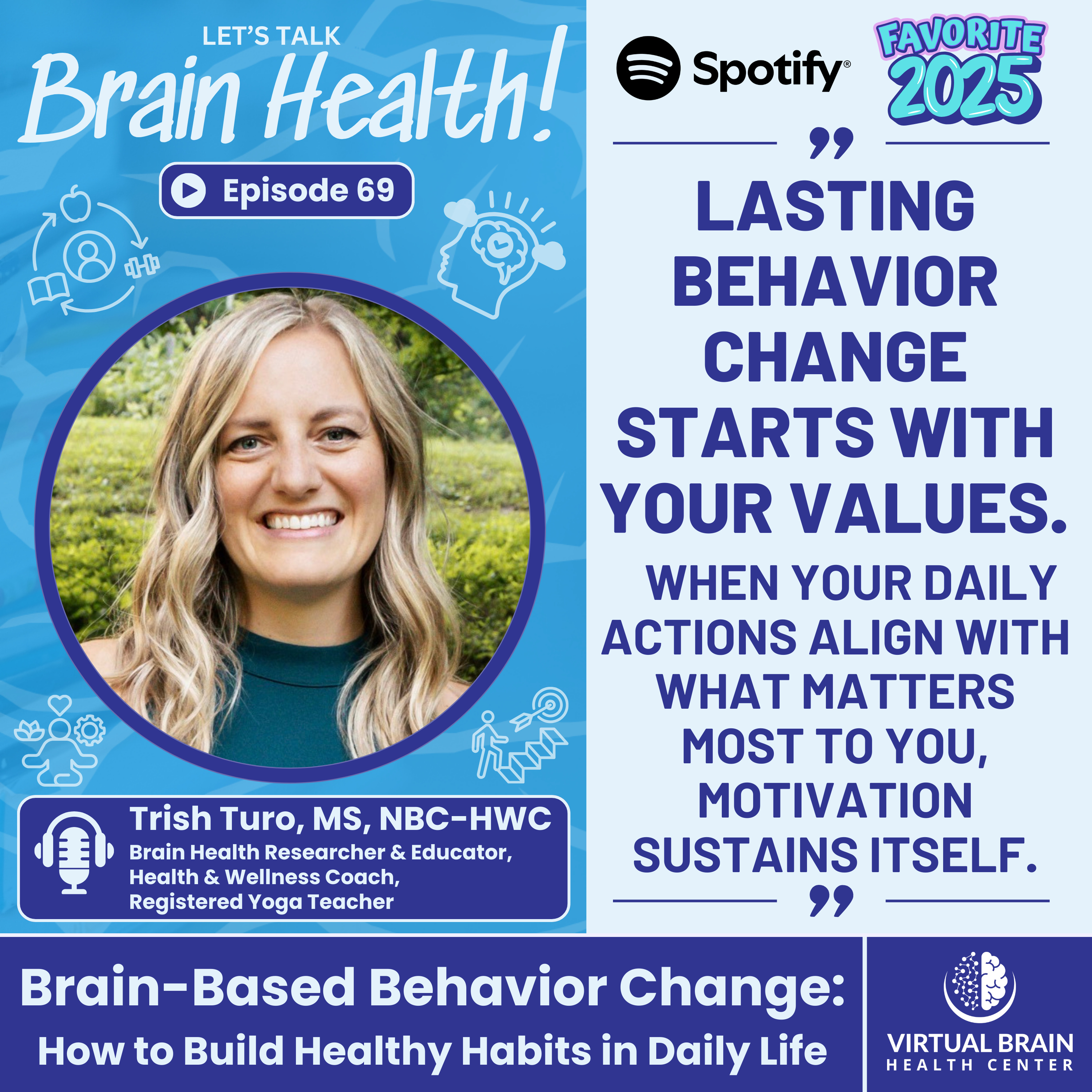
 Brain-Based Behavior Change: How to Build Healthy Habits in Daily Life with Trish Turo, MS, NBC-HWC

Episode Summary
Why is it so difficult to change habits even when you deeply care about the goal?
In this episode of the Let’s Talk Brain Health Podcast, Dr. Krystal Culler, DBH, MA, sits down with returning guest Trish Turo, NBC-HWC, health educator/researcher & brain health coach, to explore habits and behavior change through a brain-based lens.
Together, they unpack how habits form, why resistance shows up, and what is happening inside the brain when we try to change routines. This conversation focuses on real-life behavior change, not ideal conditions. You will learn how brain systems such as the amygdala, hippocampus, and prefrontal cortex influence motivation, fear, and follow-through.
This episode also explores how shame, setbacks, and past experiences shape the stories we tell ourselves about our ability to change. Instead of relying on willpower alone, Trish shares practical strategies that help you work with the brain rather than against it.
If you have ever said, “I know what to do, but I can’t seem to do it,” this conversation will help you understand why and what to do next.
What You’ll Learn in This Episode
• The difference between a behavior and a habit
• Why motivation often shows up after action rather than before it
• How the brain’s habit loop works: cue, routine, reward
• Why the amygdala can make behavior change feel threatening
• How past experiences and memories influence your willingness to try again
• The role of shame and self-talk in habit formation
• Why social support improves long-term behavior change
• Practical ways to make habit change easier for your brain
Practical Brain Health Tips from This Episode
Start small
Focus on one change at a time instead of trying to overhaul everything at once.
Use habit stacking
Pair a new habit with something you already do daily.
Anchor your habits to your values
Connect behavior change to something meaningful, such as family, health, or purpose.
Create visual reminders
Photos or objects connected to your values can reinforce daily choices.
Practice self-compassion
Your brain is designed to protect you from change. Progress requires patience.
Try something more than once
Your brain needs repetition to build new neural pathways.
Spend time in nature
Even small moments outside can support brain health and regulation.
About the Guest
Trish Turo, NBHWC, is a National Board Certified Health and Wellness Coach, brain health educator, researcher, and registered yoga teacher. She holds a master’s degree in health psychology and has spent more than a decade helping individuals and organizations support behavior change and healthy lifestyle habits.
Trish has presented at national conferences, served on national committees, and worked across digital healthcare organizations. She is also the author of "A Kid’s Book About Healthy Habits" and focuses on making brain health education accessible to people of all ages.
Connect with Trish Turo
- LinkedIn: Trish Turo, MS, NBC-HWC
- Instagram: @Coach_Trish
- LinkTr.ee: Coach_Trish
Previous Podcast Episode Mentioned In This Conversation
Key Takeaway
Habits shape daily life more than motivation ever will. When you understand how your brain responds to change, you reduce shame and increase your ability to follow through. Sustainable behavior change starts with small steps, patience, and learning to work with your brain’s natural tendencies.
Listener Question or Topic Suggestion?
Have a brain health topic you would like covered on the podcast?
Email: podcast@virtualbrainhealthcenter.com
Support the Podcast
If you found this episode helpful:
• Share it with someone who could benefit from it
• Leave a review to help others discover the show
Your brain health matters. Thank you for investing in it.
0:02 Welcome to the Let's Talk Brain Health podcast, a public health educational initiative of the virtual Brain Health Center. I'm your host, Doctor Crystal Color, and I'm so glad you're here. On this podcast, I sit down with incredible guests to explore all things brain health and Wellness. Together, we'll talk about how to care for your total brain health, mind, body, and spirit while sharing the latest brain Health Science practical tips and strategies you can use every day. By prioritizing your brain health, you're taking an important step towards living a happier, healthier life. So let's dive in and welcome today's guest. Today's episode focuses on habits and behavior change through a brain based lens. We are unpacking why change feels hard even when you care deeply about the goal.
0:51 We will explore how habits form, why resistance shows up, and what happens in the brain during disruption, fear, and recovery. This conversation centers on compassion, realism, and strategies that work in real life rather than perfect conditions. I am exploring this topic with someone who lives and works at the intersection of habits, behavior change, and brain health. This conversation builds on what we know and moves into how change feels in real life, especially when things do not go as planned. Today I'm joined by the podcast top episode of 2025 with guest Trish Turow, our Brain Health coach. She is back to help us unpack how habits form, why resistance shows up, and how to work with the brain rather than against it.
1:34 Trish Turow is an experienced National Board Certified Health and Wellness coach, brain health educator and researcher, and a registered yoga teacher. She received her Master's in Health Psychology and has presented at several national conferences, served on national committees, and has spoken on the topic of brain health education in a variety of digital healthcare settings. As a behavioral health professional, she has utilized her skills to support individuals working towards healthy lifestyle changes for over a decade, has coached individuals and groups across a variety of digital health organizations, and recently wrote a book titled A Kids Book about Healthy Habits. Trish is passionate about making brain health, Wellness, and well-being accessible to all. Trish, welcome back to the podcast. Do you have any exciting news or project updates to share with us since you have been with us about a year ago? Oh my goodness, it's awesome to be back on this podcast. I think it's really cool that our last episode hit the top of 2025.
2:39 That was such cool news. And it means that people are excited about this information and it means that brain health care, brain healthy habits are things that people want to learn about. So I'm really excited that we'll continue the conversation here. And that's what I've been doing this year is just continuing to support people with their brain health, understanding healthy habits. And I have to shout out to you as well. Even though I have a kids book about healthy habits, I still love your book, a kids book about brain health. We love to put those two right next to each other when we're talking about health and habits and how they're all interconnected. So I'm really excited for this conversation. I'm so glad to have you back on the mic with us on the podcast and can officially share with you too. Not only being episode of 2025, you also rank in the top five episodes of all time to date on the Let's Talk Brain Health podcast.
3:37 So, so I call you, I think, the brain health coach of Let's Talk Brain Health. Podcast. I'll take it. So great to have you back and especially to dive in on a topic that we really haven't explored exclusively yet on habits and behavior change and lifestyle all around brain health. I think the best way that we could ground the conversation to get started is can we talk about the basics about habits and behaviors and how they work in the brain. Can you explain the difference between a behavior and a habit in everyday life to get us started today? Yeah, a habit is that consistent choice or action that's made over a period of time, and then the behavior is the action itself.
4:23 They're really connected. But habits are a series of behaviors that happen consistently over time. And for many of us, there's a lot of things that we likely want to change. There's probably a lot of misunderstandings that we might have about the brain for when we say I wanted to do this. What do you think that most of us should know about that when we first set out to change a habit? Yeah, I can't tell you how often I've heard the phrase. I just need to find my motivation. And what we know as coaches and behaviorists is that motivation doesn't typically happen right before an action is taken. It sometimes even happens right after. For example, you get that feedback and a bunch of those feel good neurochemicals explode in your brain when something goes the way you want it to.
5:19 Or even better, rarely are we motivated to really start something. We're actually motivated by long term value. So something that speaks to that deeper human need. An example might be I want to get healthier so I can stick around for my grandchildren. That's a value system. And then the behavior stems from I'm going to start walking more, I'm going to start eating better, I'm going to prioritize my sleep, those types of things. So we think about the motivation. You're not seeking motivation or looking for it like it's under a blanket, but we're really thinking about what's our value system and how do our behaviors align with that so that the motivation and continues to keep those behaviors going.
6:05 There was one quite a few years ago when I used to do some simple brain health classes. We would just do an anchor image for us. So a lot of us carry around a smartphone or we have photos around in our house because you mentioned grandchildren was to have those visuals out that would remind us about our value system, though it could be a quote, a memorable place that we had or the person that would help us that or what we were wanting to be, whatever it would be that we were aspiring to, that would link us to. And a lot of people when they would select what was that anchor image or the value usually involve close family and friends. The anchor image on my phone currently is a photo of my niece.
6:46 After we published our kids book about brain health. She went and grabbed A stuffy brain that I had and she hugged it. And I asked her what she was doing in the moment. And she says I'm giving my brain a big hug. And I keep that as the background of my cell phone just to remind myself that we all have those moments of time throughout our day where we can make a better choice for our brain. And if a 5 year old niece could remember to do that, then I certainly can. But that photo in time reminds me of the message she had so innocently when she reached out and just hugged a stuffed animal and said she was giving her brain a big hug, that I could do that too. And that is my anchor image that I said on my phone.
7:29 And I actually need to print it out and have it probably a poster size in my office because those are the things that we can do for ourselves. One of the things I want to ask you too is one of the in common scenarios for so many of us is when we start out on this route to habit change and behavior changes. Why do these behaviors feel so mentally exhausting in the beginning? That's a great question and one I love talking about with clients. It's like, why is this so hard? That's a common question, and it's real and it's valid. The easiest way to say this is that our brain loves novelty. We love new things, we love new experiences.
8:11 But building new neural pathways is really hard work. Change is hard. One of my favorite examples of neuroplasticity, which is that idea that we build new neural connections when we're learning. Every time something new happens, we're building new connections in the brain. And one of my favorite ways to think about building those neural connections, which is what's happening when change is happening. I have to give a shout out to my yoga teacher, Rachel Wilson. This is one of my favorite metaphors for neuroplasticity. If you're thinking about that first time the snow came down and you're getting your sled up the hill and you're excited, you're about to take your sled down and you go down your first wave of the hill.
8:57 And it's a little hard, right? You might get stuck a couple times. It's a new path, path that's not quite been dug in. And then you go back up to the hill and you do it again and you do it again and you do it again. And each time you sled down that hill, the path becomes a little smoother. And basically what's happening is every time we do a habit or behavior, it just gets a little bit easier. And then think about it this way. You go up to the hill and then you're like, I'm going to try something new over here. I'm going to try to go down the hill a different way. It's going to be a little more challenging. So when you go back up to the hill and you try to sled down the old habit, it's way easier because it's a hill in love.
9:44 So when you think about these new pathways, change is hard because you have a set of reference points. But when you try something new and you do it over and over again, it just becomes a little bit easier each time. So think about those smooth pathways, how easy it is to go back to those. But when you're creating change or you're trying to improve upon a habit, you're basically going a different direction. So yeah, it's going to be a little challenging at first, but if it's worth it and it's part of your value system, it's going to require some patience. But at the end of the day, that change and that consistency over time can make a really nice path for you.
10:25 And part of that change, you talked about this just slightly early and I'm going to ask if you can elaborate on this. You mentioned about a habit loop. Can you walk us through what a habit loop is using real life examples and how that leads to help us support our habit formation and our ultimate behavior change? Yeah, absolutely. So when we think of the Stanford University definition of a habit loop, it's this framework that's Q routine reward. This helps us understand how a habit is created. I'm going to use an example in a second, but when we think of the Q routine reward, our brains are wired to respond to our environment.
11:07 We think about the five senses, right? We can see, hear, smell, touch, taste things, and all of these senses trigger us to respond in different ways. The example I have when I think about queue routine and reward, every time your alarm goes off in the morning and you hit snooze, you're telling your brain that first alarm is the false alarm, and I don't need to listen to that one. And sometimes that can make it actually harder to get up with your first alarm. And those of you who are snoozers, you know what I'm talking about. But for those of us who get up right when that first alarm goes off, you're queuing your brain. This is the time to wake up.
11:47 The routine is to get out of bed. And then the reward is I've now started my routine and if your value system is I'm going to get up and out of bed at the time that I said I would, then that's part of the value system. And there's no judgement on snoozers or people who get up right away. But it allows you to say, if I want to get up at my first alarm, I'm going to do that at the first alarm versus the two or three snoozes. So when you think of the queue routine reward, thinking about how that queue can be modified based on what your value system is. If you're saying I want to get up at my third alarm, you can cue your brain to do that.
12:34 I'm going to snooze twice and then on #3 that's when I get up. But that loop is reinforced time and time again because if you wake up at the time that you know you're going to, then it's reinforced by I have the morning routine that I want. Everything's starting the day out that I want it to. And this helps us learn how we want to build a routine as we start our day. So if you think about that loop, it creates this sense of predictability in our brains that every time that alarm goes off, I'm going to get out of bed. And that immediately sends a signal to our brain that this is rewarding because I followed through on the promise that I was going to make to myself.
13:22 Oh snoozer over here. I'll just give the no. Judgement for the snoozer. So I'm curious though, and what you're sharing with that is, why does the brain care so much about the reward, even if it feels small or invisible? Yeah, when we think of a reward, we think immediately of those good neurochemicals, the feel good stuff, right? Dopamine, it's super powerful explosion. Just take a second really quick and close your eyes and just think about imagining a small candle, small lights flickering. That's pretty. That's nice, right? Now candle goes away. Imagine a fire crackling in the fireplace. That's really pretty.
14:08 That kind of lit up a little bit. That's interesting and new. OK, cool, Now that goes away. Now imagine a bonfire. It's a little bigger, a little more fantastical. That might light up your brain. That might be interesting. Now think it's dark and all of a sudden there's fireworks, big explosions. Even a single firework explosion can stimulate your brain in this way. It can be quick and fast. It doesn't last long, but it's memorable. You're going to remember the firework over that small lighted candle. If you can imagine, every time you get even a small reward, it's like a firework going off in your brain. That really is memorable.
14:57 And that's what your brain is seeking out, that novelty, that newness, that excitement, and that's what we're stimulated by. Even when the change is feeling hard, our brain is responding to something specific so we can find ways to curate those experience for us. And I think the next thing we need to talk about is this point of resistance that a lot of us hit that come with that change around behaviors and habits. And I think there's a couple ways we can go about this, but I want to make sure we talk about first, let's talk about the brain systems. Before we get into the mess that we get around those resistance points that we have, we first dive into the amygdala. So what role does the amygdala play when someone tries to change a routine?
15:46 Oh my. Gosh, the amygdala is hugely important. It helps us stay alive. It's part of our brain that lights up when we're in what you might have heard of as fight or flight mode. Or for those of our younger listeners, maybe you think of anger from the Disney movie Inside Out. Anytime the amygdala is lighting up, it's signaling that there is a change and sometimes that information is being over responded to. And what I mean by that is sometimes we can react or respond to certain stimulus in our environment. And just an example, and this happened to me recently, so it made me think of it, the reason your heart might start to race if you hear a loud bang on the door is because our minds, our bodies are responding to this fear. There's an explosion of chemicals saying danger, right? But then I find out that it was a branch hitting my house from the strong wind.
16:51 And I didn't need to have that physiological and psychological reaction of, Oh my gosh, danger. But it's what our bodies feel as a result of that big brain explosion. And it's the same exact thing that our ancestors felt and were responding to when they would see a tiger or anything in the wild that triggered that system to say there's danger and you need to get out. We can still have that experience even when there isn't real danger. So how this relates to new routine changes is when there's something new or you're making a change to your routine, there might be an initial fear. And that's valid, right?
17:41 We don't know what's coming. It's new and our brain is really trying to protect us, but we also don't have all the information yet. For example, we might know logically that regular to moderate to intense exercise is really beneficial, but getting started and getting those feelings of this is hard and this hurts can feel like danger. So it takes some time and effort to override that reaction that this is dangerous and I need to stop what we're. Seeing now and so much of the neuroscience and what we're seeing is our brains weren't designed for the current environment that we're living in.
18:25 So we're playing catch up for the evolution of our biology, for the current worlds that we're in. And now we're adding in this technology that has just exploded and the way that it is manipulating our brains to an extent and what the Shields are we have to put in place. And you talked a bit about this earlier and I think it's fascinating when it comes to the behavior change pieces, historically, our brains are just a prediction machine. And much like you said, a lot of it is from safety. And we look back to previous experiences, which a lot of times that can be our hippocampus, diving into previous memories of experiences that we have, what is the knowledge that we do? And then we use it to predict future experiences and how we will perform.
19:10 And so for a lot of times, this to come down to behavior change or where we're wanting to change a habit to say, I've tried that and I failed. Or are brains really great at saying we've overestimated how long or how hard of a commitment we put into some type of behavior change to almost talk ourself out of trying again or saying, oh, you've done that and you failed. Of we overestimate perhaps that degree of a failure. We get really much into that negative space very quickly, which we know is our brains bias because we hold on to the negativity and we will cling to it like a giant bear hug compared to all of the positive things. We have to work really hard and practice that positivity. And we've seen the different numbers that show out that weight of the scale of how many positive things we do need to equate to one negative thing.
20:02 But I think especially around this area of behavior change where it comes to that idea for motivation and lack of willpower or we negate our past experiences for why we're not going to be successful this time. And there's so many areas around behavior change it can be. Weight loss, food preferences, trying to exercise more and we just talk ourselves out of it or we even start because of our brains, our brains. Trying to protect us. It's just doing its job. It's saying, hey, this is new and scary. I don't know what's going to happen. Maybe you need to stop. It's almost doing too good of a job.
20:44 Our brains are trying really hard to protect us. That's where we need to say, hey, brain, I see what you're doing. I know you're trying to help me. I know that this is going to help me too and I. Know this was a big part of the conversation we wanted to discuss today was around this idea about educating people about this part of our brain because we think about it in terms of yes, our brains keep us safe from the physical dangers of historically what happened, but we tend to forget how this can come online when it comes to habits and behavior change, especially in this area of motivation. Because we turn that frustration inward, we tend to have a lot of self shame around this, especially when setbacks happen or come online when we're trying to reach our brain healthy lifestyle goals. And those can be very broad under this brain health umbrella.
21:36 So I want to ask you, why does waiting for motivation to backfire come online for so many people? Yeah. I think motivation can backfire for people in a lot of ways. And oftentimes I noticed in my own work that people are waiting to feel motivated before they change something. And like I said earlier in our conversation, if they haven't fully connected with their value system, it turns into I'm bad because I didn't do this thing versus I didn't do this thing because I don't know why I'm doing this thing. And for example, we think about when we want to take action. Your motivation can be fueled even after you've taken action. I know we're thinking about different ways of doing that, but I'm not necessarily motivated to brush my teeth all the time.
22:27 I don't know if you are, but that's a habit I have. I think it's interesting. It's an example I share with people. Like you're not motivated to brush your teeth, but you do it. I want to. Point our listeners to the show notes to dive into a previous conversation we had with Doctor Kyra Bobbinette, who also ranks in the top five episodes we have where hers is the neuroscience of the Habeniola, which dives into what is the kill switch motivator, which is the habeniola in your brain specifically about this. So we have a 30 minute episode with her. So I want to point our listeners into that conversation, but I want to make sure for today with the conversation we're having with you, looks into this, the realm of health coaching and behavior change, because I think so many of us have that common scenario past the neuroscience.
23:13 We come to someone and we're like, I know what to do, but I just can't do it. What do you support people to do with that in that scenario in the realm of health coaching? What do you have to say to them? And yeah. Let me talk about it in two fold. For example, coming back to that teeth brushing or oral hygiene example, I hear people go, I don't know how to get started or I'm not motivated to go and exercise. That might be the example. And we say I'm not motivated to brush my teeth. I just do it. I've made a habit of it. I don't really sit there and jazz myself up and say I can do this. I can brush my teeth. I just got to find the motivation to do that. What keeps me quote UN quote motivated is I have a value system around good dental hygiene. I know how important it is for my overall health. I like having clean teeth and my motivation comes from the value system of an overall good oral hygiene. And when I hear people say I know what to do, I just can't do it.
24:17 It's very similar in terms of we're getting stopped or stuck on the idea that I can't do it perfectly, or I can't do it right now, or I've bitten off more than I can chew, or I'm just scared because it's new and it's different. It doesn't take away your feelings to say instead of I can't do it, instead we say, I'll just do it scared. It doesn't take away the fear that you might have or the emotions that come up around. This is new and a little scary. I don't know what's to come. But we can still take action even when we have fear in place around a new thing.
24:59 And I think that's important for people to know that we can retrain our brain even when those emotions come up. Fear, frustration, worry, concern. When those hard to deal with challenging emotions come up, that's just giving us a little signal that our brains trying to protect us. And we can say, hey, brain, I see you. I know what you're doing. I know you're trying to help and I can still do this. So when you're sitting there thinking, I want to exercise and it's really hard and scary, think I can still do this even when I'm scared, even when it's uncomfortable. And retraining your brain to that will signal that reward.
25:42 You did it anyway and you got into that habit loop, right? That's where that comes back in where you say, OK, I did it anyway and now I got reward for that. And your brain will light up when that happens. There's so much. Science behind all of this, I think when it comes down to the behavior change piece of how we can still support our brain. Even though there's areas where our brain has natural tendencies, there's ways we can still support it to want to reach our own brain healthy lifestyle goals. If we know it's natural tendencies, we can work with it rather than against it to achieve our goals. And a lot of this is the newer neuroscience that has happened in the last decade, even building on the decade before it.
26:26 But now it's we know more and we can actually put it into practice for ourselves, which is one of the goals of the podcast is to have conversations with people like yourself to say how can we actually make this practical? Now we know the science, but how does this apply in our day-to-day lives? And I want to make sure we touch on one more area that I think comes up so much of when we hear from other people around brain health and behavior change is the shame and the setbacks. Given that there's all these questions that happened in real life and life doesn't happen like a perfect experiment. Life happens in the real world where it's messy and it's unpredictable and things just don't necessarily go as point and then we're making adjustments. A lot of times we have shame that comes around that. How does shame interfere with habit formation at the brain level?
27:21 What a great. Question and I can relate to so much what you said. Life doesn't go according to plan. When we have shame, it can absolutely impact our habits, our routines, the way we view ourselves. And in fact, we do know that level of moral reasoning, what's good, what's bad, that judgment or even self judgment. All of that's happening in our prefrontal cortex, the area where we have executive functioning taking place, reasoning skills and teaches us logic and helps us work through those things. And when we're in shame or have shame spiral, it can interfere with us having logic around taking action.
28:09 We get bumped out of the executive functioning or logical thinking and we go back to that fight or flight amygdala response where shame sort of sits, tells us that we need to fight or flight or we need to be angry with ourselves. And there's a lot of self judge and this idea that we're not good enough, we're not worthy of positive actions taking place. This can really impact the way we move through the world. That's why people who have deep depression or anxiety or any sort of mental health condition that sits around shame.
28:49 It's why sometimes it's really hard to just get up out of bed, but can sound like, oh, they don't want to. But in reality it's really difficult. It's a really hard process and it's something that requires a lot of support and a lot of help with getting back into a sense of I am worthy of positive change in my life. I appreciate. All that you shared to help highlight that and I think one of the most important things to spotlight for anyone pointing into those types of conversations is to be a listener of the words that people are using when they're talking about their concerns. Even if they're not like you were trained health and Wellness coach or a brain health specialist, but listen to the language that someone is using when they're speaking to you because a lot of time they'll have these statements of I should have instead of saying I could be doing these things.
29:42 It's the language that they're using around the goals that they're having that will give the ideas of the shame or the guilt and the stigma that a lot of times that people are carrying with them. And there is a lot around the lifestyle habits that people have under brain health. If you think about even The Lancet Commission report that shows the 14 risk factors around brain health, it includes the chronic health conditions. It includes your sensory health and then some of the other ones that even aren't on that list. That includes your diet and your sleep. All these issues around brain health are very big lifestyle risk factors. And there are so many things people could be bringing to the table under this broader conversation. But to TuneIn and be an active listener to the words that people are using, that may be an indicator to you that someone has some shame or guilt and things that they're carrying around about what are the goals that they're wanting to reach and to be cognizant of those types of conversations that they're having.
30:43 So I want to make sure to ask you today, Trish, how do health conditions or accidents or loss and change of people's relationship to their brain, how many that impact the habits they're going to have that they're going to play out in their lifestyle today that you might want to let listeners know today in our conversation. Yeah, again. We keep talking about life happens, things come up, things don't always go according to plan. And a lot of what you were sharing in this idea of the shame spiral is that we have these core beliefs around how we show up in the world and our brains relationship with habits can really interact with that. Our brain makes up stories and scenarios, we fill in the gaps around different things and our experiences really shape how we view the world.
31:32 And I think what's really interesting is you mentioned a lot of the risk factors or lifestyle habits that really impact our brain's health. And one of the ones that I hear a lot is around our healthy weight. And I know that there are people I've worked with many times who've told me that they were told from a young age that quote, UN quote, being fat is bad. And and that translates to as an adult, if you have a little extra weight on you, this cognitive belief that I am bad rears its ugly head. It creates this deep messaging structure in our brain. Those grooves we were talking about those sledding hills. That big message of this is bad can really impact. And I've heard clients say I'll never be able to lose the weight or I'll lose it and gain it all back. Why should I even try?
32:32 These things can really affect our brains relationship with the habits we want to create. This is where we need to be thinking, and I think you made a good point of this. We need to be thinking about how we can talk to our brains with kindness, with compassion, give ourselves a little break, recognize when our brain is trying to override or overprotect us, and even talk to ourselves in the same way we would talk to a good friend and say, hey, you're doing your best right now. You're trying really hard. Give yourself a little bit of credit here and start to retrain your brain in that way as well, taking that negative sense of shame into this way of being more compassionate towards yourself. I'm so.
33:19 Glad you highlighted the cognitive scripts that play such an important part in this brain health conversation that happens for so many people in day-to-day life. I want to make sure we get to this real world application before we wind down our conversation with you. I have no idea how time goes so fast, how help clients bridge the gap between where they are now and where they want to be. We talk. About value systems and coaching quite a lot. What brings meaning and purpose to our lives? And the idea is that goals that we work on together shouldn't be necessarily focused on specific outcomes, but really on the why behind their progress.
34:01 You were mentioning early in our conversation the anchor photo, we talked about the why, the North Star, anything that's anchors you to a reason that your progress is important to you. And an example I have is that I know people who want to lose weight for a wedding. And when we start to get down to the root of why they want to lose weight for an event, it's because they actually I really want to be their best selves for their loved ones on that day. That's really what it's about. It's not just I want to look good for the pictures. It's really because they want to show up as the best version of themselves. Happy, healthy, confident, and this leads to that sustainable change. It isn't about I just want to look good for the wedding photos.
34:49 It really comes down to I want to be the best version of me in this moment, in this season of life because I love these people. I love my loved ones, and I want to be happy and healthy so that we can have this wonderful time together. I think that when you get down to that deeper approach, that value system, this helps bridge the gap for people when they're thinking about where they are right now and looking at that future self, who they want to be and where they want to be. It helps them connect the dots much more quickly and much more sustainably if we're thinking about what their value systems are, what's meaningful to them, what brings them purpose, and what role.
35:31 Do support systems play in long term behavior change? Yeah, I would. Say that's integral. It's a critical piece of the puzzle. I'm sure everyone's heard things like we can't do this life alone. And it might sound like a little Hallmark cardi, but it's true. Humans are social creatures and we need connection and belonging to feel resourced and supported. And to be honest, loneliness is one of the biggest risk factors of cognitive decline and health conditions all around. And if you can find connection, connection and belonging and social support and social connection, it's going to help you in your overall health, but certainly behavior change overall. And now my.
36:17 Goal is to pick your brilliant brain trash to make this very practical. So I'm going to try to give you some rapid fire questions so we can give people everyday strategies that they can use right away. After tuning in to today's episode, what is 1 Habit that people often start to bake? Rehauling. Their entire diet and what would you? Recommend that they do instead one thing at a. Time Add some veggies or think about one meal that you want to improve your fiber intake on. Just do one small thing at a time. Think those are? Great places. One thing we did in our household was we tried to find one different recipe for each meal. I love that.
37:00 Now I need to. Ask you what is habits stacking or habit bundling? It's basically. The idea that you take one habit that you want to increase or improve upon and pair it with a habit or an action that you're already doing on a regular basis. Lots of examples. Hopping on the treadmill while watching your favorite TV show. Doing a pull up every time you pass through a doorway. Reading positive affirmations while your coffee heats up, practicing deep breaths while you're folding your laundry, doing squats while you're brushing your teeth. There's just some things off the top of my head and ones that have. Been popular to be shared in our community is we have a lot of people that like to listen to podcast while vacuuming or walking with audiobooks. Since we run our neuro notebook club, they tend to pair some type of educational learning with physical movement or a more mundane household task like washing dishes or doing laundry. So whatever.
37:57 Whatever you can find, put a reward with a task you don't necessarily like to increase the likeliness that you will do it and enjoy it more. I love that. I'd love to listen to podcasts and walk, so that's one of my favorites. And what is? One simple brain healthy habit listeners can make today Go. Outside. If you can't do that, bring plants into your home, watch the sunrise or sunset, any form of connection with nature. The natural world gives your brain an automatic boost, so it's one of the best things you can do for your brain. And what? Is 1 habit people abandoned too quickly that you would like to reinforce encouragement for today?
38:37 I couldn't. Think of just one habit, but I will say it's very common for people to abandon something after they've tried something once. I typically encourage my clients to try something at least twice. Always. Good to go back to being a new learner and reminding yourself to do it more than once. Before we pass judgment, there's a closing question. I want to bring this back to the listener who might be tuning in that feels stuck or discouraged right now. If they're in that space, what is the first brain friendly step you want them to take today? Yeah. So we're all here at this point in our lives having overcome some challenge. I'd encourage you to think about a time that you've overcome something really challenging, a moment in your life. Think about what you did, who helped you, what were some of the things you learned from that experience and how you might use those learnings to apply to this current struggle. Use your amazing hippocampus to help you out. You've been living and learning up until this point, and remember that you can do it just like you have time and time again.
39:48 And if something. You have said resonated with their listeners today. Where can they find you and learn more about you and your work? Yeah, you. Can find me on LinkedIn, it's just Trish Toro. Look me up. Or you can find me on Instagram at Coach under score Trish and I love to remind people today, take care of your brain. It's the only one you've got and you're the only one we've got. Habits. Shape daily life more than motivation ever will. Understanding how the brain responds to change help reduce the shame and increases follow through. Progress starts by working with the brain's preferences and tendencies rather than against it. Small steps and patients with the habit formation process matter.
40:30 Carry one idea from this conversation into rest of your year and notice how your brain responds when change feels safer and more manageable. Remember, sustainable change takes time in the process, be kind to your mind. Trish Turow, thank you so much for letting me pick your brilliant brain on the Let's Talk Brain Health podcast. Thank you for investing your time and energy into your personal brain care by listening to today's episode of the Let's Talk Brain Health Podcast. I hope our conversation gave you fresh insights, a bit of inspiration, or practical steps that you can take on your own personal brain care journey. If you enjoyed today's conversation, I'd like to ask you to please share this episode with someone who could benefit from it or consider leaving us a review.
41:18 If you have questions or a topic in brain health you'd like me to explore, please e-mail me anytime at podcast at virtualbrainhealthcenter.com. I'd love to hear from you. We have so many more exciting topics ahead, and I can't wait to continue this lifelong journey of better brain health together with you and our growing virtual community. Until next time, remember to give your brain the care it deserves and make your brain health a priority.

Brain Health Coach, Educator, & Researcher
Trish Turo MS, NBC-HWC, RYT 500 is an experienced National Board Certified Health & Wellness Coach, Brain Health Educator and Researcher, as well as a Registered Yoga Teacher. She received her Master’s in Health Psychology and has presented at several national conferences, served on national committees, and has spoken on the topic of brain health education in a variety of digital healthcare settings. As a behavioral health leader, she has utilized her skills to support individuals working towards healthy lifestyle changes for over a decade, has coached individuals and groups across a variety of digital health organizations, and recently wrote a book titled, "A Kids Book About Healthy Habits." Trish is passionate about making health, wellness, and well-being accessible to all!