

 Apple Podcasts

 Spotify

 Amazon Music
 RSS Feed
Look Up for Your Brain: Weather, Mood, and Cognitive Health with Dr. Trevor Harley, Ph.D.
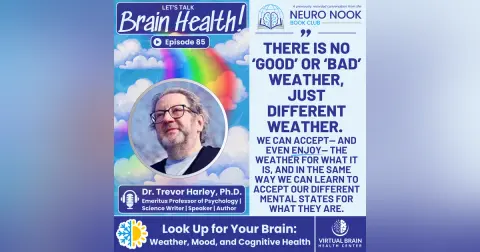
Hot, humid days. Dark afternoons. A sudden change in the clocks.
We talk about the weather every single day. It’s the world’s favorite icebreaker. But how often do we stop to ask what the weather is actually doing to our brains?
Today’s guest has spent a lifetime asking exactly that question, and his answers may change the way you look up at the sky.
In this monthly gathering of the Neuro Nook Book Club, Dr. Krystal Culler and co-host Heather Elwell sit down with Dr. Trevor Harley, Ph.D., emeritus professor of psychology and author of Head in the Clouds: How the Weather Impacts Our Minds & Mental Health.
Shaped in part by his own experience with anxiety and seasonal affective disorder, Dr. Harley blends psychology, meteorology, and neuroscience to explore how the weather influences the way we think, feel, sleep, and behave, and how we can work with it for better brain health.
What You’ll Learn in This Episode
🧠 How heat and humidity affect cognition, mood, sleep, and behavior, and why complex tasks suffer most
🧠 How light sets your circadian rhythm, and why morning light matters most
🧠 The difference between the winter blues and seasonal affective disorder (SAD)
🧠 What your “weather personality” is
🧠 The ideal temperatures for daytime and for sleep
🧠 Whether the weather really affects joint pain, headaches, and migraines
🧠 How warmth and cold may shape social connection, generosity, and loneliness
🧠 Why acceptance, and finding something good in every season, supports mental health
Key Takeaways
✔ There is no good or bad weather — just different weather. We can learn to accept our mental states the same way.
✔ Morning light helps set your body clock. If you think you may have SAD, talk with a clinician.
✔ On hot, humid days, protect your sleep and save complex thinking tasks for cooler times.
✔ Treat the clock change like jet lag: give yourself extra time and grace in the days that follow.
✔ Knowledge is power. Simply knowing the weather may be affecting you helps you respond instead of react.
✔ Author-approved Brain Health Rx: Look up at the sky daily. Pay real attention to the clouds or the night sky, and use reminders to make it a regular brain break.
Earn FREE CEs
This podcast qualifies for continuing education credit for the following healthcare professionals: Physicians (AMA PRA Category 1 Credit™), Nurses (ANCC), Pharmacists (ACPE), Physician Associates (AAPA), Dentists (ADA CERP), Dietitians (CDR), Social Workers (ASWB), Psychologists (APA), Athletic Trainers (BOC), and Interprofessional Continuing Education (IPCE).
Each eligible episode offers 0.5 hours of FREE CE credit. Not seeing your profession listed? You will receive a Certificate of Participation to submit to your licensing board for possible credit approval. Join the Learn at Pinnacle app to earn FREE CE credit for listening to this episode — available on the Apple App Store and Google Play.
Support the Podcast
If you enjoyed this episode, please help us grow the conversation around better brain health:
Follow or subscribe to the Let’s Talk Brain Health! Podcast
Share this episode with a friend, colleague, caregiver, or fellow brain health advocate
🙏 Thank you for investing your time and energy into your brain care. A special thank you to Dr. Trevor Harley for sharing his brilliant brain and generous expertise with our Neuro Nook community, and for reminding us to look up. ☁️
Previous Podcast Episodes to Explore:
Resources
Learn more about his book “Head in the Clouds: How the Weather Affects Our Minds and Mental Health”
Check out Dr. Harley’s weather photography and blog on his personal website
Connect with Dr. Harley on social media: LinkedIn, Instagram, Facebook, or email him at trevor.harley@mac.com